Graphene’s latest miracle? The ability to detect cancer cells

graphene detects cancer cells
AlexanderAlUS
This is a great year for graphene researchers, who have identified astonishing new applications for the amazing wonder material seemingly every week.

The latest? The fact that it turns out to be pretty darn good at cancer detection, thereby hinting at the possibility of a future noninvasive tool for early diagnosis.

The work was carried out by scientists at the University of Illinois at Chicago, who placed brain cells (astrocytes) taken from mice onto a graphene sheet, comprising a one-atom-thick layer of carbon atoms, and found that the sheet was able to distinguish between a single cancerous cell (glioblastoma or GMB cell) and a normal cell.

“What we’ve shown is that a graphene-based system can detect the activity of a cell, and by doing that we can differentiate between a cancer cell and a normal cell,” Vikas Berry, associate professor and head of chemical engineering at UIC, told Digital Trends. “That’s because a cancer cell is hyperactive and has a different biochemistry on its surface and degree of activity that it exhibits. Based on the activity of the cell, we are able to make our differentiation.”
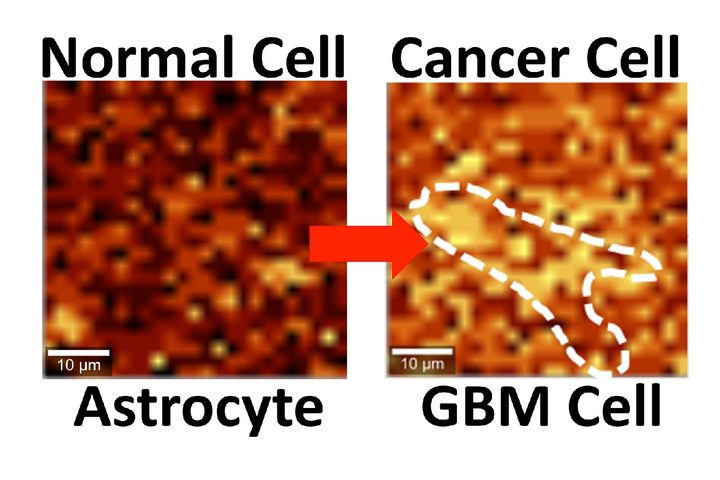
The amazing cancer-detecting abilities of graphene relate to its impressive electrical conductivity. When exposed to a hyperactive cancerous cell, the electric field around the cell pushed away electrons in the graphene’s shared electron cloud. This changes the vibration energy of the carbon atoms: something which can be studied using ultra-high resolution vibration energy mapping. As a result, the researchers were able to tell what kind of cell the graphene was interfacing with.

“It’s an incredibly sensitive mechanism for detection,” Berry continued.

It’s exciting stuff, and could have significant real-world impacts. At present, however, it’s still a long way from clinical use. However, the researchers are hoping to expand beyond mouse trials to human patient biopsies in the future. They also hope that the same approach could be used to distinguish between different types of bacteria, and also identify sickle cells.


Editors' Recommendations

Luke Dormehl
I'm a UK-based tech writer covering Cool Tech at Digital Trends. I've also written for Fast Company, Wired, the Guardian…
9 amazing uses for graphene, from filtering seawater to smart paint
9 amazing graphene applications superconductor a

Graphene is a single layer of graphite — also known as that soft material commonly found in pencil lead -- with the atoms arranged in a honeycomb-like, hexagonal pattern. While that description is decidedly unexciting, graphene is actually emerging as one of science's most versatile new materials.

Just one atom thick (or thin, depending on how you think about it), graphene is among the strongest materials in the known universe, with 100 times the strength of steel, an astonishing amount of flexibility, and a whole lot of other talents lurking beneath the surface.

Read more
Light-controlled nanoscale buzz saws kill cancer cells by drilling holes in them
nanoscale

Rice University scientists broke records in 2005 when they constructed the world’s smallest car, a single-molecule “nanocar” boasting a chassis, axles, and four wheels. More than a decade later, the same research lab is still working at the nanoscale level -- although its latest project could provide a whole lot more benefit than just nanoscale car races. With help from researchers in the U.K. and at North Carolina State University, what Rice scientists have developed are tiny nanoscale motorized molecules that are designed to drill holes in the membrane of individual cells. Depending on whether these cells are bad or good, it can then kill them or, potentially, deliver healing drugs.

“In [our work], we showed that these molecular machines can selectively kill cancer cells,” Gufeng Wang, an assistant professor in analytical chemistry at N.C. State, told Digital Trends. “We expect that molecular machines could also be used in vivo to cure diseases. In general, this technology can be used as a highly efficient, highly specific drug-delivery method, or, simply as a way to kill cells directly by disrupting their material exchange with the environment.”

Read more
Mobile app can screen for pancreatic cancer when users snap a quick selfie
selfie

There have been a few examples of research we covered that have used machine learning technology to diagnose cancer. None of them have been quite like the University of Washington’s BiliScreen project, however. In an attempt to diagnose cancer, researchers at the university have developed a smartphone app that is capable of carrying out a screening by asking users to snap a quick selfie. Could there be a more 2017 medical diagnosis tool?

But if the idea sounds whimsical, the problem it is helping to solve is anything but. The type of cancer the researchers are interested in is pancreatic cancer, a particularly nasty type of cancer with a five-year survival rate of just nine percent. (Pancreatic cancer was the cause of death of former Apple CEO and co-founder Steve Jobs). Making pancreatic cancer hard to spot is the fact that it does not display obvious telltale symptoms which allow people to catch it prior to it spreading. That is where the University of Washington’s new smartphone app enters the frame.

Read more