  1. Home
  2. Emerging Tech
  3. News

Seataci superyacht concept mimics a whale’s tail-propulsion system

Add as a preferred source on Google

What do blue whales and 70-meter fast-displacement superyachts like Hessen’s Galactica Super Nova have in common? They can both cruise for long distances at 12-14 knots and top out at about 30 knots — using a similar propulsion system. The blue whale’s method of moving fast and far in the water inspired Charles Bombardier when he designed the biomimetic propulsion system for the Imaginactive Seataci superyacht concept.

Bombardier’s original vision for the Imaginactive Seataci superyacht came when he was scuba diving. He wondered about the possibility of eco-friendly propulsion systems for cruise ships that could navigate shallow waters. Bombardier was apparently thinking about how cruise ship passengers could view the underwater wonders without their vessel simultaneously destroying them.

Recommended Videos

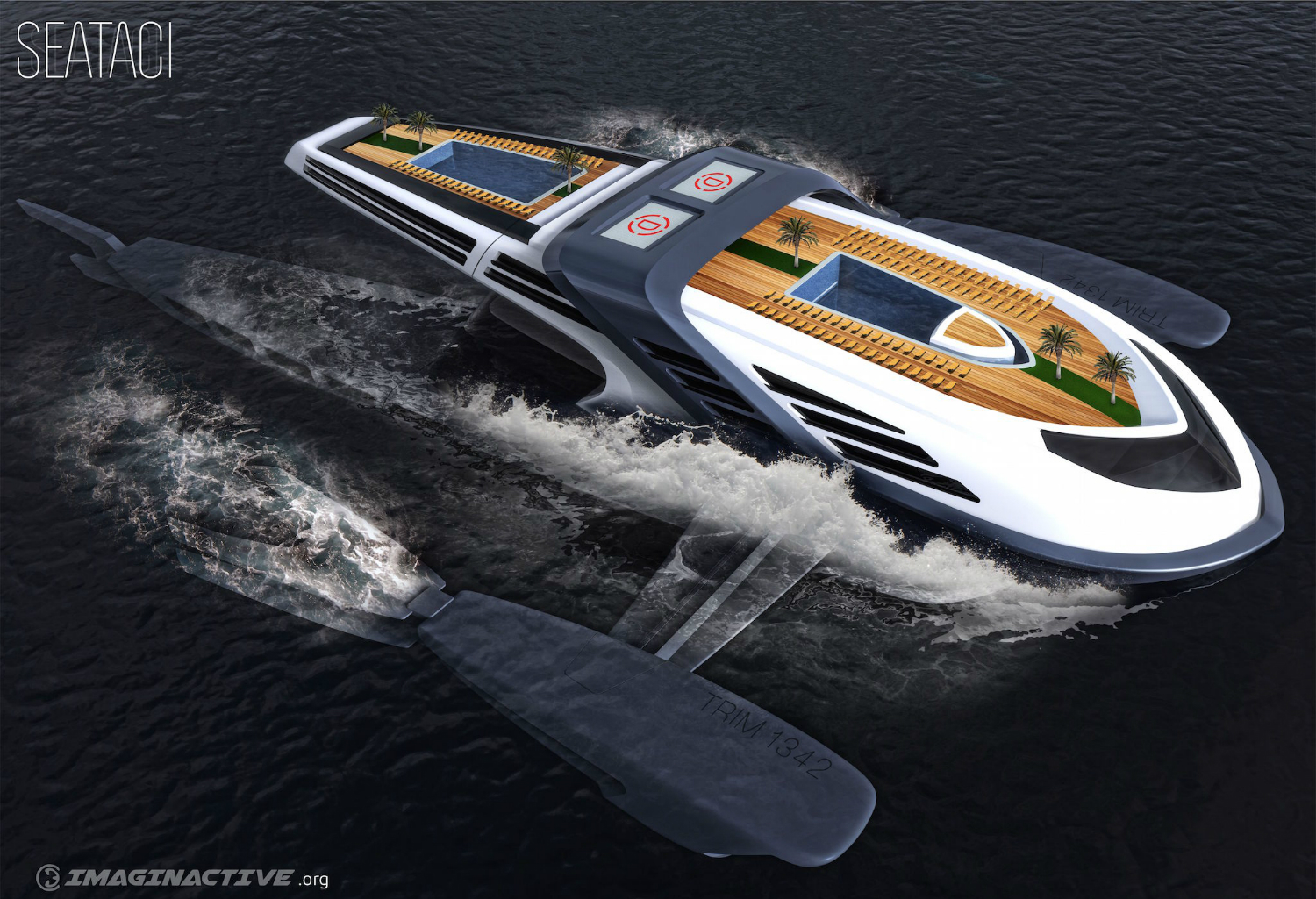
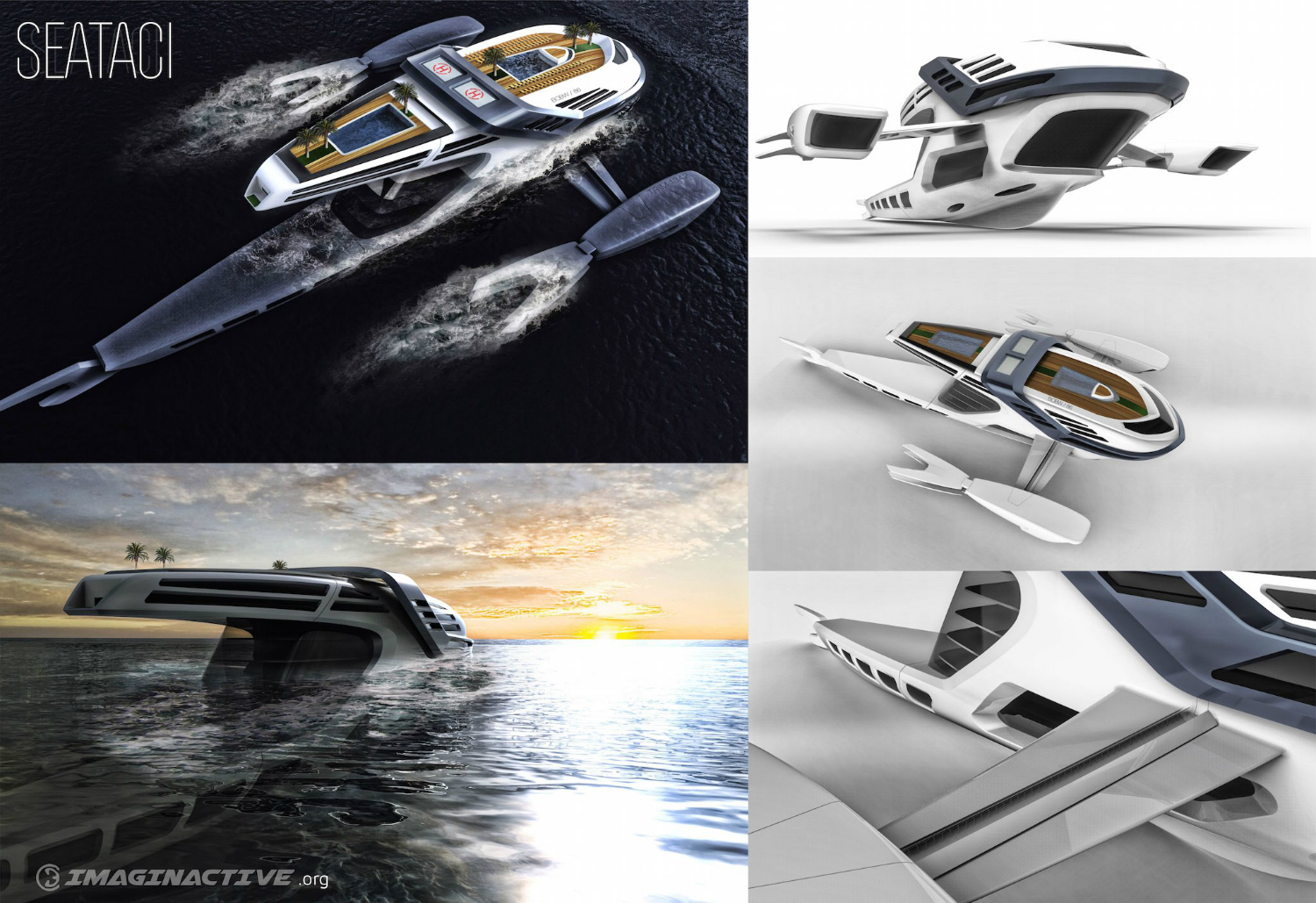
Under further consideration, the designer/innovator realized the potential for such a craft used in scientific research and experimentation. The Seataci’s whale-tail-action engines would be located in retractable pods on either side of the vessel’s upper section.

According to Bombardier, with the biomimetic system, the Seataci could travel in shallow waters without damaging power and navigation components while likely making less underwater noise and possibly operating more efficiently than conventional propellers.

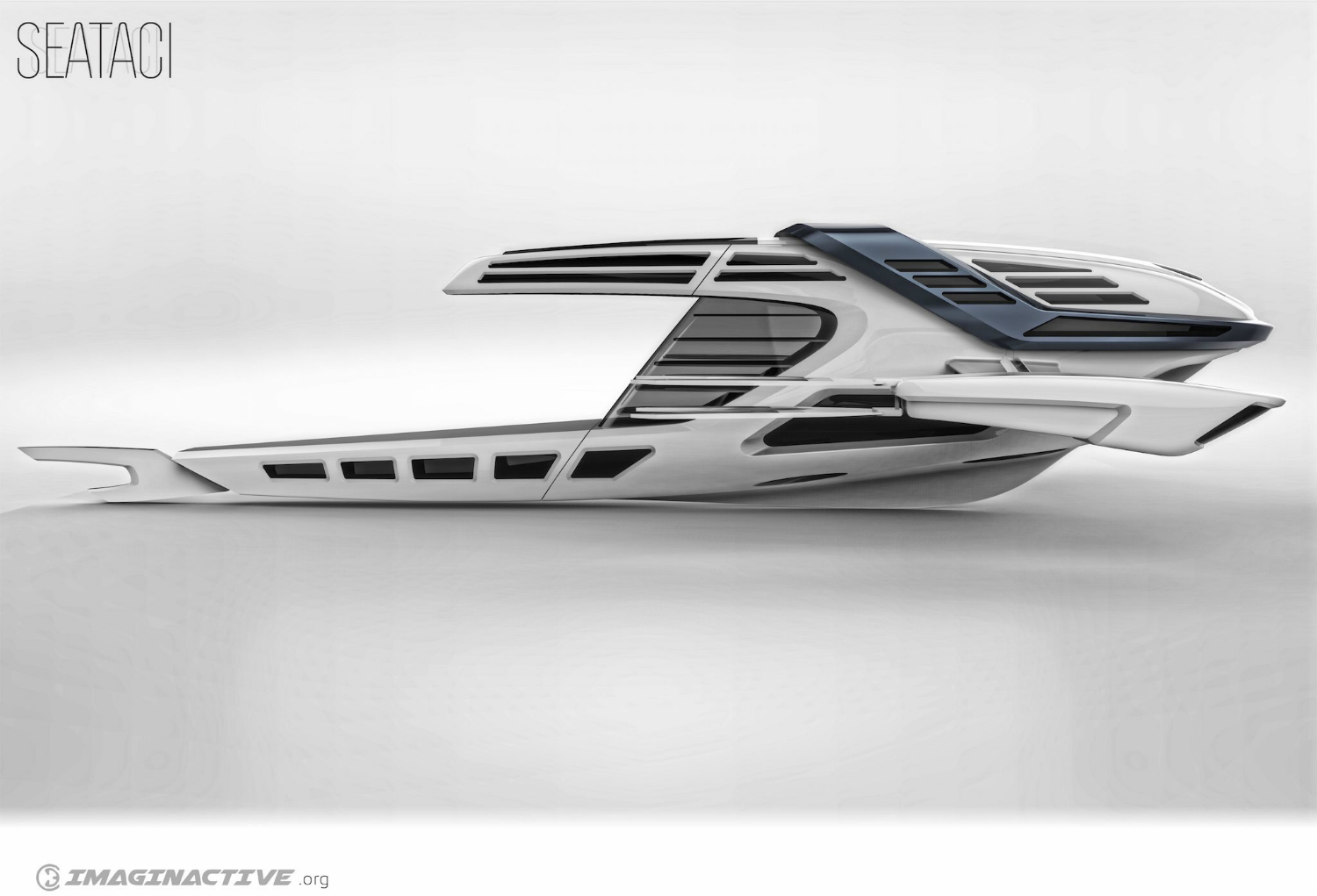
As envisioned by Bombardier, Seataci’s lower section would have expansive observation areas and some passenger cabins. Overall the Seataci concept as illustrated would have a dozen passenger cabins plus crew living quarters.

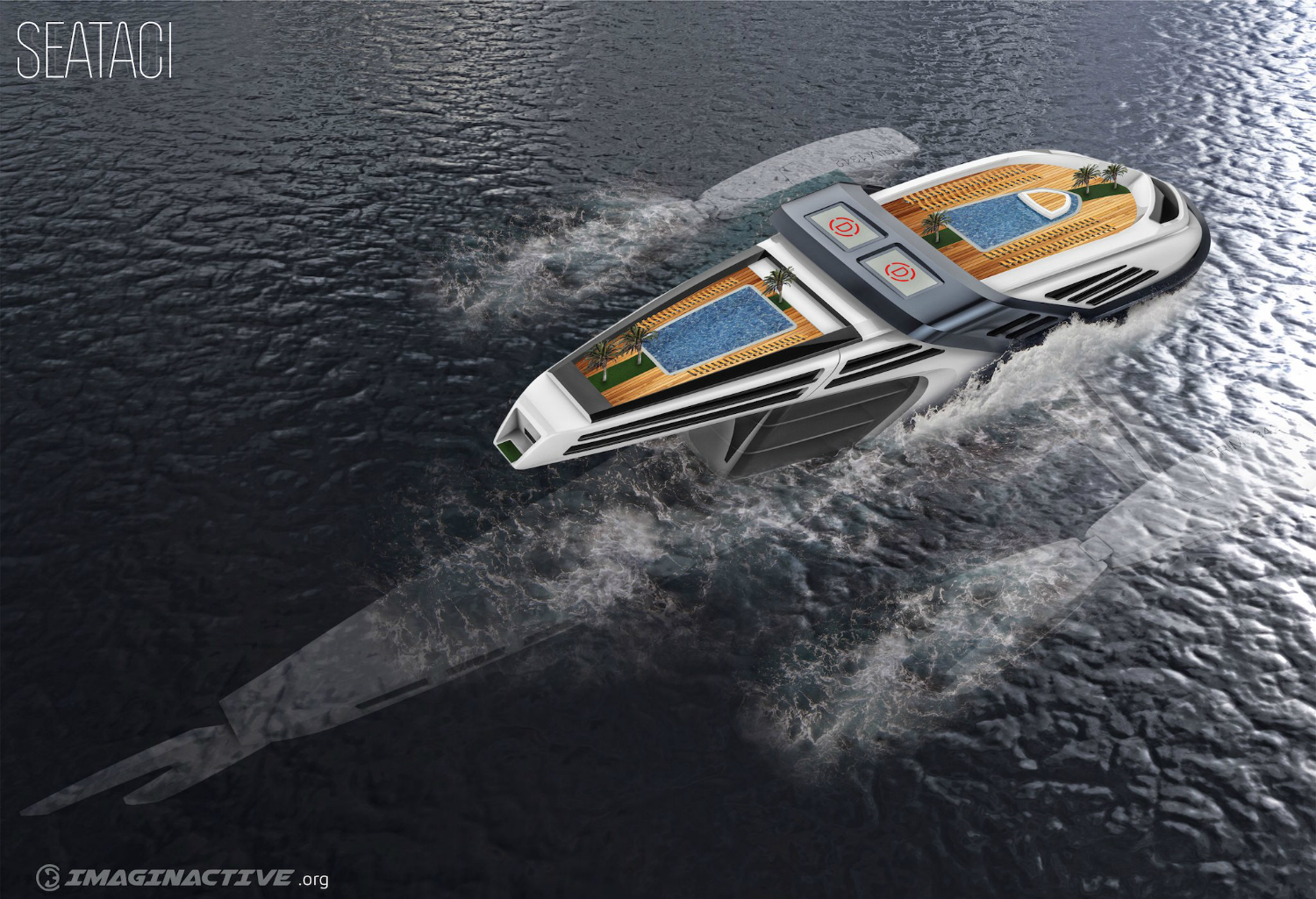
The design includes two large swimming pools and space for two personal drone landing pads on the top deck. He also foresees an application as a landing platform for drones to allow people to visit small islands without needing to dock or disperse tenders. With cruise ships more than research vessels in mind, Bombardier also envisioned tropical gardens around the pools.

The Seataci’s lower hull would use water as ballast to submerge or rise while the pods on the upper section of the ship would serve the dual purposes of stabilization and to keep the ride smooth. The scale of the structures would be large enough that passengers and crew could move into either pod for various raised views.

Bombardier acknowledges that developing a propulsion system of this type at a scale large enough to move a superyacht involves a significant risk. His argument is that because current propulsion systems are not eco-friendly and also restrict access to shallower waters, that if the oscillating system could work, the risk would be worth it.

Bruce Brown
Bruce Brown Contributing Editor   As a Contributing Editor to the Auto teams at Digital Trends and TheManual.com, Bruce…
Anti-surveillance clothing is getting cheaper, but don’t expect an invisibility cloak
Affordable shirts now claim to confuse facial recognition, although their protection depends heavily on the camera and software watching you
Chart, Plot, Adult

Anti-surveillance clothing is starting to look less like an art-school experiment and more like something you could actually wear outside. Shirts designed to confuse facial recognition systems now cost about as much as ordinary streetwear, although buying one won’t make you disappear.

The Guardian reports that designers are using face-like prints, unusual cuts and infrared lights to interfere with computer vision. These techniques target specific weaknesses, so their success depends on what happens to be watching you.

Read more
This spinning drone hides in plain sight using a visual illusion
This drone doesn't turn invisible. It tricks your brain into thinking it has.
Phantom Twist

For decades, engineers have chased the dream of an invisible drone. The usual approaches have involved transparent materials, camouflage coatings, or complex optical systems that bend light around an object. Researchers at Northwestern University decided to take a completely different route. Instead of hiding the drone itself, they chose to fool the human eye.

The result is Phantom Twist, an experimental drone that spins so rapidly it almost disappears into the background. It's not technically invisible, but to anyone watching, it looks more like a faint blur than a flying machine.

Read more
This smart knitted fabric can flip switches, count your steps, and even change shape
Grandma's knitting just entered its Iron Man era
Representative Image

For most of us, knitting brings to mind sweaters, scarves, and perhaps an ambitious grandmother determined to make winter more fashionable. Researchers at Harvard University, however, have a far more futuristic vision. They've transformed ordinary knitted fabric into a programmable material capable of changing shape, acting as an electrical switch, sensing movement, and potentially forming the foundation of tomorrow's wearable technology.

The research, published in Advanced Functional Materials by scientists at the Harvard John A. Paulson School of Engineering and Applied Sciences (SEAS), demonstrates how machine-knitted textiles can "snap" between multiple stable shapes without relying on motors or rigid mechanical parts.

Read more