1. Home
  2. Emerging Tech
  3. Cars
  4. News

Racing to catch a flight? Robot valet at French airport will park your car

Add as a preferred source on Google
Stanley Robotics - World premiere: Stan reinvents parking at Lyon-Saint Exupéry airport

“Oh, I don’t park my own car; I get a robot to do it for me.” That might sound like the kind of arrogant statement you’d expect to hear coming out of the mouth of a snooty character in a sci-fi show, but it’s not quite as futuristic as you might expect.

Recommended Videos

At France’s Lyon Airport, startup Stanley Robotics has unveiled its new automated robotic valet system. Set to be opened to airport passengers in the coming weeks, the robot-managed parking lot means that it may never again be necessary to circle packed airport lots searching for an empty space. Instead, airport visitors simply book a parking spot in advance on the website, then drop their vehicle off at a designated point. While the passengers then head to the terminal via a dedicated shuttle service, one of four autonomous robot valets will sort out the rest of the parking hassle. It’s like the ultimate car accessory.

“After your drop off, our robots come to take care of your car,” Edouard Petit, head of marketing and communications for Stanley Robotics, told Digital Trends. “The robot lifts your car by the wheels slowly, and then takes it to park for you in a closed and secure parking lot. After your trip, the experience is also very easy. When you book your place, you inform our booking system for your flights. With this information, we know exactly when you will be back, even if your flight is delayed. A few minutes before your return flight arrives, our robot comes to pick up your car again.”
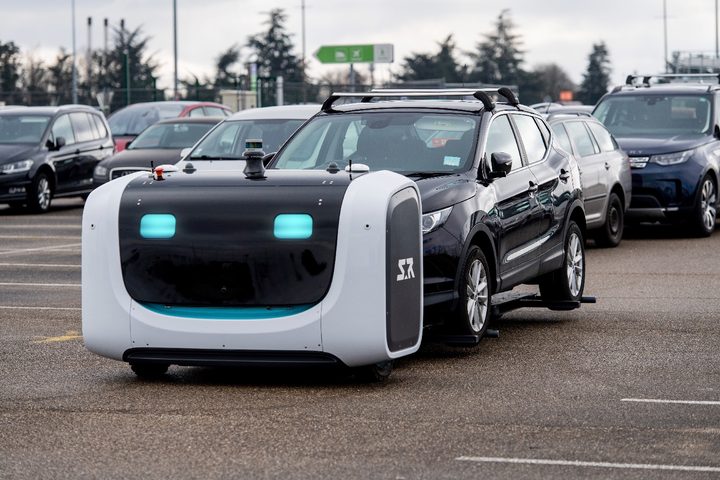
Image used with permission by copyright holder

By the time you, the passenger, arrive back at the cabin you dropped your car off at, it’s ready and waiting to take you home.

While this isn’t the only robot valet system we’ve covered, Stanley Robotics claims that this is the world’s first outdoor car park to be managed entirely by bots. The robots built by the company boast several smart sensors which, combined with its A.I. algorithms, will ensure that it avoids collisions while parking. The robots can transport any standard-size car up to 16 feet in length and 6,000 pounds in weight.

According to Petit, this kind of technology isn’t just going to be useful for passengers, but airports as well. With more people traveling all the time, space requirements for modern airports are always growing. Using this kind of robot valet parking system can, he claims, help optimize space and create around 50 percent more available parking by enabling vehicles to be packed in more systematically.


Luke Dormehl
I'm a UK-based tech writer covering Cool Tech at Digital Trends. I've also written for Fast Company, Wired, the Guardian…
This spinning drone hides in plain sight using a visual illusion
This drone doesn't turn invisible. It tricks your brain into thinking it has.
Phantom Twist

For decades, engineers have chased the dream of an invisible drone. The usual approaches have involved transparent materials, camouflage coatings, or complex optical systems that bend light around an object. Researchers at Northwestern University decided to take a completely different route. Instead of hiding the drone itself, they chose to fool the human eye.

The result is Phantom Twist, an experimental drone that spins so rapidly it almost disappears into the background. It's not technically invisible, but to anyone watching, it looks more like a faint blur than a flying machine.

Read more
This smart knitted fabric can flip switches, count your steps, and even change shape
Grandma's knitting just entered its Iron Man era
Representative Image

For most of us, knitting brings to mind sweaters, scarves, and perhaps an ambitious grandmother determined to make winter more fashionable. Researchers at Harvard University, however, have a far more futuristic vision. They've transformed ordinary knitted fabric into a programmable material capable of changing shape, acting as an electrical switch, sensing movement, and potentially forming the foundation of tomorrow's wearable technology.

The research, published in Advanced Functional Materials by scientists at the Harvard John A. Paulson School of Engineering and Applied Sciences (SEAS), demonstrates how machine-knitted textiles can "snap" between multiple stable shapes without relying on motors or rigid mechanical parts.

Read more
Starlink V5 is here, and it’s lighter, smarter, and far more efficient
The next-generation satellite internet kit promises improved efficiency while maintaining high-speed connectivity.
Starlink V4 vs V5

Not every hardware upgrade needs to be about speed. With Starlink V5, SpaceX is betting that a lighter design and lower power consumption matter just as much. The company has officially introduced its next-generation Starlink V5 kit, featuring a smaller and lighter design with significantly improved power efficiency.

Smaller, lighter, and far more efficient

Read more