For the last couple of decades, security measures in places like airports, schools, stadiums, and other public venues have continuously ramped up. X-ray machines, surveillance cameras, and bag searches have all become commonplace, but still concealed weapons, bombs, and explosive can slip through the cracks — sometimes with tragically devastating effect.
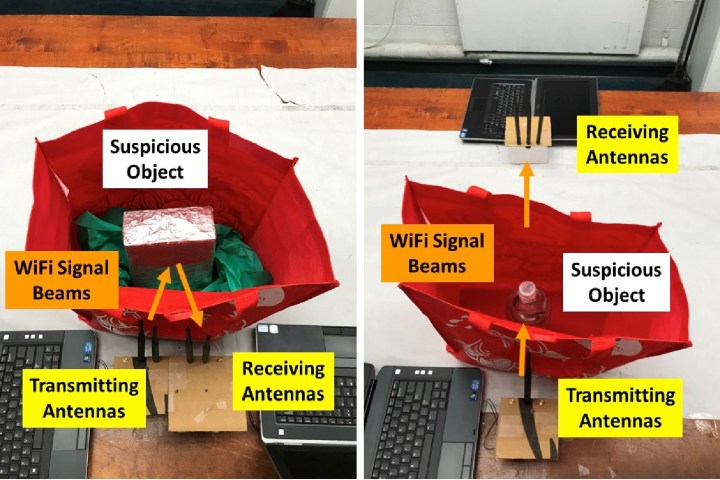
Looking for a new way to help solve this problem, researchers from Rutgers University, Indiana University – Purdue University Indianapolis, and Binghamton University have found a fresh use for a technology that is ubiquitous in 2018: Ordinary Wi-Fi. Using this radio wave-based connectivity tool, they developed a new type of security screening system which is both low-cost and, potentially, life-saving. It works by detecting suspicious objects by leveraging the fine-grained channel state information (CSI) from off-the-shelf Wi-Fi, without needing to invade the user’s privacy by physically rifling through bags.
“According to our research findings, most dangerous objects are metal or liquid, which create significant interference to wireless signals, while non-dangerous objects and baggage are usually made of fiber, plastics or paper which allows wireless signals to pass through easily,” Yingying Chen, a professor of Electrical and Computer Engineering at Rutgers, told Digital Trends. “Our idea is to capture the various wireless interference caused by the materials and shapes of objects by inspecting the rich information of CSI complex — including both the amplitude and phase information of wireless signals.”
By examining the differences caused by absorption, refraction, and reflection when Wi-Fi signals transmit through or bypass certain objects, it’s possible to get a detailed idea of the object in question — even down to liquid volume estimation for chemicals. The result is an effective first line of defense for detecting hidden suspicious objects, without having to resort to major security checkpoints.
In a proof-of-concept experiment, the researchers tested 15 types of objects in three categories, including metal, liquid and non-dangerous, carried in six types of bags. During repeated testing over a period of six months, the system successfully detected more than 95 percent of suspicious objects in different types of bags and identified 90 percent of dangerous material types.
While anything less than 100 percent accuracy means that more still needs to be done, Chen said that this is something the team is currently working toward.
“We are still working on different algorithms to improve the accuracy in identifying in-baggage objects, and continue to increase the resolution on metal object imaging and liquid volume estimation under complex scenarios,” she continued. “We hope the system could be commercialized in a couple of years.”
A research paper describing the work was recently awarded “best paper” at the 2018 IEEE Conference on Communications and Network Security.
Editors' Recommendations
- The key to fixing your bad Wi-Fi connection may finally be here
- Upcoming Sonos headphones may well include Wi-Fi
- TP-Link’s Wi-Fi 6E router comes with motorized antennas for better reception
- Wi-Fi 7 is coming to CES 2022 with promises of even faster speeds
- Netgear’s $1,500 Orbi mesh Wi-Fi 6E router promises double the speed