1. Home
  2. Emerging Tech
  3. News

Low-cost 3D-printed thermos could help diagnose Zika virus by testing saliva

Add as a preferred source on Google

Engineers at the University of Pennsylvania have developed a rapid, low-cost genetic test for the Zika virus that could cost as little as $2 to manufacture and doesn’t require any electricity or technical know-how to use.

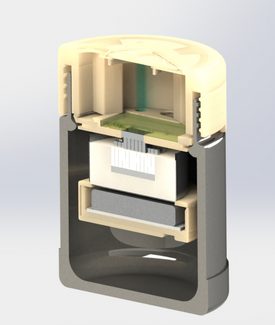
The size of a regular soda can, the test simply requires potential patients to provide a saliva sample. A removable slide/cassette inside the thermos changes color to reveal whether or not the virus has been detected. The test kit itself ia made up of a thermos bottle, an integrated heating element that uses a chemical reaction normally seen in portable military rations, and a 3D-printed lid that holds all of the components together.
Recommended Videos

Zika Test cut-away _0The test could be particularly useful since, at present, the only approved diagnostic tools to indicate the presence of Zika involve sensitive laboratory equipment.

“The Centers for Disease Control and Prevention (CDC) has approved, on an emergency basis, only laboratory-based molecular tests for the Zika virus,” Changchun Liu, research assistant professor at the University of Pennsylvania, tells Digital Trends. “However, [these tests] require a well-trained technician and expensive instrumentation — conditions that are not optimal for point of care diagnostic applications.”

Rapid diagnosis is extremely important for the Zika virus, particularly when it comes to pregnant women who have been infected. The creation of a field diagnostic tool therefore represents a possible major breakthrough.

The University of Pennsylvania’s test takes about 40 minutes to run, and in preliminary studies proved to be as sensitive as the so-called RT-PCR laboratory test, which is used for diagnosing the virus at present.

Liu describes the thermos-based genetic test as a “proof of concept,” and says that more experiments must be done before it can be adapted for medical use — including further experiments to ensure that it matches the most accurate available tests for the virus. However, once this is achieved, the test could be rolled out and used in areas affected by Zika.

It is hoped that a future version could even ramp up its efficiency by being able to quantify the viral load using a fluorescent dye and integrated smartphone camera.


Luke Dormehl
I'm a UK-based tech writer covering Cool Tech at Digital Trends. I've also written for Fast Company, Wired, the Guardian…
Anti-surveillance clothing is getting cheaper, but don’t expect an invisibility cloak
Affordable shirts now claim to confuse facial recognition, although their protection depends heavily on the camera and software watching you
Chart, Plot, Adult

Anti-surveillance clothing is starting to look less like an art-school experiment and more like something you could actually wear outside. Shirts designed to confuse facial recognition systems now cost about as much as ordinary streetwear, although buying one won’t make you disappear.

The Guardian reports that designers are using face-like prints, unusual cuts and infrared lights to interfere with computer vision. These techniques target specific weaknesses, so their success depends on what happens to be watching you.

Read more
This spinning drone hides in plain sight using a visual illusion
This drone doesn't turn invisible. It tricks your brain into thinking it has.
Phantom Twist

For decades, engineers have chased the dream of an invisible drone. The usual approaches have involved transparent materials, camouflage coatings, or complex optical systems that bend light around an object. Researchers at Northwestern University decided to take a completely different route. Instead of hiding the drone itself, they chose to fool the human eye.

The result is Phantom Twist, an experimental drone that spins so rapidly it almost disappears into the background. It's not technically invisible, but to anyone watching, it looks more like a faint blur than a flying machine.

Read more
This smart knitted fabric can flip switches, count your steps, and even change shape
Grandma's knitting just entered its Iron Man era
Representative Image

For most of us, knitting brings to mind sweaters, scarves, and perhaps an ambitious grandmother determined to make winter more fashionable. Researchers at Harvard University, however, have a far more futuristic vision. They've transformed ordinary knitted fabric into a programmable material capable of changing shape, acting as an electrical switch, sensing movement, and potentially forming the foundation of tomorrow's wearable technology.

The research, published in Advanced Functional Materials by scientists at the Harvard John A. Paulson School of Engineering and Applied Sciences (SEAS), demonstrates how machine-knitted textiles can "snap" between multiple stable shapes without relying on motors or rigid mechanical parts.

Read more