  1. Home
  2. Emerging Tech
  3. News

Processed pies: Silicon Valley’s Zume Pizza ready to offer you dinner made by a robot

Zume Pizza robots are getting arms to help retrieve and box pies

Add as a preferred source on Google
Image used with permission by copyright holder

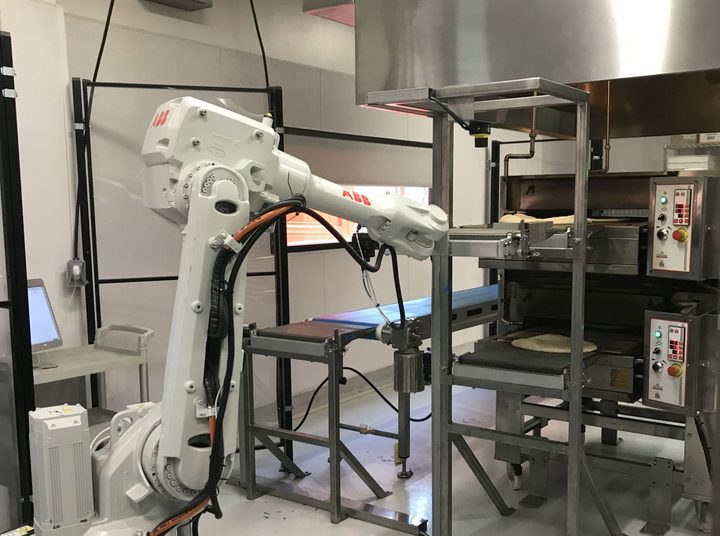
Even the food in Silicon Valley is getting high tech. No, we’re not talking about meal-replacement shakes or coffee with butter in it — we’re talking good, old-fashioned pizza. Well, not exactly old-fashioned — the pies from Zume Pizza are made by robots. To help it reach new heights, the company is upgrading its existing robots by adding arms into the mix.

It is the latest in a new trend within the food industry  — and a number of industries globally —  to increasingly depend upon machines rather than human labor. In this case, robots are not just taking your order or clearing your tables — they are the chef, too.

Recommended Videos

In order to help these machine chefs better do their jobs, Zume is giving them ABB robotic arms, which are capable of pulling pizzas from 800-degree ovens, and placing them on shelves. So efficient are these appendages that they can fill a whole rack in just 4.5 minutes.

“We’re going to eliminate boring, repetitive, dangerous jobs, and we’re going to free up people to do things that are higher value,” co-founder Alex Garden, a former Microsoft manager and president of mobile game maker Zynga Studios, told the Associated Press in 2016. Seeing that a stat from Cintas claims that restaurants jobs are responsible for up to 33 percent of occupational burns, Zume really could be saving humans several trips to the hospital.

Already, Zume’s robots are taking care of spreading sauce on pizza dough when it comes down a conveyor belt and sliding the raw masterpieces into a hot oven. While humans are still dealing with prepping the dough and ensuring the right amount of cheese and toppings make it onto every pie, robots will soon be in charge of that aspect as well.

“We automate those repetitive tasks so that we can spend more money on higher quality ingredients,” said Julia Collins, Zume’s CEO and co-founder. “There will always be a model here at Zume where robots and humans work together to create delicious food.” So don’t worry — robots won’t be kicking you out of the restaurant industry altogether, yet.

That said, robots seem to be taking the place of humans at an increasingly alarming rate. Wal-Mart cut 7,000 jobs due to automation and both hardware manufacturer and fast-food chain Wendy’s made similar changes to their workforce. The restaurant industry has not always had luck replacing people with machine parts — in fact, a Chinese restaurant chain had to shut down a couple locations due to poor service from its robotic waitstaff.

But who knows — maybe machines will have better luck with Italian cuisine.

Updated on June 21: Zume adds a robotic arm to help with its automated pizza-making process. 

Lulu Chang
Fascinated by the effects of technology on human interaction, Lulu believes that if her parents can use your new app…
Tiny robots could shrink weeks of heart infection treatment into a single day
Forget open-heart surgery, because these rice-sized robots take the express route to your heart.
heart being treated by tiny robot

Treating a heart infection is no walk in the park. Patients often spend weeks on IV antibiotics, and if that fails, open-heart surgery enters the picture. Johns Hopkins University engineers may have found a better way.

The team has developed magnetic “millirobots” that are about as wide as a pencil tip and roughly as long as a grain of rice. As detailed in their study published in Advanced Materials Technologies, the robots are designed to deliver medicine directly to infected heart tissue.

Read more
Meta goes toe-to-toe with the big boys as it launches Muse Wonder AI models
Illustration of Meta Muse Wonder AI model.

It's raining frontier AI models. Soon after Anthropic set alarm bells ringing with its Claude Fable model at the summit of AI peformance, OpenAI answered with GPT-6 Astra. Not one to be left behind, Google released Gemini 4 Argon. The race is now getting hotter as Meta enters the fray with two new AI models in the Muse series: Wonder and Wonder Full. Cheesy naming aside, these Meta AI models mean business, or at least that's what the benchmark figures suggest. More importantly, these AI models are already making their way to Muse users.

https://twitter.com/DigitalTrends/status/2109699549375988120

Read more
AI can’t tell if you’re gay or straight, but it thinks it knows what both look like
AI knows it shouldn't judge a face, but apparently, drawing one is a different story.
Emilia Clarke AI generated stock image. Gemini / Nano Banana is on the left

We've all been told not to judge a book by its cover, and you'd think AI would follow that rule, too. Ask an AI chatbot to guess someone's sexual orientation just by looking at their face, and it'll likely tell you that there's no reliable way to know. But what happens when you ask that same model to change someone's appearance to match a particular sexual orientation? Well, that's where things get uncomfortable.

A new study, accepted for presentation at the 2026 Conference on Empirical Methods in Natural Language Processing, found that AI models from OpenAI and Google can be inconsistent when handling sensitive personal characteristics. They might refuse to make assumptions about someone based on their appearance, but when asked to generate those same assumptions visually, the results tell a very different story.

Read more