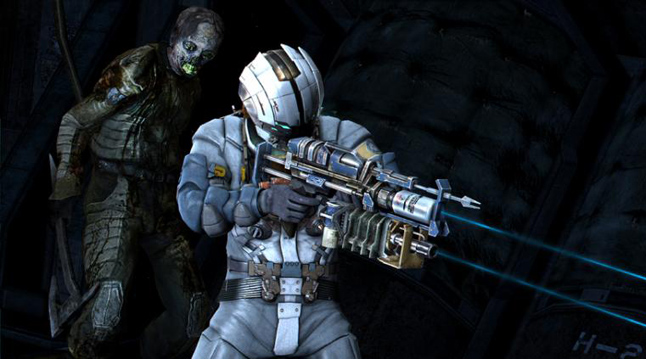
Your friend is screaming bloody murder into your headset. Necromorphs surround both Isaac Clarke and John Carver, and your co-op pal – as Clarke – is doing his best to fight back the horde. He’s furious though, because you’re just standing there.
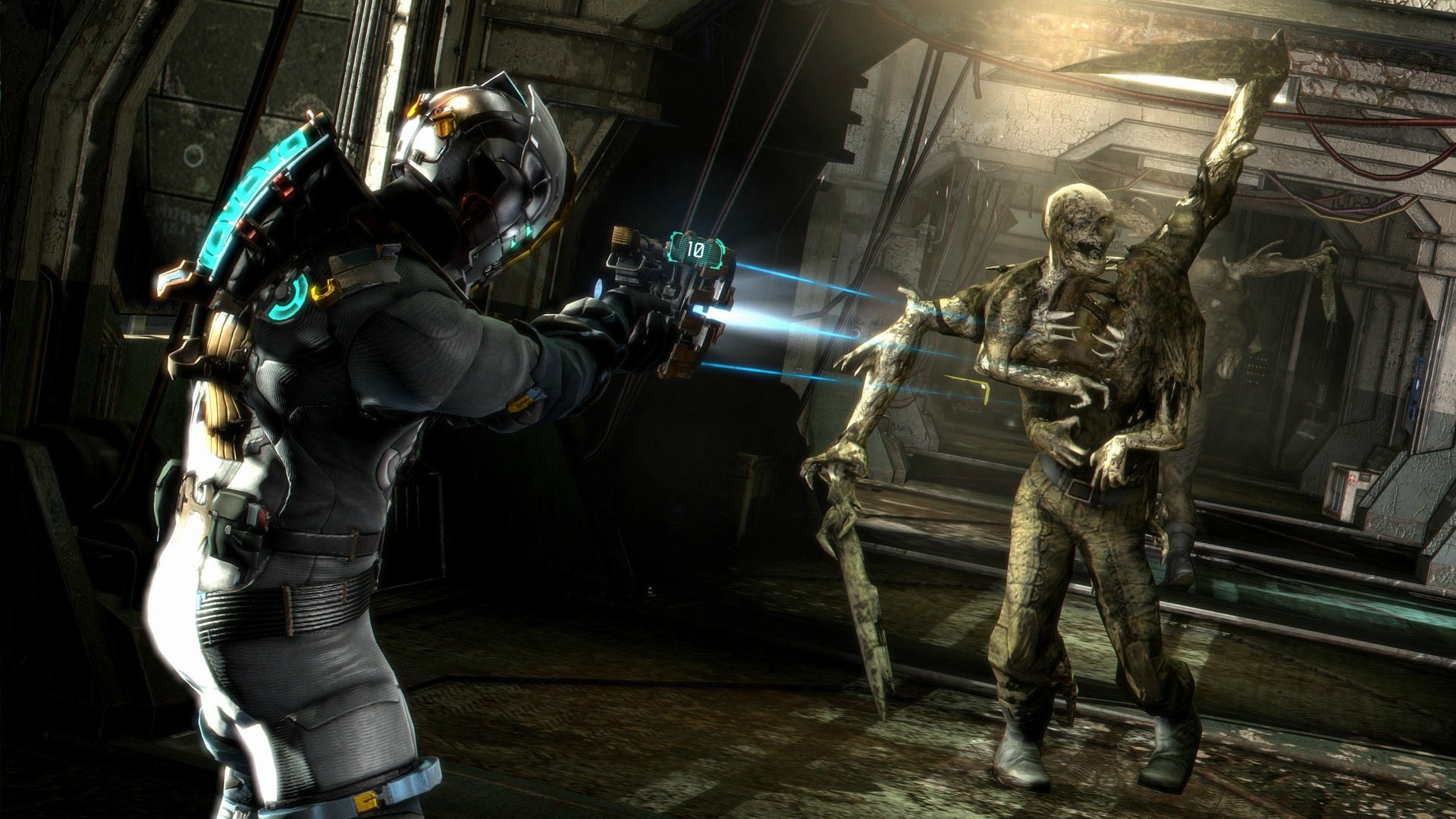 What he doesn’t realize is that your Carver is actually deep inside his own subconscious, fighting back internal demons that have taken the form of Necromorphs. On his screen, Carver is motionless and useless; on yours, a flurry of action captures your attention. Both human players are confused, and confusion leads to mistakes. Clarke is gruesomely torn apart and a Game Over screen appears.
This is the co-op portion of Dead Space 3 at its very best. Visceral knew full well that it’s tough to keep players on edge when they’re babbling back and forth in a co-op game, and so the dev team engineered moments that pit Clarke and Carver against different, mutually exclusive challenges without warning. It’s an easy fit for a franchise narrative that deals heavily with insanity.
“From the start with Dead Space, there were definitely strong themes around dementia and specifically the dementia induced by the Marker,” executive producer Steve Papoutsis told us.
“You can see that running rampant throughout the game, whether it’s the group suicides that were present on the Ishimura to the things scrawled on the wall to, ultimately, the visions that Isaac was seeing throughout the game. There was a strong and present theme that is actually a big component of what the Markers are all about.”
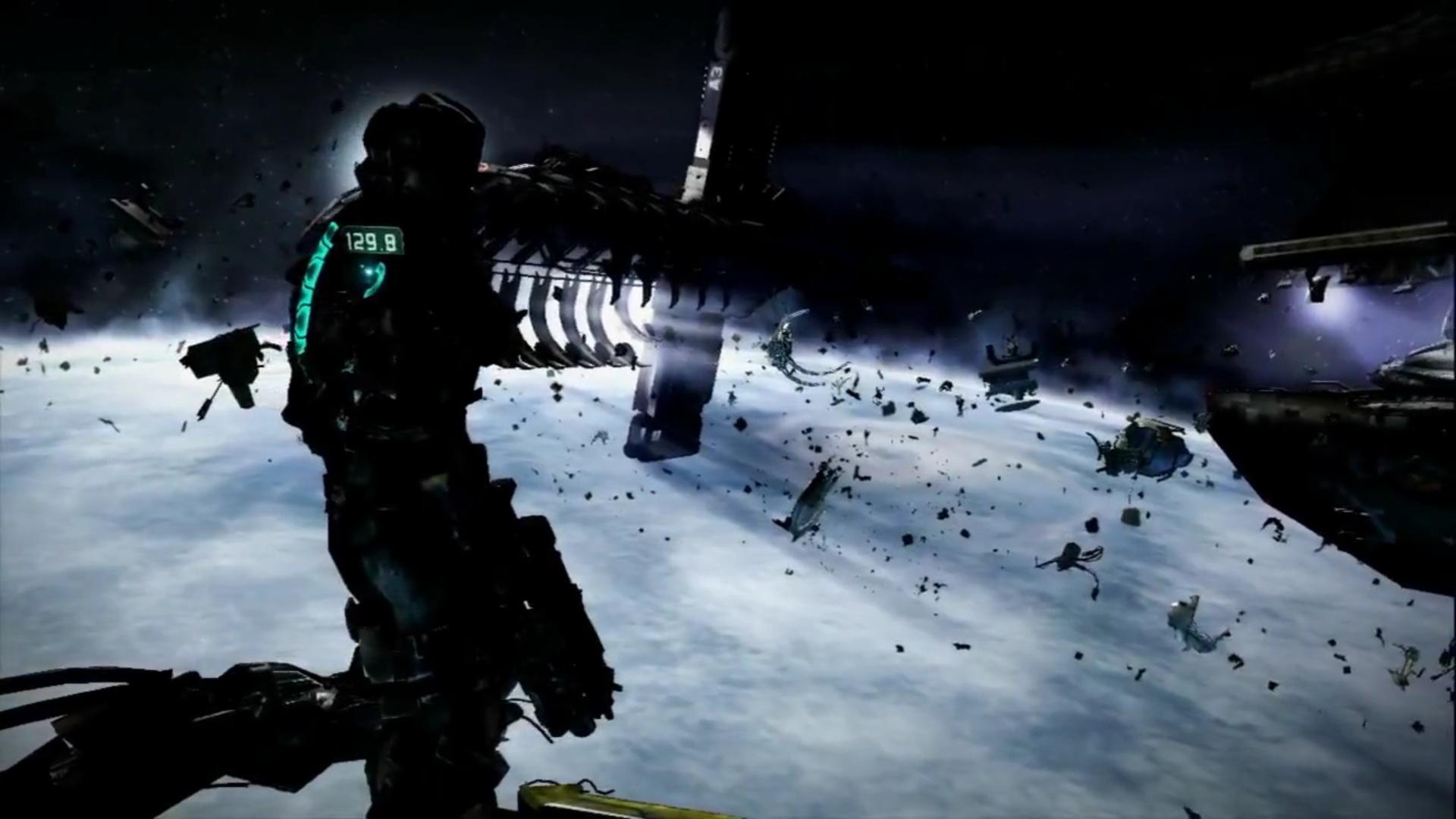 Coping with dementia in a stressful situation is a theme that emerged even more in Dead Space 2 and Dead Space 3. The latest game also adds another wrinkle in the form of Carver who, much like Isaac, is a victim of the Marker’s influence. Papoutsis cites H.P. Lovecraft as an essential point of reference for creative director Ben Wanat, and the links are easy enough to see for anyone familiar with the Cthulhu creator’s work.
Even still, the most difficult thing for Visceral to process prior to release is the fear factor. How can you really tell if players will, by and large, find a particular moment scary? Focus testing seems like the obvious answer here, but it’s really not.
“The focus tests that we generally do are more about usability than the specifics of if something scares you or not,” Papoutsis explains. “[Horror] is very subjective. I think that’s the really interesting about working on a series like Dead Space: how completely subjective horror and terror are to people.”
Unfortunately, this fact makes focus testing difficult when it comes to measuring that aspect of the game. Papoutsis typically observes players closely as they play during these sessions looking for cues.
“When you talk to them afterward they can tell you a variety of different things, but really their body language and their reactions [while they play] are good [indicators] of how intense a moment may be for somebody,” he says. “Whether they lean back or lean forward, or if you see them tense up on the controller. What people write sometimes [on response forms] can be really different from their body language.”
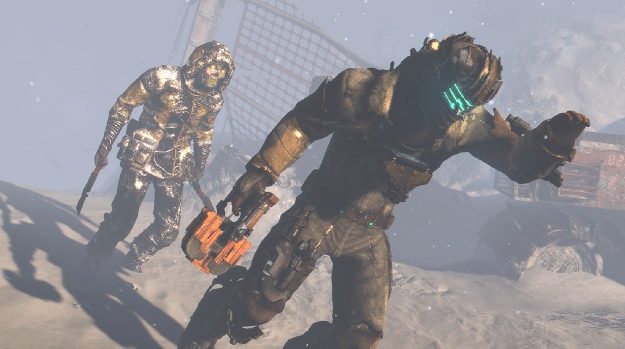
Papoutsis admits that the playing environment is also a key factor in making focus tests less than helpful for working out which scare moments work and which don’t. “I think if you’re in a room with other people and the lights are on in a focus test, it’s probably not going to be as scary as if you’re at home with your headphones on in a dark room,” he says.
All of which means it’s up to the development team to figure out how to leave players unsettled and on edge. “So many different people have to work together to make that work within the game,” Papoutsis explains. “One, you have to have a story that really works for that. The next thing is, pretty much every discipline has to work on [bringing that together].”
The Dead Space franchise debuted in 2008 and has spawned two sequels and the spin-off games: Dead Space: Extraction, an on-rails shooter for the Wii, Dead Space: Ignition, a puzzle game, and a Dead Space mobile game. The franchise has also produced two animated films, comics, and original novels based on the material.
“When you think about some of the scenes in Dead Space 2 where Isaac is having a flashback moment,” Papoutsis said, “we’re talking about coordination between the audio group, the animation group, the visual effects team, the design team, the character art team, the environment art team in some places, all of those disciplines need to coordinate and work together.
 “Ultimately it needs to be directed in a way that pays off in terms of the camera and the pacing and the timing. It’s all about pacing, it’s all about the coordination of all of those disciplines. In a movie, you have eight camera angles being presented to you by the director, and that is what you will watch. In a video game, you could be turning around or looking in a corner or opening up your inventory or doing whatever, so those are things that we have to take into account.”
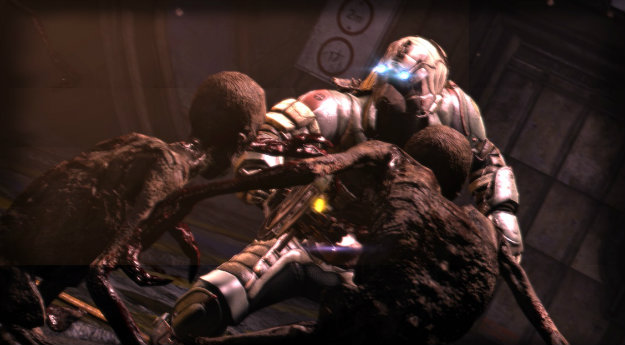 Dead Space 3 complicates everything with it’s co-op. No longer can the team be content to create a spooky environment and then populate it with jump scares. Those tactics still work with two players on the board, but they must be used much more sparingly. As a result, the team is forced to look at other potential sources of horror.
“I think some of those things that we really look at in terms of how to bring tension and keep the core tenets of Dead Space alive in co-op is really focusing in on the characters,” Papoutsis says. “So having Carver, his personality, not only add to the story but also add to the tension and support some of the anxiety going on within the game world. That’s one thing, whether it’s through dialogue or interactions, he is providing some texture there that helps amplify the situation that [players] are going through.”
When you play the game alone, you take control of the series’ original protagonist, Issac Clarke. In this mode, the character of John Carver melts into the background. He appears at times, but he is not an AI controlled partner, rather a piece of the story. When you play the co-op mode, however, Carver’s story is very much integrated into the game and a completely new narrative emerges. The recently released graphic novel, Dead Space: Liberation, also helps to build Carver’s backstory.
“We also took a very different approach to doing our co-op; it is additive, in that it adds additional flavor and context to Carver’s personal story. It doesn’t change the end story in any way, it just gives you more detail around his journey.
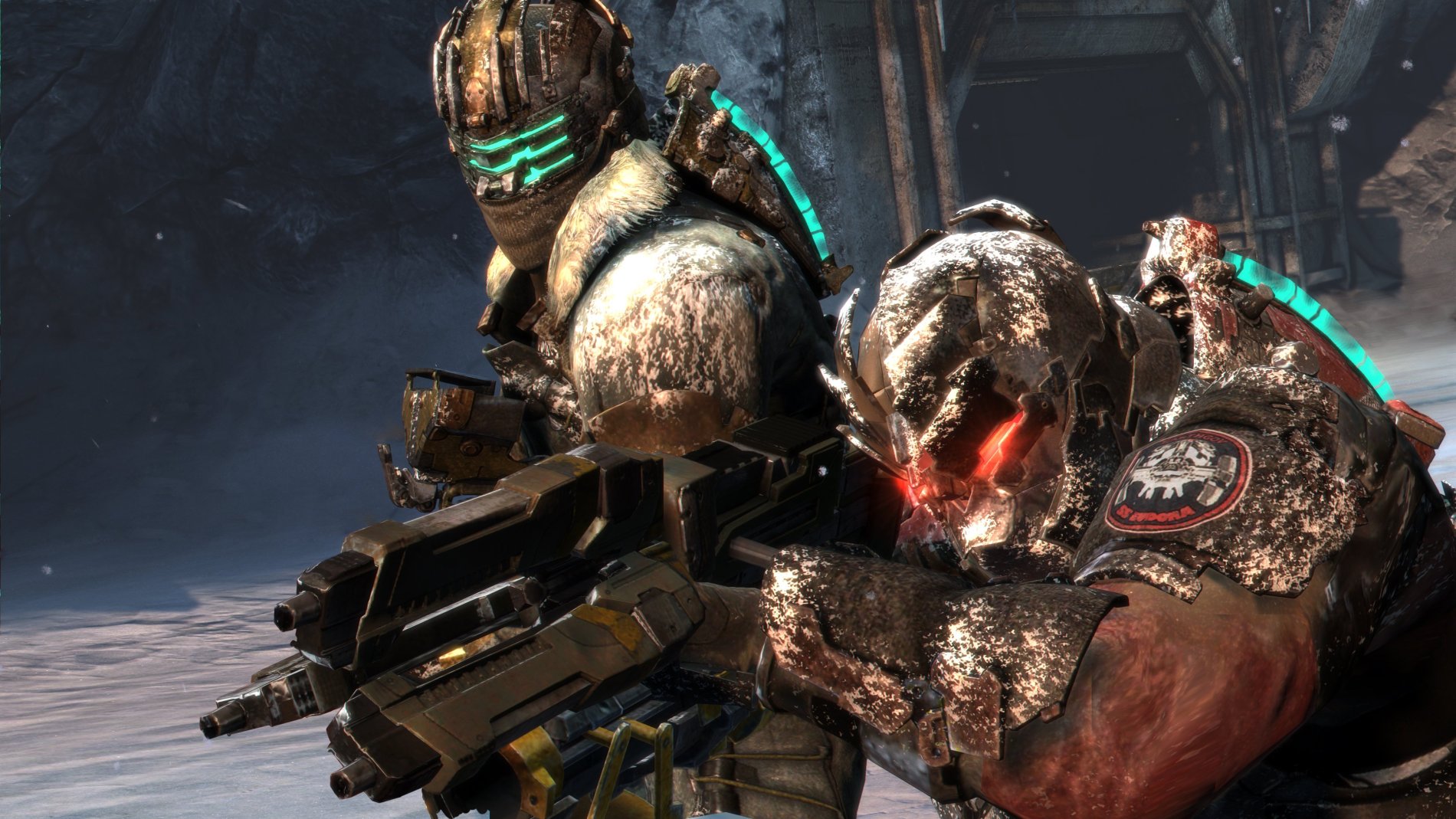 “To have a character in a Dead Space game, or really any form of entertainment, you have to have strengths, you have to have weaknesses, you have to have flaws, and you have to have a character that can go on a journey and overcome something. Carver is just like that. He’s got all of those things, he’s a complex character and he’s kind of dealing with his own situations.”
It’s from this idea that the moments of dissonant play discussed up top emerged. The in-game characters are experiencing different things in a particular moment and dealing with it in their own way, and the players are given a different experience because of it.
“It can create some interesting dialogues for the players,” Papoutsis muses. “So now you’re experiencing the dementia moment, I’m not seeing it but I have to protect you, and now I’m saying ‘Hey man, what are you doing? Help me out here!’ And you’re telling me about some fantastical thing you’re seeing.”
“That’s adding tension and pressure to the game. While it’s not a traditional jump-scare moment, it’s more of a psychological moment that adds an additional layer of flavor and thrills to the game that are very much Dead Space.”