“Oppo’s Sonica multiroom speaker will bowl you over with bombastic sound”
- Powerful and musical bass response
- Clear and detailed upper register
- High resolution audio support
- Bluetooth, Wi-Fi, and ethernet ready
- Premium look and feel
- Treble and upper midrange occasionally too sharp
- Short on streaming services - no Spotify Connect
- No graphic EQ
“Why you can trust Digital Trends – We have a 20-year history of testing, reviewing, and rating products, services and apps to help you make a sound buying decision. Find out more about how we test and score products.“
Oppo Digital — not to be confused with phone maker (and sister company) Oppo Electronics — has quickly made a name for itself as a top audiophile brand. Oppo’s high-end Blu-ray players have set a new bar for both audio and video performance, and the company’s transition into the advanced field of planar magnetic headphones last year has put it in some rarified company, competing well with the likes of Audeze, HiFiMan, and others.
Now Oppo has turned its talents to another cutthroat audio segment, multiroom speakers. The new Sonica is designed by the same man behind Oppo’s PM-1 and PM-3 planar headphones, Igor Levitsky, and the $300 short-stack speaker is loaded with virtually all the features you’d expect, with a few notable exceptions.
Out of the box
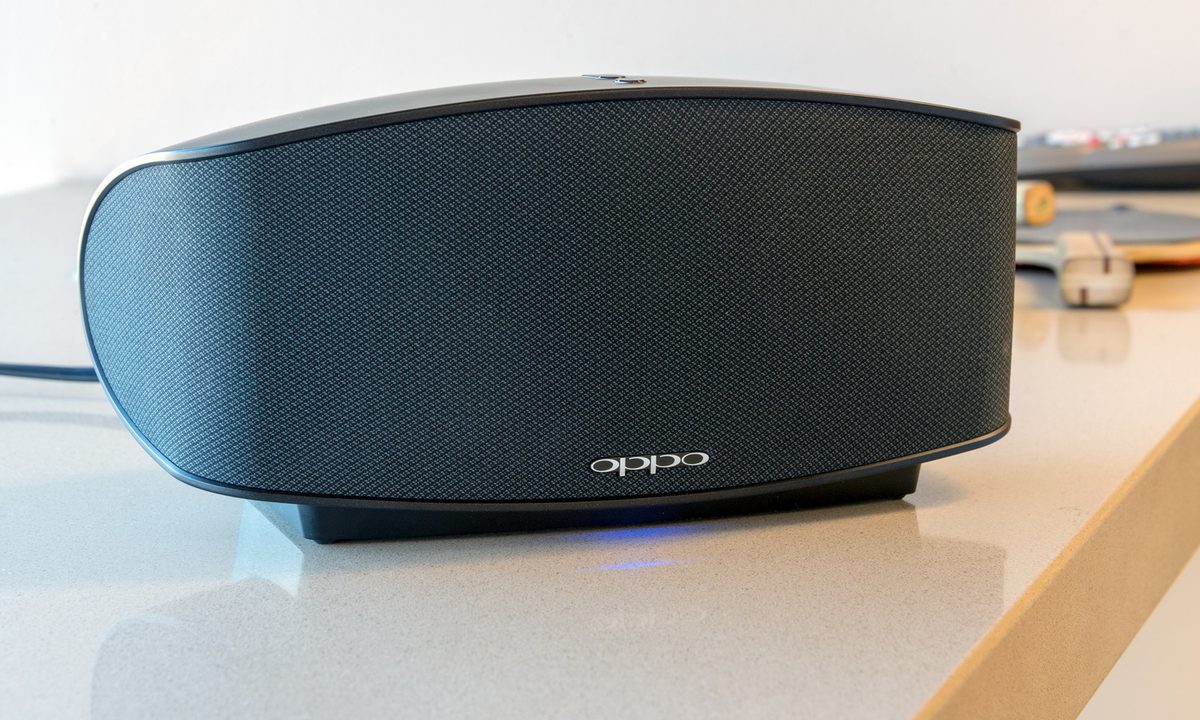
The Sonica’s design doesn’t do much to distinguish it from the crowd, reminding us of similar wireless jobs from the likes of Cambridge Audio, Denon, and many others. That said, the Sonica does have a premium feel, with smooth cuts of matte plastic along the body and silver accents to match the gleaming logo. The speaker also feels very solid, and its weight (around six pounds) is substantial considering its diminutive stature. Ports at the back include a 3.5mm analog input and an Ethernet port for hardwiring.
Features and design
When it comes to hardware, it’s no surprise that Oppo’s new baby is loaded to the gills. That includes a powerful collection of drivers for such a small profile, comprising dual 2.5-inch full-range drivers flanking a single 3.5-inch woofer at the center. The smaller drivers are each pushed by a 10-watt custom amplifier, while the woofer draws from dual 15-watt amplifiers in a bridged configuration. On top of that, Oppo throws in two passive bass radiators to help the Sonica produce a burly helping of bass that defies its size (around 12 inches long, six inches wide, and five inches tall).


Like most of its Wi-Fi peers, the Sonica supports high-resolution audio in a wide variety of file types (save DSD), maxing out at 24bit/192kHz. (Sonos, credited with pioneering multiroom audio, is one of the few brands to max out at CD-quality, 16 bit/44.1kHz resolution.) Audio files can be sourced from your phone, computer, or storage drive. A very short list of streaming services is also supported, including Jay-Z’s CD-quality streamer Tidal (with a 90 day free trial for new users), and Apple Music thanks to Airplay support alongside DLNA.
As you might have noticed, Spotify is a glaring omission. It’s one thing for speakers to skip services like Google Play or Amazon Prime Music, but launching the Sonica in 2016 without the most popular on-demand streaming service on the planet is a head scratcher. Bluetooth support makes for a good low-resolution workaround, especially since Spotify maxes out at 320 kbps MP3 quality anyway, but listening to Spotify across multiple speakers — i.e. multiroom streaming — is out.
The Sonica’s lack of Spotify (for now) and other marquee services puts it in direct opposition to other multiroom systems, including Sonos, Yamaha’s year-old MusicCast, and DTS’ Play-Fi system, a Wi-Fi-based open-source protocol that connects myriad speakers from some of the world’s top brands (MartinLogan, Definitive Technology, Harman, etc.). Oppo’s lone Sonica speaker has its work cut out to compete with those established multiroom systems, which not only offer more streaming options, but also a vast array of models and sizes.
Setup and playback: The Sonica app
All things considered, Oppo’s Sonica app (iOS and Android) is surprisingly smooth for its young age, offering easy navigation that follows the already established multiroom format by the numbers. Getting the system connected to your Wi-Fi system isn’t as easy as Sonos’ single button setup (virtually nothing is), but the app’s step-by-step instructions make connection relatively painless.


While only a single speaker was shipped for review, adding new speakers appears simple enough, and you can pair two Sonica’s for stereo separation. Under the settings tab, DSP features allow you to choose from five EQ presets or tune the sound according to your room size. We fiddled with the settings a bit, getting slightly better performance for our living room-style listening environment by choosing the medium size room with preset two. However, as a device aimed at audiophiles, we’re surprised the Sonica doesn’t feature a full graphic EQ, which would come in handy to tone down the speaker’s sometimes excitable upper register.
Performance
While the Sonica does a lot of things very well, the big ticket is the speaker’s potent, yet extremely musical, bass response. The power down below helps the speaker sound a lot bigger than its size implies. Unlike a lot of smaller speakers, which seem to shoot for a bass-like tone, the Sonica dives deep towards the 60Hz line, and even sends vibrations through the floor from a table or countertop.
In some ways, the Sonica seems to suffer a bit from its own considerable talents and ambitions.
In some ways, the lighter color of the upper register brings things down to earth a bit. That’s not to take away from the talents of the smaller drivers — in fact, they’re capable of some extremely luscious detail in the midrange and treble, rendering albums like Radiohead’s In Rainbows with crystalline clarity. An ultra-fast transient response helps carve out the spindly entrances of synths and even acoustic guitar like a fresh blade, while the resonance of strings and vocals flutters gracefully up far out to the sides front. That’s enhanced by the speaker’s relatively wide soundstage, allowing sounds to pop out beyond its edges, almost like a virtual surround sound bar.
That said, selections like The Decemberists’ The King Is Dead exposes the Sonica’s thin-bodied upper register. At times, lighter instruments like cymbals, tambourine, and even snare have an icy touch, especially when the bass drops out. Even acoustic guitar and vocals can get a little tight at the attack, with “S” sounds occasionally hissing too sharply. The worst offender we heard is Stevie Wonder’s Sunshine of My Life, which, to be fair, has a lot of “S” words.
The tenuous balance between high and low is highly dependent on the source material, however. In contrast to the sharp cut of The Decemberists album, Ray LaMontagne’s brilliantly produced God Willing and the Creek Don’t Rise sounds smooth, detailed, and relatively well balanced. Guitar and vocals still run a bit thin, but the sibilance is all but gone.
In some ways, the Sonica seems to suffer a bit from its own considerable talents and ambitions. In its quest for weighty bass and sparkling-clear detail, the thinner character of the upper mids and treble is more readily exposed. And while the sibilance is never piercing, it does occasionally ride the line. Still, the Sonica’s ambitious reach is noble for such a pint-sized package, offering precise detail and perhaps the most musical bass in its class. In fact, while it doesn’t offer nearly as much warmth or power, it offers sharper detail, and even stands up reasonably well in the lower register to the much bigger (and pricier) Sonos Play:5 — an impressive feat for a mid-size speaker.
Warranty
Oppo’s Sonica has a limited one-year warranty, which does not apply to accidental damage, incorrect electrical line voltage/power surges, or normal wear and tear. Check out the website here for more info.
Conclusion
If Spotify is your go-to streaming service, Oppo’s Sonica isn’t for you – at least not yet. However, if you don’t mind a little spice in your treble this powerful little speaker will bowl you over with bombastic sound.