  1. Home
  2. Audio / Video
  3. News

Sony’s insane 16-foot Crystal LED screens will cost more than a Ferrari

Add as a preferred source on Google
Image used with permission by copyright holder

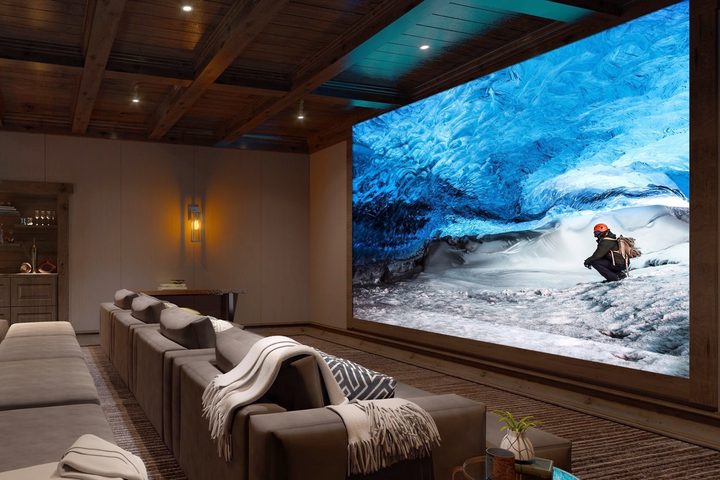
When it comes to high-end video options for your living room, most folks find themselves deciding between a high-resolution big screen TV — perhaps Samsung’s $15,000 85-inch 8K QLED, or LG’s $29,999 88-inch 8K OLED — or a serious home theater projector, like Sony’s $60,000 4K SXRD that can throw a superbly bright image up to 150 inches in size. But these options now pale in comparison to Sony’s latest announcement that it will start selling its MicroLED-based Crystal LED screens to consumers. Very, very wealthy consumers.

Sony Crystal LED is the technology behind the mind-blowingly big 16K, 17-foot-tall display that Sony showed off earlier this year. That staggering size is achieved through the combination of much smaller MicroLED panels, stacked into virtually any ratio of rectangle you can imagine. Samsung has also created MicroLED displays. The company’s The Wall is an 8K 292-inch MicroLED behemoth that has a similar ability to scaled up and down in size.

Recommended Videos

The biggest benefit to MicroLED technology — other than its ability to scale to huge sizes — is that it offers the perfect black levels and color performance of OLED screens, with the kind of brightness that bests even the brightest QLED panels. In short, it’s truly commercial-theater-grade display technology, which is why we were left with the impression that Sony had no intention of selling its Crystal LED technology to consumers. In fact, the company said that when the screens would hit the Japanese market later this year, they would be used in commercial applications like a research center for a cosmetics group.

And yet, at this year’s CEDIA expo in Colorado, Sony announced that Crystal LED displays are now available through custom installer channels. In other words, anyone with the means can buy one. What kind of means? A single 360×360-pixel module will cost $10,000 according to TechHive. If that’s true, a configuration capable of displaying a mere Full HD (1080p) image at 120 inches will require 18 modules, putting the price at $180,000. Want a 4K-capable display? You’ll need 16 feet of wall width, for a 220-inch screen that uses 72 modules. Yup, that’s $720,000.

But wait, there’s more. Sony’s technology happily scales all the way up to the same staggering 16K, 790-inch size that we thought would remain the exclusive domain of commercial movie theaters or perhaps industrial settings. At that size, you’ll need 576 modules according to Sony, and enough money to finance the $5,760,000 all of those modules will cost. We’ve reached out to Sony to confirm this pricing and will update this article once we hear back.

Simon Cohen
Former Contributing Editor, A/V
Simon Cohen obsesses over the latest wireless headphones, earbuds, soundbars, and all manner of related devices and…
OpenAI’s first gadget sounds like a tiny expressive AI companion
The device will have a doughnut-shaped body, built-in cameras, and moving parts
OpenAI press image

For months, reports have suggested that OpenAI’s first hardware product would be a screen-free smart speaker designed to act more like an AI companion. We already knew it could understand its surroundings, be carried around the home, and proactively help users. A new Bloomberg report now gives us a clearer picture of what the device may actually look like.

As per the report, OpenAI’s first gadget will be shaped like a doughnut and measure about the same size as a hockey puck. You will be able to carry it between rooms or leave it nearby on whatever surface is convenient. The device is expected to be on the expensive side, as the company has pondered pricing it around $300 to $400. A release is currently planned for 2027.

Read more
Marantz upgrades its CINEMA Series 2 with a new DAC, Dirac Live, and better gaming support
Marantz's CINEMA Series 2 lineup adds a new DAC, wider Dirac Live availability, and AMD FreeSync gaming support.
Amplifier, Electronics, Speaker

AV receivers have felt increasingly optional for the average living room, because modern TVs, home theaters, and soundbars can handle simple setups without the additional box. 

However, Marantz's latest CINEMA Series 2 lineup compels you to pay attention to the spec sheet and the price tag. The new CINEMA Series 2, which consists of four different models, packs enough hardware and software upgrades to attract both enthusiasts and professionals.

Read more
Bose reveals second-gen QuietComfort Headphones and they steal some of the Ultra’s tricks.
Bose adds Immersive Audio and lossless USB-C playback to its new QuietComfort headphones
Bose QuietComfort headphones second gen.

Bose has officially launched the QuietComfort Headphones (2nd Gen), confirming most of the features that surfaced through recent leaks. The new model has a cleaner design, improved noise cancellation, lossless USB-C audio, and Bose Immersive Audio modes previously limited to the more expensive QuietComfort Ultra series.

Preorders open August 8 through Bose and selected retailers for $359, just $10 more than the 2023 model’s launch price. Shipping begins August 13. Black and White Smoke return alongside three limited-edition finishes called Eucalyptus Green, Dewdrop Mint, and Rosewood Mauve.

Read more