  1. Home
  2. Mobile
  3. Legacy Archives

Americans were obsessed with mobile apps on Thanksgiving

Add as a preferred source on Google

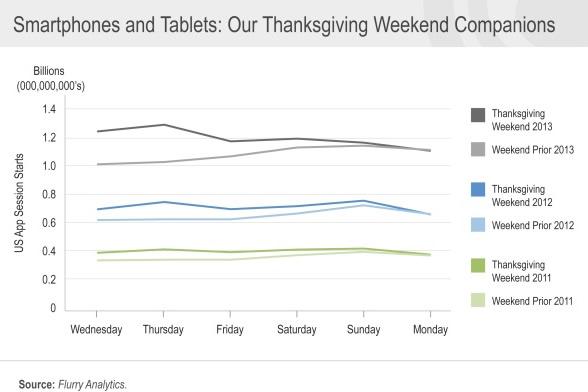
Detailed within a recent study conducted by app analytics company Flurry, mobile app use spiked on Thanksgiving 2013 with approximately 1.3 billion app starts in the United States. Rising nearly 75 percent year over year, Thanksgiving 2012 accounted for about 750 million app starts. The total figure has also tripled in size since 2011 which brought in about 400 million app session starts on Turkey Day. Flurry attributes the large spike in activity to the significant change in how we utilize mobile devices over traditional computers when working, playing games and relaxing while consuming media.

Specifically, media apps that allow users to consume feature-length movies, music, television shows, YouTube videos and photos where the most popular when compared to the week prior to Thanksgiving. Video games also spiked significantly week over week, likely due to more people looking for some entertainment while relaxing over the holiday weekend. Usage of lifestyle apps that include books and magazines rose slightly year over year as well as social networking applications like Facebook and Twitter.
smartphone-usage-thanksgiving
Image used with permission by copyright holder

Interestingly, the use of shopping apps didn’t spike as sharply week over week compared to previous years. However, it’s likely that consumers started their holiday shopping earlier due to the shortened shopping season between Black Friday and Christmas this year. In fact, Flurry reports that shopping app usage during the week prior to Thanksgiving spiked by 70 percent when compared to the same time period during 2012.

Recommended Videos

Apps that were less popular this year were related to business, education, news, travel, health and fitness. It seems that Americans were less likely to do anything work related this year during the holiday weekend and keeping track of calories wasn’t a priority when a giant turkey was on the dining room table. While Thanksgiving is one of the heaviest travel days of the year, people were less likely to use travel apps since travel for the weekend had already been booked. 

Mike Flacy
By day, I'm the content and social media manager for High-Def Digest, Steve's Digicams and The CheckOut on Ben's Bargains…
Snapchat Planets Meaning: Order, Rankings, and How Friend Solar System Works
Snapchat Planets turns your best friends list into a solar system, and yes, your orbit says a lot
Snapchat Planets being shown on the Snapchat app on iPhone.

Snapchat+ includes several exclusive features, but few have generated as much curiosity as Snapchat Planets. Part of the app's Friend Solar System, it transforms your Best Friends list into a planetary ranking, assigning each of your top eight friends a planet based on how often you interact.

From Mercury, which represents your closest friend, to Neptune, which represents your eighth closest, the system offers a quick visual snapshot of your interactions. But what do the different planets actually mean, and how does Snapchat decide who gets which one?

Read more
How to use WhatsApp Web
We'll show you how to use WhatsApp on your desktop or laptop
WhatsApp Web

As one of the most popular messaging services, you’ve already heard of WhatsApp. From its humble beginnings in 2009—two years before Apple introduced iMessage—to its acquisition by Facebook (now Meta) in 2014, WhatsApp has become the dominant messaging platform around the globe.

In recent years, it's grown even more potent with new features like video messages, self-destructing voice messages, the ability to edit sent messages, and more. We even finally got an WhatsApp iPad app in May 2025.

Read more
What is WhatsApp? How to use the app, tips, tricks, and more
From setting it up to mastering hidden features, here is your complete guide to WhatsApp.
WhatsApp app store listing open on iPhone

There's no shortage of messaging apps out there. The past decade has given us more options than we know what to do with, largely because smartphones demanded something better than plain old SMS.

Both the App Store and the Play Store are packed with apps that promise to revolutionize the way we communicate. Most of them didn't make it. The truth is, a messaging app is only as good as the number of people using it, and most apps never cross that threshold.

Read more