Google has finally launched its first smartwatch, the aptly named Pixel Watch. It stays true to the famed Pixel formula of mixing half-decent hardware with a ton of Google-integrated services to offer a seamless software experience.
For the Pixel Watch, Google is charging $350 a pop. But if you’re eyeing the version with cellular connectivity (4G) support, prepare to pay a cool $400. For comparison, the Apple Watch Series 8 starts at $400, while the Samsung Galaxy Watch 5’s LTE variant costs only $330 right now.
What’s on the table?
The Pixel Watch’s design is fresh, thanks to the dramatically curved glass alongside the periphery, meeting the metallic shell halfway through. It will be available in three case choices – matte black, polished silver, and champagne gold – all made out of stainless steel.
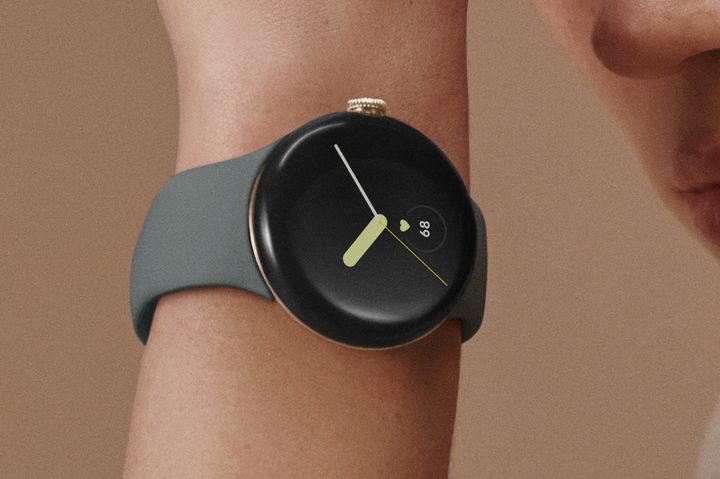
Google is touting 5ATM of water resistance, which means it can survive immersion up to a depth of 50 meters, just like Samsung and Apple’s latest smartwatches. The bundled Active Band will be offered in two sizes: Small (fit for wrists measuring between 130mm to 175mm) and Large (suitable for wrists with 165mm to 210mm girth).
The AMOLED display measures approximately 1.6-inches, offering a peak brightness output of 1,000 nits and a pixel density of 320 PPI. The screen is protected by Corning’s 3D Gorilla Glass 5, but the uncharacteristically thick round bezels stick out like an eyesore.
Inside is the aging Samsung-made Exynos 9110 SoC from the 2018 smartwatch era, ticking alongside 2GB of RAM and 32GB of onboard storage. Google is touting 24 hours of battery life, while the charging stats stand at 0% to 50% in 30 minutes.
Health and wellness
On the fitness side of things, the Pixel Watch is capable of heart rate monitoring, blood oxygen level analysis (in markets where it’s available), and sleep tracking. There’s also an ECG sensor onboard, which keeps a tab on the heart rhythm and can help users detect signs of serious conditions like Atrial Fibrillation.

As is clearly evident, the Pixel Watch is a showcase of Google’s software finesse, and it also serves as a vehicle for Fibit’s health-centric services. The Google smartwatch puts the Assistant on your wrist, alongside smart home controls, and contactless payments, among others.
The hardware might not sound like much, but if you’ve ever used a Pixel phone before and fallen in love with the tiny bits of software-level conveniences, the Pixel Watch offers just that. Assistant conversations should be smooth, voice dictation will likely be accurate, and the overall experience should be the best that Wear OS can offer.
There’s also an SOS feature for calling the 911 emergency hotline, but nothing fancy like Apple’s automatic crash detection system. The Pixel Watch also comes with a fall detection feature that can alert emergency contacts if the user is non-responsive after the accident.

As for the Fitbit integration part, it comes to life with a new app for Wear OS 3 smartwatches. Just for the sake of clarity, though, the Pixel Watch’s official spec sheet mentions that it runs version 3.5 of Wear OS.
The Pixel Watch comes with six months of free Fitbit Premium subscription, which offers features such as a daily readiness score for workouts with personalized guidance, detailed sleep analysis with snore and noise detection, stress management, and a library of expert-curated workout content.