  1. Home
  2. Mobile
  3. Emerging Tech
  4. Smart Home
  5. Wearables
  6. News

Wearable fingerprint sensor uses whole hand to control multiple smart devices

Tapdo, the finger-powered smart sensor, starts at $100 on Kickstarter

Add as a preferred source on Google

Unless you are a few years behind in upgrading your smartphone, chances are that you’ve used a fingerprint sensor. If you have, then you will no doubt have had the revelation about how much quicker it is than tapping in a PIN code or password to unlock your device or purchase an item.

While it’s possible to get your iPhone or Samsung Galaxy to recognize different fingers to carry out the same task, a neat new piece of hardware wants to take things up a level. Called Tapdo, it’s a wearable fingerprint reader that lets you map a variety of shortcuts for your different smart devices to various parts of your hand.

Recommended Videos

It’s available on Kickstarter starting at $100. Backers will receive their devices, including a battery and rubber wristband, in September.

“One of our founders developed the innovative interaction concept through his Ph.D. studies in human-computer interaction,” Irina Reimer, Tapdo campaign manager, told Digital Trends. “People are using so many apps on their smartphone every day, but there is no way to control them simultaneously. This is the problem that Tapdo solves. Using different parts of your hand makes interaction fast, intuitive, and discreet.”

For example, imagine controlling your smart home by manipulating, say, your Philips Hue Lights with one finger, your music player with another, and your smart lock with another. In all, there are about 20 functions available, along with If This Then That integration.

Sure, it will take a bit of memorization if you’re mapping the maximum number of shortcuts to your hand, but it’s certainly a smart concept — provided the touch sensor works as well as more established offerings.
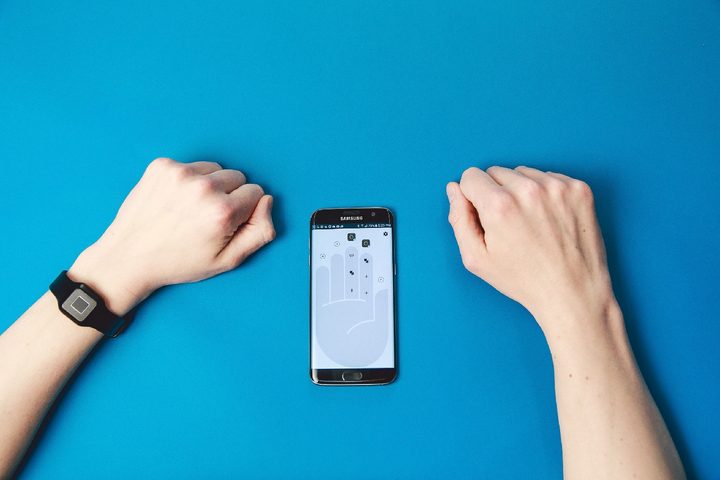
Image used with permission by copyright holder

The Tapdo button connects to both Android and iOS mobile devices, via Bluetooth LE. Like the fingerprint sensors you’re used to, it boasts haptic feedback to let you know of successful or unsuccessful attempts at reading biometrics — but unlike the fingerprint sensors you’ll have used previously, it is worn in the form of a wristband or as a clipped-on button.

“[The Kickstarter] campaign has the aim to start with the first mass-production batch,” Reimer said. “The plan is to start with the production in the spring months after the Kickstarter campaign, so that initial shipping for pre-orders can start in summer. At the beginning, the product will be available in Europe and the U.S.”

The $100 price tag includes a wristband and clip for the button. Now you just need to remember which finger part you set up for PayPal authentication.

Article originally published in December 2016. Updated on 03-27-2016 by Kyle Wiggers: Added Kickstarter pricing and availability information. 

Luke Dormehl
I'm a UK-based tech writer covering Cool Tech at Digital Trends. I've also written for Fast Company, Wired, the Guardian…
The best phones in 2026: our 14 favorite smartphones right now
We tested phones across all price brackets so that you can make the best pick based on your needs and budget.
Google Pixel 10 Pro Fold vs Galaxy Z Fold 7 cameras

Choosing the right smartphone in 2026 is no easy task. Apple and Android manufacturers now have strong options at almost every price, while better cameras, longer battery life, improved software support, new AI features, and more refined foldable designs have made the market more competitive than ever. But picking one is not easy, especially if your budget is tight, or you are just legitimately concerned about getting the best value for your money and need a reliable daily driver for long-term usage.

We have tested and compared the leading smartphones available today, looking beyond the spec sheet to see how they actually perform in daily use. Camera quality, battery life, performance, display quality, software, design, and long-term value all play a part in our recommendations. Whether you are looking for a powerful flagship, a dependable budget phone, a compact device, or a foldable, this guide should help narrow down your choices.

Read more
Snapchat Planets Meaning: Order, Rankings, and How Friend Solar System Works
Snapchat Planets turns your best friends list into a solar system, and yes, your orbit says a lot
Snapchat Planets being shown on the Snapchat app on iPhone.

Snapchat+ includes several exclusive features, but few have generated as much curiosity as Snapchat Planets. Part of the app's Friend Solar System, it transforms your Best Friends list into a planetary ranking, assigning each of your top eight friends a planet based on how often you interact.

From Mercury, which represents your closest friend, to Neptune, which represents your eighth closest, the system offers a quick visual snapshot of your interactions. But what do the different planets actually mean, and how does Snapchat decide who gets which one?

Read more
How to use WhatsApp Web
We'll show you how to use WhatsApp on your desktop or laptop
WhatsApp Web

As one of the most popular messaging services, you’ve already heard of WhatsApp. From its humble beginnings in 2009—two years before Apple introduced iMessage—to its acquisition by Facebook (now Meta) in 2014, WhatsApp has become the dominant messaging platform around the globe.

In recent years, it's grown even more potent with new features like video messages, self-destructing voice messages, the ability to edit sent messages, and more. We even finally got an WhatsApp iPad app in May 2025.

Read more