  1. Home
  2. Space
  3. News

Parker Solar Probe detects a natural radio signal coming from Venus

Add as a preferred source on Google

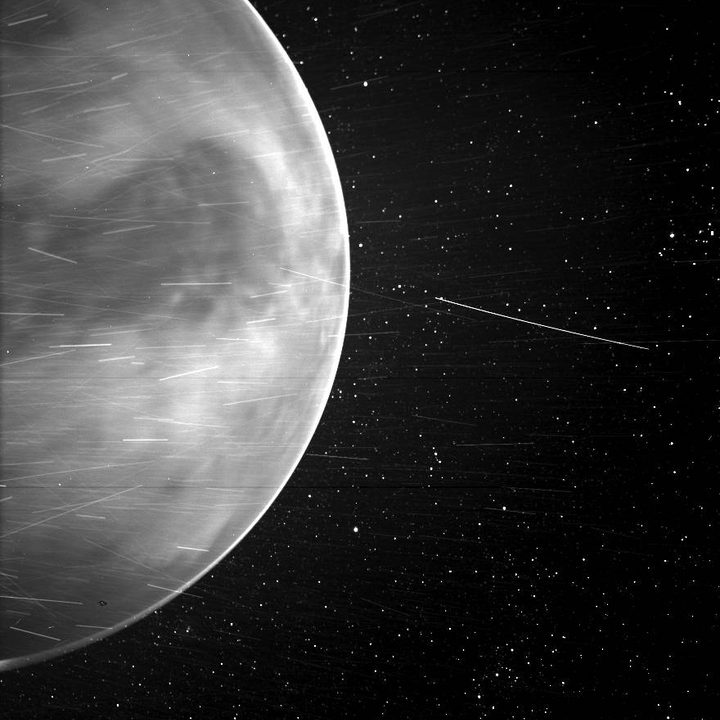
When flying past Venus in July 2020, Parker Solar Probe’s WISPR instrument, short for Wide-field Imager for Parker Solar Probe, detected a bright rim around the edge of the planet that may be nightglow — light emitted by oxygen atoms high in the atmosphere that recombine into molecules in the nightside. The prominent dark feature in the center of the image is Aphrodite Terra, the largest highland region on the Venusian surface. Bright streaks in WISPR, such as the ones seen here, are typically caused by a combination of charged particles — called cosmic rays — sunlight reflected by grains of space dust, and particles of material expelled from the spacecraft’s structures after impact with those dust grains. The number of streaks varies along the orbit or when the spacecraft is traveling at different speeds, and scientists are still in discussion about the specific origins of the streaks here. The dark spot appearing on the lower portion of Venus is an artifact from the WISPR instrument.
During its third Venus flyby on July 11, 2020, Parker Solar Probe’s WISPR imager captured this view of Venus’ nightside from 7,693 miles away. NASA/Johns Hopkins APL/Naval Research Laboratory/Guillermo Stenborg and Brendan Gallagher

A NASA spacecraft intended to study the sun has been doing some bonus science, revealing new information about Venus as it passes by the planet. It’s been a long time since a spacecraft has taken a direct measurement of the Venusian atmosphere — according to NASA the last time was almost 30 years ago when the Pioneer Venus Orbiter peered into the atmosphere in 1992 — and the study has revealed some fascinating facts about our planetary neighbor.

Recommended Videos

The big finding is a naturally occurring low-frequency radio signal which is emanating from the planet’s atmosphere. It was detected using the Parker Solar Probe’s FIELDS instrument, which is designed to measure electronic and magnetic fields around the sun. But it could also be used to detect the radio signal from Venus — a small disturbance with a familiar shape and strength.

Lead scientist Glyn Collinson recognized the disturbance as similar to a finding made when the Galileo spacecraft swung past Jupiter’s moons. That occurred when the spacecraft passed through a moon’s ionosphere or the ionized part of the atmosphere. By comparing the results from Galileo to those from Parker, Collinson and his colleagues were able to extrapolate information about the ionosphere of Venus as well, as its relationship to the phases of the sun.

The sun goes through phases of more or less activity, called the solar maximum and solar minimum, and researchers think that these phases are related to how thick Venus’s atmosphere is. The atmosphere may be lost into space over time, and the pace of this loss could be related to solar activity.

All of this science data comes as a bonus to the Parker mission, which primarily aims to study the sun. The probe is on a trajectory that will bring it increasingly close to the sun so it can study solar phenomena in more detail. To help get the spacecraft closer, its orbit periodically swings around Venus and it has previously captured a gorgeous image of the planet.

“The goal of flying by Venus is to slow down the spacecraft so that Parker Solar Probe can dive closer to the Sun,” said Nour E. Raouafi, Parker Solar Probe project scientist at the Applied Physics Laboratory, in a statement. “But we would not miss the opportunity to gather science data and provide unique insights into a mysterious planet such as Venus.”

Georgina Torbet
Georgina has been the space writer at Digital Trends space writer for six years, covering human space exploration, planetary…
Space is becoming Bezos and Musk’s next data center site, and we have every reason to worry
The AI boom is coming for the night sky
How Vast's space station will look in orbit.

AI data centers already consume vast amounts of electricity and water on Earth, so Silicon Valley has begun looking somewhere considerably more spacious... literally.

Elon Musk's SpaceX and Jeff Bezos' Blue Origin, along with several other companies, have proposed enormous constellations of satellites designed to operate as orbital data centers. However, environmental groups and former space officials are now warning that putting them into orbit at the proposed scale could have severe consequences for Earth's atmosphere and the night sky.

Read more
The first possible exomoon is here, and it makes our Moon look hilariously tiny
Scientists may have found the first exomoon, except this one is the size of Jupiter
This artist’s concept depicts a potential volcanic moon between the exoplanet WASP-49 b, left, and its parent star. New evidence indicating that a massive sodium cloud observed near WASP-49 b is produced by neither the planet nor the star has prompted researchers to ask if its origin could be an exomoon.

We have already discovered more than 6,000 planets outside of our immediate neighborhood. Yet, finding a moon orbiting one of those distant worlds has proved considerably harder. Astronomers may finally have something close to the real deal, but this particular object stretches the word “moon” almost beyond recognition.

Using the European Southern Observatory’s Very Large Telescope in Chile, researchers detected strong evidence for a moon-like object in the CD-35 2722 system. Further observations are still necessary to confirm the discovery, but it could become the first confidently detected natural satellite outside our solar system. There is still one tiny complication though. This moon is apparently massive.

Read more
China’s answer to SpaceX’s reusable rockets literally catches boosters in a net
SpaceX catches boosters on legs. China just used a net.
Ammunition, Missile, Weapon

SpaceX's playbook for recovering a rocket booster generally involves legs, a precisely controlled vertical landing, and either a concrete pad or a drone ship. 

China just managed to pull off something similar, but in a slightly different way, and on July 10, it tested the method as well.

Read more