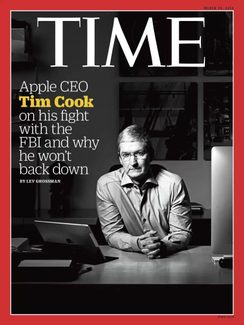
As Apple continues to wrestle with the FBI over iPhone encryption, its soft-spoken CEO has stepped up from gadget pitchman to privacy activist. In a wide-ranging interview published Thursday in Time magazine, Cook granted further insight into the company’s unyielding stance on encryption, and his own.
Far from backing off or waffling, Cook reserved his strongest statements yet for his interview, doubling down on his dedication to privacy and suggesting that the FBI’s request violates the U.S. Constitution and Americans’ civil liberties. We’ve collected the most powerful and revealing quotations from the transcript, and one thing’s for sure: The Feds have a formidable foe, and he’s not going anywhere.
You can read the full interview on Time magazine right here.
Read more: Apple vs. FBI Showdown | Apple vs. the FBI: A complete timeline of the war over tech encryption
Apple debated the issue internally
At the start of the interview, Cook explained how the FBI approached Apple about getting information from the San Bernardino shooter’s iPhone 5C. After fielding and resisting some FBI requests for data, Apple was sued by the government. It asked Apple to create code to help it break into the shooter’s iPhone and potentially other phones from different cases, as well. Apple refused and openly defied a court order to do so. Cook says that the decision wasn’t made on a whim or overnight, but it was something that he and other Apple leaders had discussed at length previously.
“When we saw the government going not only to this extent, but now going to a greater degree and asking us to develop … a new product that takes out all the security aspects, and makes it a simple process for them to guess many thousand different combinations of passwords or passcodes, we said you know, that case is now important,” Cook said. “Lots of people internally were involved. It wasn’t just me sitting in a room somewhere deciding that way, it was a labored decision. We thought about all the things you would think we would think about.”
The crux of Apple’s argument is that creating a backdoor for the FBI to access is not only dangerous, but a violation of civil liberties and American values. Cook referenced the Constitution and the Bill of Rights in his arguments.
“When I think of civil liberties I think of the founding principles of the country,” Cook began. “The freedoms that are in the First Amendment. But also the fundamental right to privacy.”
Cook argues that removing encryption will not make Americans more secure, nor will it protect their privacy: “I believe that if you took privacy and you said, I’m willing to give up all of my privacy to be secure. So you weighted it as a zero. My own view is that encryption is a much better, much better world. … And to me it is so clear that even if you discount the importance of privacy, that encryption is the way to go.”
You can’t have privacy without security
Another key point Cook raised during the interview, was that this case isn’t about having privacy or security — it’s about having both.
“No one should have a key that turns a billion locks. It shouldn’t exist.”
“I know everybody wants to paint it as privacy versus security, as if you can give up one and get more of the other,” Cook said. “I think it’s very simplistic and incorrect. I don’t see it that way at all.”
Cook believes that when you view it as an either-or issue, you’re saying that we have to trade privacy for security. And if we do that, then you may have stopped one bad guy, but “you’ve exposed 99 percent of good people.”
“I think it’s privacy and security or privacy and safety versus security,” he added. “It’s not that people’s wellbeing, their physical wellbeing is not a part of privacy. It is. It very much is.”
The dangers of backdoors
Cook reiterated his fears about creating a backdoor for the government, painting a frightening scenario in which an anti-encryption law is passed.
“Let’s say you just pulled encryption. Let’s ban it. Let’s you and I ban it tomorrow. And so we sit in Congress and we say, thou shalt not have encryption. What happens then?” he asked. “Well, I would argue that the bad guys will use encryption from non-American companies, because they’re pretty smart.”
“So are we really safer then? I would say no. I would say we’re less safe, because now we’ve opened up all of the infrastructure for people to go wacko at.”
Same goes for putting in a backdoor to get at your messages or digital communication, Cook claims. In the case of messaging, Cook says Apple doesn’t want to read or store your messages. He explained that Apple’s job is just to send the message — not to read it or store it somewhere so it can be read later.
“I’m the FedEx guy. I’m taking your package and I’m delivering it,” Cook said. “My job isn’t to open it up, make a copy of it, put it over in my cabinet in case somebody later wants to come say, ‘I’d like to see your messages.’ That’s not a role that I play … No one should have a key that turns a billion locks. It shouldn’t exist.”
More tech equals more data and more danger
Cook called the technology era “the golden age of surveillance,” because “there is more information about all of us, so much more than 10 years ago, or five years ago. It’s everywhere.”
He takes issue with the argument that Apple’s push for end-to-end encryption is as good as “going dark.”
“No one’s going dark,” he said. “I mean really, it’s fair to say that if you send me a message and it’s encrypted, it’s fair to say they can’t get that without going to you or to me, unless one of us has it in our cloud at this point. That’s fair to say. But we shouldn’t all be fixated just on what’s not available. We should take a step back and look at the total that’s available.”
“Because there’s a mountain of information about us. I mean there’s so much. Anyway, I’m not an intelligence person. But I just look at it and it’s a mountain of data.”
America will do the right thing
At the end of the day, Cook believes that America will do the right thing and stand up for the right to privacy and encryption.
“I think there’s too much evidence to suggest that [backdoors are] bad for national security,” he said. “It means we’re really throwing out founding principles on the side of the road. So I think there’s so many things to suggest that they wouldn’t do that. That’s not something I lose sleep over. I’m very optimistic, I have got to be, that in a debate, a public debate, all of these things will rise up and you’ll see sanity take over.”
“Right to privacy is really important. You pull that brick out, and another, and pretty soon the house falls.”
This case has the potential to set a dangerous precedent, Cook has said, but it also has the potential to set America on the right side of history in the encryption debate.
“We’re going to fight the good fight not only for our customers but for the country,” Cook said. “We’re in this bizarre position where we’re defending the civil liberties of the country against the government. Who would have ever thought this would happen? I never expected to be in this position. The government should always be the one defending civil liberties. And there’s a role reversal here. I mean I still feel like I’m in another world a bit, that I’m in this bad dream in some wise.”
To read the full transcript, head over to Time.