1. Home
  2. Space
  3. News

NASA is almost ready to touch down on asteroid Bennu and grab a sample

Add as a preferred source on Google
OSIRIS-REx Cruises Over Site Nightingale During Final Dress Rehearsal

NASA’s OSIRIS-REx spacecraft has been investigating asteroid Bennu since it arrived there in 2018, sharing pictures of the distant body. But the craft didn’t just travel there to snap photos — it will also touch down onto the surface of the asteroid and take a sample to be returned to Earth.

Recommended Videos

This week, OSIRIS-REx performed its final practice run ahead of its planned touchdown. The rehearsal took four hours, during which NASA engineers checked that the spacecraft could perform its functions as intended, checking its orbit departure burn, the “Checkpoint” burn during which autonomous systems check the craft’s position and speed and adjust as needed to bring it into line with the asteroid, and the “Matchpoint” burn during which the craft matches the asteroid’s speed so it can touch down accurately and safely.

As part of the rehearsal, OSIRIS-REx also deployed its sampling arm, called the Touch-And-Go Sample Acquisition Mechanism (TAGSAM), which it will use to scoop up a sample of rock and dust from the asteroid’s surface.
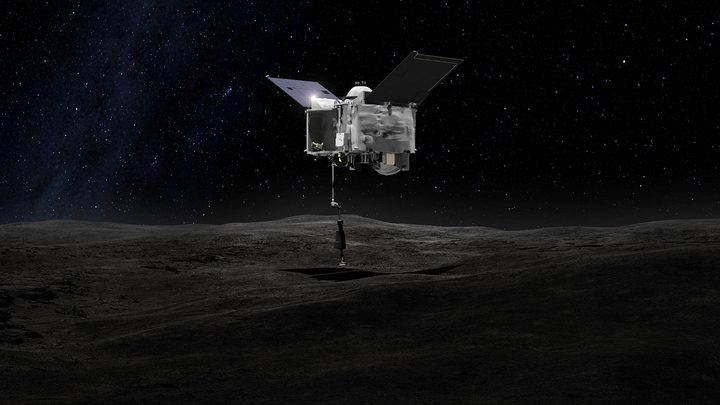
This artist's rendering shows the OSIRIS-REx spacecraft collecting a sample from the asteroid Bennu using a mechanical arm to touch the asteroid's surface.
This artist’s rendering shows the OSIRIS-REx spacecraft collecting a sample from the asteroid Bennu using a mechanical arm to touch the asteroid’s surface. NASA/Goddard Space Flight Center

“Many important systems were exercised during this rehearsal — from communications, spacecraft thrusters, and most importantly, the onboard Natural Feature Tracking guidance system and hazard map,” OSIRIS-REx principal investigator Dante Lauretta of the University of Arizona, Tucson, said in a statement. “Now that we’ve completed this milestone, we are confident in finalizing the procedures for the TAG [touch and go] event. This rehearsal confirmed that the team and all of the spacecraft’s systems are ready to collect a sample in October.”

While it was rehearsing, the spacecraft was also able to gather some science data including images of the asteroid and spectrometry observations. You can see some of the data captured in the video at the top of the page, which shows images taken by OSIRIS-REx’s SamCam camera as the spacecraft approached the asteroid’s surface. The images were taken over a period of less than 15 minutes, and during the rehearsal, the craft came within just 131 feet of the asteroid’s surface.

With everything working and the rehearsal deemed a success, OSIRIS-REx is ready to touch down on the asteroid and grab a sample on October 20, 2020. It will then return this sample to Earth for study, arriving on 24 September, 2023.

Georgina Torbet
Georgina has been the space writer at Digital Trends space writer for six years, covering human space exploration, planetary…
SpaceX Starship reaches orbit for the first time but its historic flight ends early
Starship reaches orbit for the first time and deploys 26 Starlink satellites before an early splashdown.
spacex-starship

After 13 suborbital test flights and more than $15 billion in development costs, SpaceX's Starship has finally reached orbit. The 407-foot megarocket, the most powerful ever built, lifted off from Starbase, Texas, on Monday and delivered its first real payload on it's 14th attempt. The celebration came with an asterisk, though, since SpaceX had to cut the planned 10-hour mission to roughly three hours.

https://twitter.com/SpaceX/status/2104601695711904180

Read more
Starship is finally going orbital, and SpaceX has picked September 22
Flight 14 is aiming for orbit, Starlink V3 deployment and a very long day in space.
Starship rocket.

SpaceX is finally ready to give Starship its biggest test yet. The company says the massive rocket's 14th test flight is scheduled for September 22, when it will attempt to put the upper stage into Earth orbit for the first time. The launch is currently pending regulatory approval, with a 75-minute window opening at 7:15 a.m. CT.

Starship has 26 Starlink satellites to deliver

Read more
Want a city on the Moon? Scientists say there’s not enough water
A billion tons still comes up short
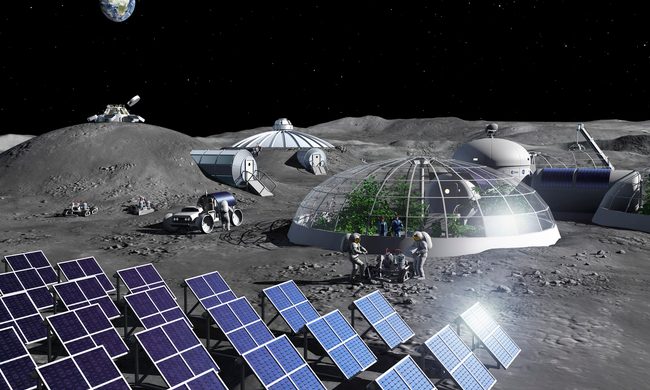
Artist impression of activities in a Moon Base.

For decades, humanity has looked up at the Moon and wondered what it would be like to live on it. Think sprawling cities, factories, research centers, and permanent human settlements. Unfortunately, there is one fairly fundamental problem with that vision.

A new study published in Frontiers in Space Technologies argues that even the Moon's potentially enormous reserves of frozen water may be nowhere near enough to support city-sized populations sustainably. Researchers Martin Elvis and Jonathan McDowell estimate that the permanently shadowed regions near the lunar poles could contain roughly one billion tons of water. It sounds like an extraordinary amount until you put a million thirsty humans next to it.

Read more