  1. Home
  2. Space
  3. News

This is the glass dome on SpaceX’s new Crew Dragon capsule

Add as a preferred source on Google

SpaceX has shown off a key feature of a modified Crew Dragon spacecraft that will soon launch its first all-civilian crew to orbit.

The new design includes a glass dome that will offer the four-person crew panoramic views of Earth and beyond.

Recommended Videos

The first pictures (below) of the cupola appeared in a tweet on Wednesday, September 1. The photos show each of the crewmembers peering out from the dome ahead of its preflight integration with the spacecraft.

A look at Dragon’s Cupola, which will provide our Inspiration4 astronauts with incredible views of Earth from orbit!

The crew visited the flight-hardware Cupola in California before it was shipped to Florida for integration with Dragon Resilience. pic.twitter.com/9ivMZrS1ip

— Inspiration4 (@inspiration4x) September 1, 2021

The Inspiration4 mission is expected to take place this month, though a specific date has yet to be announced.

The three-day space voyage was the idea of Shift4 Payments boss Jared Isaacman, who secured the mission in a private deal with SpaceX.

Isaacman is using the mission to help publicize the work of St. Jude Children’s Research Hospital in Memphis, Tennessee. He’s also been encouraging people to donate to the organization as it seeks to reach its funding target of $200 million.

The Inspiration4 mission will include three other crew members. Physician assistant Hayley Arceneaux will become the first bone cancer survivor to travel to space, and also the first person to head to orbit with a prosthetic body part (in Arceneaux’s case, prosthetic leg bones). And that’s not all. At 29, she’ll also become the youngest American to orbit Earth.

Trained pilot Dr. Sian Proctor is also part of the mission, as is Christopher Sembroski, a veteran of the U.S. Air Force and current Lockheed Martin employee.
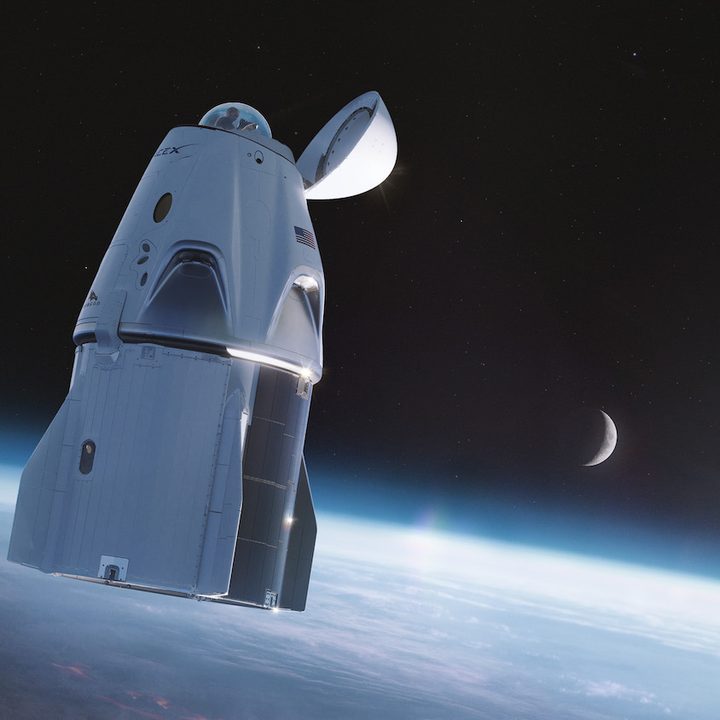
How the new Crew Dragon spacecraft will look.
An illustration of the new Crew Dragon spacecraft featuring a glass dome. SpaceX

On other Dragon capsules, a docking mechanism is required at the top so they can link up with the International Space Station. But as the Inspiration4 mission is an orbit-only adventure, SpaceX engineers saw an opportunity to include the cupola.

Shortly after SpaceX announced the new design in March, it was revealed the spacecraft’s bathroom would be located in the same place. Isaacman responded at the time: “When people do inevitably have to use the bathroom, they’re going to have one hell of a view.”

He added that the capsule is pretty small and therefore lacks privacy, though fortunately the bathroom does include a curtain so you can avoid doing your business under the full gaze of others.

And just in case anyone spends longer in the bathroom than is reasonably necessary (though, with those views, it will be kind of understandable), then the crewmembers can still enjoy the amazing scenery through the spacecraft’s four smaller windows.


Trevor Mogg
Contributing Editor
Not so many moons ago, Trevor moved from one tea-loving island nation that drives on the left (Britain) to another (Japan)…
Want a city on the Moon? Scientists say there’s not enough water
A billion tons still comes up short
Artist impression of activities in a Moon Base.

For decades, humanity has looked up at the Moon and wondered what it would be like to live on it. Think sprawling cities, factories, research centers, and permanent human settlements. Unfortunately, there is one fairly fundamental problem with that vision.

A new study published in Frontiers in Space Technologies argues that even the Moon's potentially enormous reserves of frozen water may be nowhere near enough to support city-sized populations sustainably. Researchers Martin Elvis and Jonathan McDowell estimate that the permanently shadowed regions near the lunar poles could contain roughly one billion tons of water. It sounds like an extraordinary amount until you put a million thirsty humans next to it.

Read more
NASA’s new telescope can see 100 times more sky than Hubble in a single shot
NASA just launched a $4 billion telescope to map billions of galaxies
NASA Roman Telescope Launch Featured

The Hubble telescope has an almost legendary status. Over the last three decades, Hubble gave us some of the most spectacular close-ups of the universe ever captured, and now, NASA’s newest space telescope wants to see the bigger picture. The Nancy Grace Roman Space Telescope successfully launched aboard a SpaceX Falcon Heavy from Kennedy Space Center in Florida at 7:26 a.m. EDT on August 30. Roman is now beginning a roughly three-month journey toward the Sun-Earth L2 point, nearly a million miles away, where it will spend its primary five-year mission surveying huge portions of the cosmos.

Roman carries a 2.4-meter primary mirror, the same diameter as Hubble’s, but its Wide Field Instrument can capture a field of view at least 100 times larger than Hubble’s. NASA expects it to use that combination of sharpness and scale to map billions of galaxies, study dark matter and dark energy, and discover enormous numbers of previously unknown worlds.

Read more
NASA built the Roman Space Telescope to study dark matter, but it can also help protect Earth from killer asteroids
The Nancy Grace Roman Space Telescope wasn't built to hunt asteroids, but it turns out to be great at it.
Nancy Grace Roman space telescope.

NASA is about to launch a telescope built to unlock some of the universe's biggest mysteries, and it turns out that same design could help protect Earth along the way.

The Nancy Grace Roman Space Telescope is set to launch from Kennedy Space Center on August 30, 2026, with a primary mission focused on studying dark matter and dark energy - the invisible forces shaping galaxies and cosmic expansion. Researchers now say its unique design also makes it unexpectedly effective at spotting dangerous asteroids headed our way (via MIT Technology Review).

Read more
