1. Home
  2. Space
  3. Emerging Tech
  4. Legacy Archives

NASA confirms ‘impossible’ thruster actually works, could revolutionize space travel

Add as a preferred source on Google

When Roger Shawyer first unveiled his EmDrive thruster back around 2003, the scientific community laughed at him. They said it was impossible, that it was based on a flawed concept, and couldn’t work because it goes against the laws of conservation of momentum. But somehow, despite all of the reasons it shouldn’t work, it does.

Scientists at NASA just confirmed it.

Recommended Videos

Shawyer’s engine provides thrust by “bouncing microwaves around in a closed chamber.” That’s it. There’s no need for a propellant of any kind like rocket fuel. When filled with resonating microwaves, the conical chamber of the thruster experiences a net thrust toward the wide end. These microwaves can be  generated using electricity, which can be provided by solar energy. In theory, this means that the thruster can work forever, or at least until its hardware fails.

Initially, the idea was met with criticism because it flies in the face of Newtonian physics, which dictate that no closed system can have this kind of net thrust. Shawyer, however, says that net thrust occurs because the microwaves have a group velocity that’s greater in one direction when Einstein’s relativity comes into play. But can it really?

Apparently, yes. The idea was first confirmed by a group of Chinese scientists back in 2009. They built their own version of Shawyer’s thruster and were able to produce 720 milinewtons of force — but even then, nobody really believed it.

Related: NASA offering $35,000 to ‘”citizen scientist” asteroid hunters

Now, American scientists at NASA have given the EmDrive a go, and once again confirmed that it actually works. The test results were presented on July 30 at the 50th Joint Propulsion Conference in Cleveland, Ohio, and astonishingly enough, they are positive. The team behind the drive still doesn’t know why it works, just that it does.

“Test results indicate that the RF resonant cavity thruster design, which is unique as an electric propulsion device, is producing a force that is not attributable to any classical electromagnetic phenomenon and therefore is potentially demonstrating an interaction with the quantum vacuum virtual plasma,” the report reads.

Therefore, we’ve still got a long road ahead of us before we’ve got energy-harvesting, self-propelled intergalactic spacecraft, but these studies (assuming they’re not flawed) suggest we’ve made a major breakthrough in space propulsion systems. With further refinement, microwave thrusters could drastically cut the cost of satellites and space stations, and potentially even make it possible to travel to distant planets, like Mars, in weeks rather than months or years.

Drew Prindle
Former Senior Editor, Features
Drew Prindle is an award-winning writer, editor, and storyteller who currently serves as Senior Features Editor for Digital…
Space is becoming Bezos and Musk’s next data center site, and we have every reason to worry
The AI boom is coming for the night sky
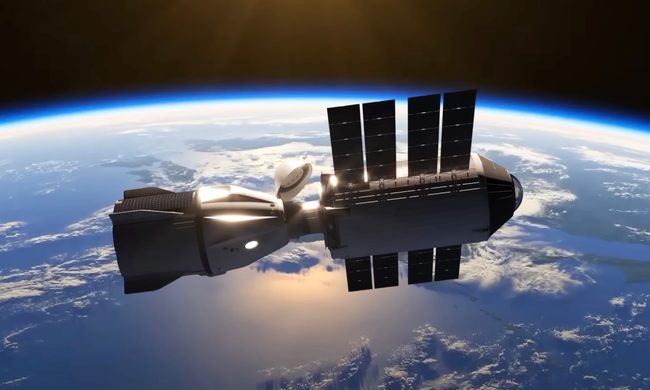
How Vast's space station will look in orbit.

AI data centers already consume vast amounts of electricity and water on Earth, so Silicon Valley has begun looking somewhere considerably more spacious... literally.

Elon Musk's SpaceX and Jeff Bezos' Blue Origin, along with several other companies, have proposed enormous constellations of satellites designed to operate as orbital data centers. However, environmental groups and former space officials are now warning that putting them into orbit at the proposed scale could have severe consequences for Earth's atmosphere and the night sky.

Read more
The first possible exomoon is here, and it makes our Moon look hilariously tiny
Scientists may have found the first exomoon, except this one is the size of Jupiter
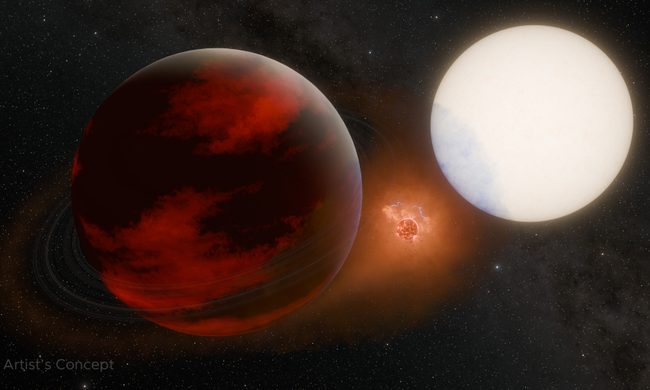
This artist’s concept depicts a potential volcanic moon between the exoplanet WASP-49 b, left, and its parent star. New evidence indicating that a massive sodium cloud observed near WASP-49 b is produced by neither the planet nor the star has prompted researchers to ask if its origin could be an exomoon.

We have already discovered more than 6,000 planets outside of our immediate neighborhood. Yet, finding a moon orbiting one of those distant worlds has proved considerably harder. Astronomers may finally have something close to the real deal, but this particular object stretches the word “moon” almost beyond recognition.

Using the European Southern Observatory’s Very Large Telescope in Chile, researchers detected strong evidence for a moon-like object in the CD-35 2722 system. Further observations are still necessary to confirm the discovery, but it could become the first confidently detected natural satellite outside our solar system. There is still one tiny complication though. This moon is apparently massive.

Read more
China’s answer to SpaceX’s reusable rockets literally catches boosters in a net
SpaceX catches boosters on legs. China just used a net.
Ammunition, Missile, Weapon

SpaceX's playbook for recovering a rocket booster generally involves legs, a precisely controlled vertical landing, and either a concrete pad or a drone ship. 

China just managed to pull off something similar, but in a slightly different way, and on July 10, it tested the method as well.

Read more