
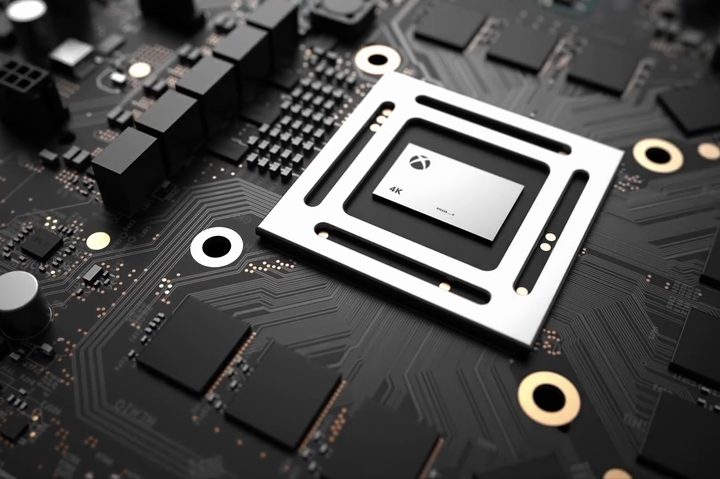
The video game console market is changing rapidly. What used to be a safe five-to-seven year investment has become a disjointed waiting game to get the best hardware. Both Sony and Microsoft are releasing updated versions of its consoles. Sony recently announced the PlayStation 4 Pro, slated to come out this November, and Microsoft’s Project Scorpio will come out sometime next year. This has left a lot of gamers who purchased the PlayStation 4 and Xbox One upset, as their investments will soon become out-of-date.
This never has been an issue for PC gamers. Hardware can easily be updated if required. But there are some drawbacks. While upgradability is one of PC gaming’s biggest strengths, it can be intimidating for the average gamer.
Razer changed the game with the Core. It’s a unit that lets gamers add a desktop-grade graphics card to a laptop, making plug-and-play external graphics a reality. This same technology could work in the next generation of gaming consoles. All gamers have to do is pick the desktop graphics card of their choice, place it in the Core, and connect it to the laptop via a Thunderbolt 3 cable. Once done gaming, gamers can unplug the core and head off with the laptop in-hand.
Upgradability is one of PC gaming’s biggest strengths, but it can be intimidating for the average gamer
To understand how upgradable tech works, Digital Trends reached out to Travis Furst, Razer’s Systems Product Market Manager, to get some insight.
“Razer Core was a massive collaboration of some of the biggest technology companies in the world” said Furst. “We partnered up with Intel—their Thunderbolt team was very helpful—and we collaborated with them a lot to bring this to market. Microsoft helped support us from an OS standpoint to ensure the switchable graphics were working. AMD and NVIDIA were also critical to helping support us.”
“None of it is proprietary” said Furst. Meaning, any hardware manufacturer can add Core support as an option. It also means that modular graphics technology is open for both Sony and Microsoft to use. While Sony hasn’t announced plans to use modular graphics, it’s easy to see why it might be adopted. Such a scheme could provide an instant boost to performance without replacing the entire console.
“I think the concept of the modularity on the PC side—of having a thin and light computer and getting that full desktop experience—does seem to be sticking very well,” said Furst. While the PC audience is more informed, the reaction Furst has seen does point to the universal charm of upgrading. From swapping out a car exhaust to getting a new washing machine, taking what was already there and improving upon it is a widespread concept. And hurdles that were once there for upgrading computer systems have subsided, meaning there is a possibility for mass appeal.
Cutting the baby in half
But there are some drawbacks to making consoles modular. Michael Pachter, a research analyst for Wedbush Securities, and host of The Pachter Factor on Siftd.net, sees some problems. “It doesn’t make sense to upgrade if only a portion of the audience buys the upgrade” said Pachter. “That would create different graphical standards for games, and different standards would be confusing, would limit the market and would generally be unpopular with developers.”
Pachter has a point. Gamers are already upset that updated consoles are incoming, as it is bound to cause confusion, and make gamers with the old model feel obsolete. “Games would (and should) be designed to the lowest common denominator” said Pachter, meaning that console gaming really cannot adopt the current PC model.
Even Microsoft and Sony have echoed this sentiment. During Microsoft’s E3 press conference, the company stated clearly that all Xbox One games must be compatible with legacy hardware.
That causes another problem. Insider reports reveal that developers are not happy about having to develop games on two different specs.
Rami Ismail, founder of indie studio Vlambeer, the team behind Ridiculous Fishing and Nuclear Throne, had some poignant thoughts on fragmented consoles this generation. “Unless developers efforts are funded by the platform, there’s minimal or no profits to be made from that work,” said Ismail.
Because of the large install base of current PS4’s, many developers will aim to hit that spec first, and later do the additional work to take advantage of the PS4 Pro. “None of those benefits can be communicated over non-4K non-HDR media, so the marketing benefit is negligible,” added Ismail. “Since it’s also hard to lock PS4 Pro functionality behind a paywall, it won’t give any direct returns either.”
If there’s any saving grace for developers it’s this: “I can’t see any developers being excited about fragmentation, but in most cases developers are not affected too much. A PS4 Pro version is not necessarily required,” said Ismail.
Modularity seems to leave Microsoft and Sony in a lose-lose situation, at least when it comes to developers. If developers don’t have to use the upgraded hardware, most won’t. But forcing them to use it is sure to cause hard feelings.
The future is upgradable, like it or not
Sony recently revealed that it the rise of PC gaming inspired the release of a more powerful PS4 midway through its lifecycle. Clearly, as consumers are getting older and have more disposable income, they’re looking to put their money down on the best possible experience. Sony thinks it’s now battling the PC platform, as well as Xbox, and to win that fight it needs to create a system that makes owning a console easier and just as powerful as PC.
Going modular seems to be the obvious course of action. Because technology now allows for plug-and-play graphics, giving consumers PC-like upgradability with console-like ease might prevent them from jumping ship – even if it is to the chagrin of the development community.


