 A study from the NPD group shows that mirrorless interchangeable lens cameras, while still trailing behind traditional digital cameras in sales, are fueling consumer interest. The research groups Next Camera study “revealed that two-thirds of consumers interested in a mirrorless interchangeable lens camera and willing to spend $500 said it would replace the purchase of a point-and-shoot camera. Nearly a quarter said it would replace a DSLR purchase.” These sleek cameras are attracting a wide range of buyers: From those who have outgrown the simplicity of point-and-shoots to hobbyists that need to round out their camera collections.
One type of mirrorless interchangeable lens camera is Micro Four Thirds, or MFT. Currently, MFT is utilized by Panasonic and Olympus – its creators – but we may see new lower-priced entries from Polaroid and Kodak later this year. Packed inside those bodies is a unique technology that comes with a fairly steep price tag and, as always, a few compromises.
The magic is in the mirror…or lack thereof
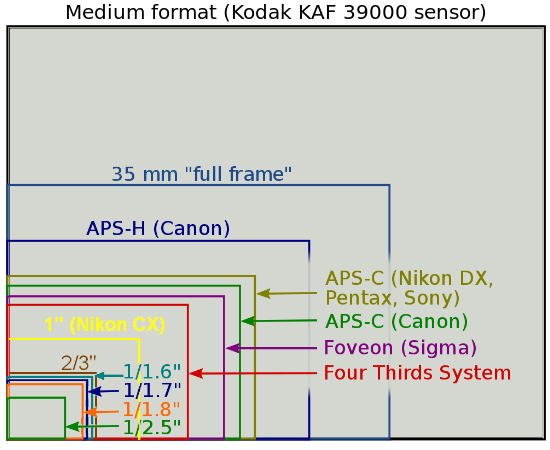 If you’re unfamiliar with the MFT systems, you’ve probably heard a lot of different names for the devices tossed around. Labels like mirrorless cameras, compact system cameras, and interchangeable lens (or ICL) cameras are also fairly common, although the latter is somewhat misleading (DSLRs are ICLs, as well).
The moniker Micro Four Thirds camera refers to a standard of mirrorless camera that uses the Micro Four Thirds sensor (it shares the size and specifications of the Four Thirds standard developed by Kodak and Olympus). A MFT sensor size is much larger than your typical digital point-and-shoot but much smaller than a 35mm full frame or APS DSLR’s (see the chart). However, their bodies are small and more compact, meaning there isn’t room for a mirror and prism mechanism (hence the “mirrorless” label).
But don’t call all mirrorless cameras an MFT: Sony, Fujifilm, Nikon, Pentax, and Canon also produce mirrorless models, but theirs utilize other types of sensor standards and therefore aren’t considered MFTs like those from Panasonic and Olympus (Sony and Canon, for example, use APS-C sensor formats for their mirrorless products). The reason why MFT somehow became associated as the de facto mirrorless standard may be because Olympus and Panasonic were among the first to come out with such a camera. For this article, let’s focus just on MFTs.
The good, the bad, and the gorgeous
MFT cameras are something of a perfect middle ground between big-bodied and button-heavy DSLRs and easily outgrown point-and-shoots. Better yet, they are perfectly suited for photography hobbyists who want to expand their imaging repertoire. As far as hard specs go, the absence of a mirror cuts down on inner camera vibration, so you might avoid what would otherwise be blurry images. The smaller sensor size also can be a plus, because it offers deeper depth-of-field. There are more than a few advantages on leaving the point-and-shoot behind and moving to a MFT device, but they all basically come down to one thing: Vastly improved image quality.
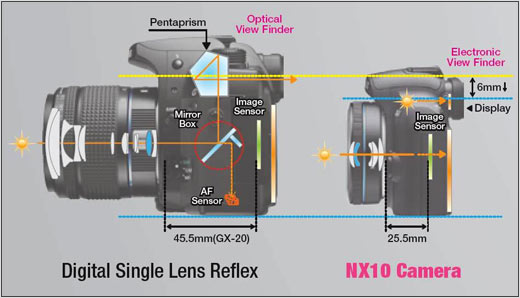 Of course, you’re missing out on the benefits of compacts (a convenient form factor) and DSLRs (true, top-notch image quality and faster-than-fast shutter speeds). Middle ground doesn’t always mean the compromises you’re making are good ones. Notably, if you choose to upgrade and you buy a MFT camera instead of a DSLR, you’re going to notice it when it comes to low lighting situations and (in most cases) the elimination of a built-in optical viewfinder (MFTs use an electronic viewfinder). They also use a different (and generally more accurate) Contrast AF system, but are slower than the ones employed by DSLRs, but manufacturers are improving the speed through new features like hybrid autofocus.
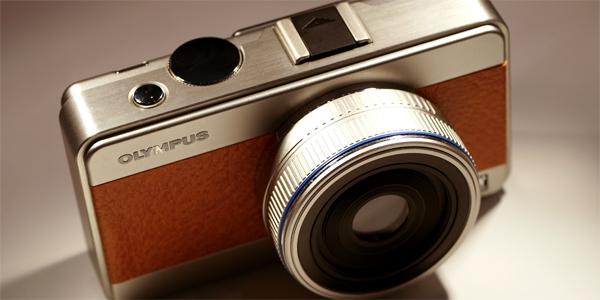 One of the most attractive aspects of the MFT camera is…well, how attractive it is. The devices offer a quality upgrade from point-and-shoots in sleek, modern-meets-retro packages. Digital photography has been taking cues from the rest of the technology world and outfitting these lineups with eye-catching exteriors. That might sound shallow, but given the typical $500+ price tag that accompanies these beauties, it’s safe to say that photography buffs and not wannabes are still the true investors.
Which MFT is right for me?
Size: If your pocket cam’s convenient size is the only thing keeping you from upgrading, there are options. Sure, you aren’t going to find a MFT device that can out-mini your current camera, but there are a couple that make valid arguments. The Olympus PEN E-PM1 ($499) is one such camera.
Price: Unfortunately, there isn’t a lot of wiggle room when it comes to MFT cameras. They generally begin at $500 and skyrocket from there. Again, the Olympus PEN E-PM1 is a popular choice at $499, but it’s also a more muted take on professional-level photography. Another MFT veteran, Panasonic’s DMC-GF3 is currently selling for $699.99. Of course, if you don’t mind last-gen models, there are a slew of quality options on Amazon and eBay: We found the Olympus PEN E-P2 for $469 as of this writing. This year, we may see lower-priced MFT cameras from Kodak and Polaroid, although they may lack the quality fit-and-finish of those from Panasonic and Olympus. There’s a lot of movement in this sector, so keep an eye for refreshes.
Performance: If money is no object, considering the doors blown wide open. Olympus’ PEN series is a popular and well-rated lineup, and the E-P3 is no exception. The camera improves on all the little kinks and glitches from its predecessors in the same stylish package—and comes with an $899.99 price tag. Although Panasonic’s Lumix DMC-G5 may lack sex appeal, this $699 MFT shooter boasts very fast autofocusing.
What to hold out for: As we’ve mentioned, there are other mirrorless interchangeable lens cameras from a variety of manufacturers, except they aren’t MFTs. Sony offers its popular NEX series, for example. Nikon has its 1 Series, Fujifilm has its X-Series, and Canon finally joined the mirrorless party with its EOS M. While Panasonic and Olympus were the first to unveil mirrorless interchangeable lens cameras, nearly every other manufacturer now has a model for you to choose from. Don’t count MFT out, however, as Panasonic and Olympus continue to unveil new models in their lineups.
(This article was updated on January 28, 2013)