It’s no secret that Hillary Clinton and Donald Trump were two of the most popular Halloween costumes this year.
But how much do you resemble either of the presidential candidates for the 2016 election cycle, without the use of fake tan or pantsuits? Ntechlab, the company behind one of the world’s most accurate facial recognition systems, want to give you a way of finding out.
“FaceElections 2016 is a project designed to give everyone the opportunity to compare their face to the faces of the two main presidential candidates in America,” Ntechlab co-founder Alexander Kabakov told Digital Trends. “We’ve got maybe the best algorithm in the world for facial recognition, and we thought it would be interesting to voters to be able to see the degree of similarity they share, expressed as a number.”
Ntechlab’s FindFace system made waves last year when its beat one developed by Google for University of Washington’s Megaface Championship 2015. At the event, FindFace achieved an impressive 73 percent accuracy with a database of 1 million pictures. When that number dropped to 10,000 images, the system’s accuracy rose to 95 percent.
Since then, it has used its expertise to create a facial recognition-based dating app which has racked up more than 1 million users — although the idea of doing a new project based on this year’s presidential race proved too tempting to ignore.
FaceElection 2016 is a free website, which lets users upload an image of themselves and the website assigns a similarity score to both Clinton and Trump.
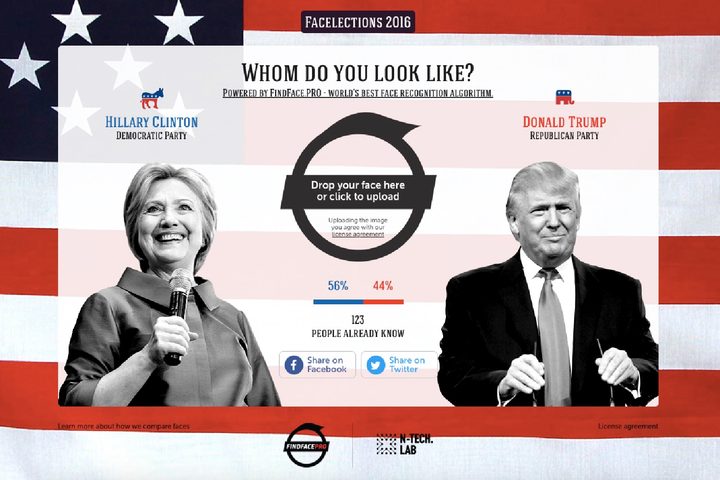
Does it work? Given that there is no objective measure to be had on whether we really are facially 54 percent Donald Trump, it is tough to determine for certain. Uploading pictures of ourselves never resulted in looking more Hillary than Donald, although the numbers did change depending on the image we uploaded. On the other hand, images of Trump and Clinton throughout their lives were successfully recognized as the person in question.
One interesting detail is that Kabakov said that the neural network used for measuring similarity was tweaked to avoid weighting gender too heavily. “We developed a gender-tolerant algorithm so that your own gender and that of the candidate is not taken too much into consideration,” he said. “If you’re a woman, it won’t automatically say you’re similar to Hillary Clinton, while men won’t automatically be taken as looking similar to Donald Trump. Gender is one of the points of similarity, but it’s not the main one. We have many others, such as the type of face, the sizes of eyes and more.”
So do voters tend to vote for candidates who look like them, like the old saying about dogs resembling their owners (or vice versa)? “We haven’t researched that, but it’s definitely an interesting question,” Kabakov laughed.
Maybe we will find out as people share the results on social media.