What does Google have planned for securing home? Two patents it recently filed may provide some insight. These are continuations of previously filed patents, and they outline plans for a highly advanced security system. The system, and the arm and disarm technology laid out in these two patents, is not like the typical alarm technology we see today.
Regular security systems rely on modes like “stay” and “away” to determine whether or not to sound an alarm if there is motion detected in a home or business. We have to manually set the security system – like by pressing a keypad on our way out the door — to activate these various modes. Google’s technology takes a different .
Google wants to use external inputs to determine whether or not a person is at home. This way, we never have to worry about arming or disarming the security system, because it will automatically arm and disarm itself.
It may sound like science fiction, but from what Google indicates in the two patents, it appears viable. Nest already accomplishes this automatic arming and disarming in some ways, using geofencing to determine when it should lower your thermostat and turn on your security camera when no one’s home. Of course, this presents a problem if Mom leaves for the grocery store and a tween without a smartphone is left home alone.
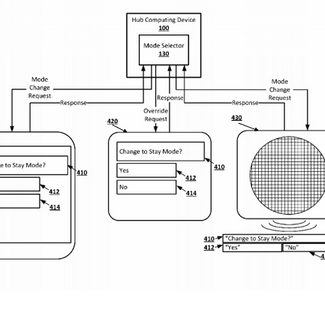
To make the security system smarter, it would use more inputs, like our geolocation data, electronic device location data (e.g. the location of our smartphone, smart watch, or other wearable device), sensor data (like motion sensors, window and door detection, and cameras), and aggregate data regarding the days and times we are at home versus away from the house. It would then be able to arm and disarm itself accordingly. It sounds like Google is hoping that, in a few years, our houses will be packed with sensors: “The sensors may be, for example, low power motion sensors, such as a passive infrared sensor used for motion detection, light sensors, cameras, microphones, entryway sensors, smart light switches, mobile device scanners for detecting the presence of mobile computing devices or fobs via Wi-Fi, Bluetooth, and RFID, and the like,” according to the patent.
The security system’s hub could come preloaded with “rules” based on a setup similar to your home. If you live in a two-bedroom house with a child, your spouse, and a dog, it would set up security responses accordingly. Parameters would change when the babysitter entered the house using a code. Instead of having to turn on the alarm before bed, the sensor and device data would let the system know everyone was home and, at 10 p.m., it would automatically turn on the alarm.
None of this sounds far off from similar routines that can be set up with hubs and IFTTT recipes, but having a device that was programmed with all these rules ahead of time might make setting up a security system a little easier.