Google Translate may be able to handle more than a hundred languages, but it supports some more robustly than others. Take English, for example — support for English is built natively into the search giant’s Android operating system, Google’s Chrome browser, and dozens of other mobile and web products. But on Tuesday, Google remedied things a bit with support for nine languages spoken on the Indian subcontinent.
In March 2017, Google introduced a machine learning algorithm to Google Translate, its eponymous translation platform, that significantly improved accuracy by using a “broader context” to figure out the most “relevant” translations. It understands Russian, Vietnamese, and dozens more of the 103 languages that Google Translate currently supports, and the Indian rollout is an expansion of the effort. Now, Google Translate can interpret nine languages that are widely used on the subcontinent — Hindi, Bengali, Marathi, Tamil, Telugu, Gujarati, Punjabi, Malayalam, and Kannada — and translate them between any other tongue.
Google said the new technique improves the quality of translation “more in a single jump than we’ve seen in the last ten years combined,” Google said.
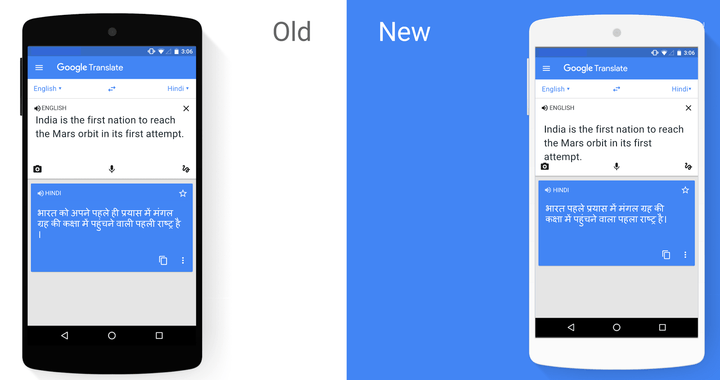
Alongside the addition of Indian to Translates’s AI-assisted lexicon, Google added machine learning-powered translation to the Chrome browser’s built-in Translate functionality. Now, when you encounter a webpage with foreign text, Chrome will automatically offer to translate it using Google’s new neural network-assisted technique.
“This means higher quality translations of everything from song lyrics to news articles to cricket discussions,” Google said.
In addition to the Chrome and Google Translate enhancements, Google’s bringing support for more Indian languages to its Gboard software keyboard for Android and iOS. More than 11 new languages will join the fray, including Hindi, Bengali, Telugu, Marathi, Tamil, Urdu, and Gujarati. They’re replete with support for auto-correction, prediction, and two layouts each — one for the native language script and one for the QWERTY layout for transliteration, which lets you spell words phonetically using QWERTY alphabet and get text output in your native language script.
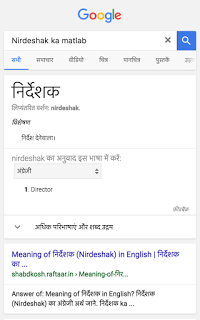
Finally, Google’s adding a Hindi dictionary in the Google Search app. In collaboration with Oxford University Press, it has brought the Rajpal & Sons dictionary online with full support for transliteration. Next time you tap a term in Google Search, you’ll get a dictionary definition and meanings, including English translations.
These updates are on the heels of auto-translated local reviews in Maps, which Google introduced on Monday. Google Maps automatically translates reviews into your system’s default language — saving you the trouble of having to copy and paste it to a translation app. And it includes the review in its original language, for anyone who wants to clarify a word or two.