
  1. Home
  2. Computing
  3. Emerging Tech
  4. Web
  5. Legacy Archives

OLPC Outlines Future XO Laptops

Add as a preferred source on Google

The One Laptop Per Child project may be facing some competition for inexpensive notebooks aimed at juicing education in developing markets—and may never have hit its major $100-per-system price point—but that doesn’t mean Nicholas Negroponte’s ambitious effort to bridge the so-called digital divide is giving up. The OLPC project has just announced a roadmap for future XO laptop systems, including an XO 1.5 and XO 1.75 aiming at 2010 and 2011, respectively, and an XO 3.0 concept laptop that’s just a sheet of flexible, unbreakable plastic that it hopes to bring to market in 2012 for under $100.
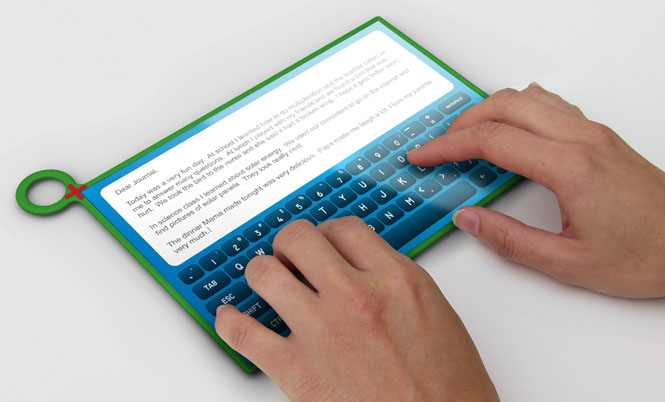
OLPC XO 3.0 Concept
Image used with permission by copyright holder

“The first version of OLPC’s child-centric laptop, the XO, is a revolution in low-cost, low-power computing,” said OLPC founder and chairman Nicholas Negroponte, in a statement. “To fulfill our mission of reaching 500 million children in all remote corners of the planet, OLPC will continue to innovate in design and performance. Because we are a non-profit, we hope that industry will copy us.”

Recommended Videos

On the immediate horizon in the XO 1.5, which will feature the same basic industrial design as the current XO laptop, but with double the processor speed, pack in four times the RAM. (That would push it to 866 MHz and 1 GB of RAM.) The XO 1.5 will boot either Linux or Windows, and OLPC anticipates it will be available in January 2010 at about $200 per unit, with some variation owing to fluctuations in the RAM and flash memory markets.

In 2011, OLPC plans to launch the XO 1.75, which will add rubber bumpers to the outside of the XO case and expand out to an 8.9-inch tech-sensitive display. The Xo 1.75 will use an ARM processor from Marvell (rather than the x86 processor in the XO 1.5) that OLPC says will offer twice the speed at a quarter the power consumption—but the XO 1.5 will remain in production to offer a choice of processor platform. OLPC anticipates the XO 1.75 will cost $150 or less.

Almost a year and a half ago, the OLPC project announced a dual-screen concept for the XO 2.0 based on two touch-sensitive displays: one could act as a keyboard while the other worked as a traditional display, or innovative applications could make use of both displays in new ways. The displays would be developed by OLPC spinoff Pixel Qi. Now, looking out to 2012, OLPC gets a lot more ambitious, announcing a concept for an X0 3.0 that is just a single sheet of flexible, unbreakable plastic based on Pixel Qi display technology. The XO 3.0 would stick with the XO 2.0’s dual-screen approach, enabling one screen to be used as a keyboard or other input mechanism and the other for display, and (again) apps could make innovative use of both displays. OLPC says the XO 3.0 will be “unbreakable” and have no holes in it—although it will apparently support a ring for hanging around and being lashed on to things. The X0 3.0 will be based on the ARM architecture of the X0 1.75, and OLPC hopes to bring it to market at a per-unit cost under $75.

Only time will tell whether these designs come to fruition and whether OLPC can meet its target prices, but, regardless, we admire all the hard work going towards such a worthy cause.

Geoff Duncan
Former Contributor
Geoff Duncan writes, programs, edits, plays music, and delights in making software misbehave. He's probably the only member…
Google Earth’s AI misadventure lasted only a day. It was a tale of dangerous ignorance.
Nuclear reactors, tanks, and historical destruction on a life-like satellite map? Yeah, that's bad.
Nano Banana AI image generator representation.

Technology behemoths are clearly not reading the room, or they are just moving faster than they should when it comes to AI deployment. Google has already stuffed its Gemini AI in every corner of its software stack, from Android to daily productivity tools like Gmail that are used by hundreds of millions of users every day. AI is everywhere. Not all of it is bad, mind you. But in a few places, it just feels forced.

In its latest AI-fication experiment, the company targeted Google Earth. The idea was to let the audience use its Nano Banana 2 AI image generator and make images that can be placed on the map view. On paper, it's a cool idea. What would the Colosseum of Rome look like in your urban neighborhood? Yeah, fun stuff like that.

Read more
AMD is apparently gearing up to raise GPU prices right after Nvidia’s steep hike
AMD has reportedly told AIB partners about a price hike that goes into effect in. August.
AMD RX 7800

AMD is next in line to raise the asking price of its Radeon GPUs, merely days after the news of a similar hike coming for Nvidia graphics cards started making waves. As per ChannelGate on Weibo (h/t VideoCardz), AMD has informed its board partners that the price of GPU and memory bundles will go up by at least 10% in August.

Is a similar price hike coming for standalone graphics cards? I won't be surprised if that happens. The situation is so bad that AMD is planning to bring back graphics cards with 4GB of onboard memory. AMD just introduced the RX 9050 GPU, which costs $279. Notably, it's just $20 less than the RX 9060 XT that offers double the graphics memory.

Read more
Microsoft will make Windows work well with just 8GB RAM. We desperately need it
The dream of a reliable and affordable Windows laptop hinges on the next milestone at Microsoft.
Surface laptop on wooden table

The year 2026 has marked a huge course correction for Microsoft after years of frustrating users with plenty of confusing processes, unoptimized UI elements, and just the generous bloatware that can bring any Windows system to a crawl. Microsoft has finally shifted into a new phase. From fixing the right-click behavior to speeding up the Search system, the company has fixed plenty of papercuts.

The next major milestone is making Windows 11 run smoothly on Windows PCs with just 8GB of RAM. That directly means entry-level and budget laptops will at least get the basics right, even if that means sacrificing the on-device AI bells and whistles. Let's face it. The increasingly AI-first approach to computing on a Windows 11 machine is a little too taxing on the hardware at hand.

Read more