1. Home
  2. Emerging Tech
  3. News

A.I. cameras could help stomp out wildfires before they become disastrous

Add as a preferred source on Google
Promotional image for Tech For Change. Person standing on solar panel looking at sunset.
This story is part of Tech for Change: an ongoing series in which we shine a spotlight on positive uses of technology, and showcase how they're helping to make the world a better place.
Helping Fight Wildfires with AI, IoT and Weather technology

This summer marks one year since California’s deadliest and most destructive wildfire season ever. And while not for a second diminishing the devastation caused by that disaster, it’s not an isolated event. Many countries around the world are experiencing unprecedented heat waves, which pose similar fire risks. Could cutting-edge technology help?

Recommended Videos

The folks behind Bee2FireDetection certainly believe that it can. They’ve developed technology, in conjunction with IBM, that can help spot burgeoning wildfires earlier. This can, in turn, help firefighters better distribute resources and take proactive steps to ensure that small sparks don’t turn into larger blazes.

“Early detection is key,” Vasco Correia, chief business officer of Bee2FireDetection, told Digital Trends. “If you’re fighting a fire in its first 20 minutes, it’s most likely that you won’t end up facing huge, devastating fires. If you wait longer than that, you’re simply trying to minimize damage and contain a situation that is already a disaster.”

The Bee2FireDetection system utilizes three different types of camera. The first of these is an optical HD camera, which uses IBM A.I. to identify smoke columns and light variations. The second, a thermal infrared camera, monitors for temperatures that show a fire has either broken out or is about to. Finally, a spectrometric camera can classify smoke columns by chemical component analysis. “We can identify if a smoke column is coming from wildfire, if it’s a cloud that looks like smoke, or if it’s a dust cloud,” Correia said.
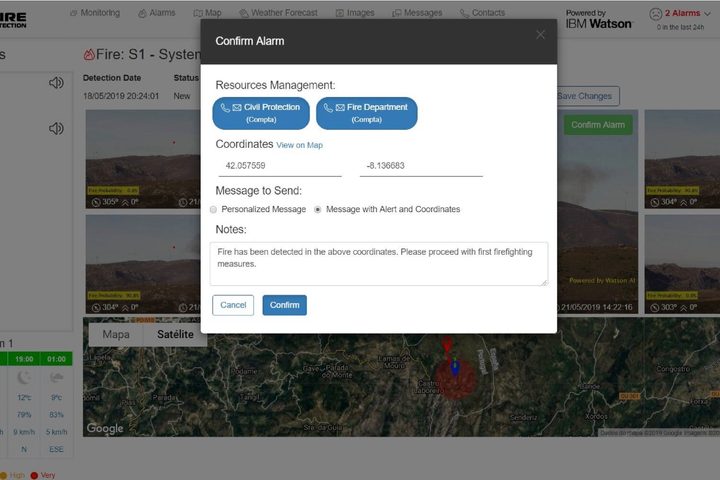
Image used with permission by copyright holder

This triple-pronged approach helps avoid potential false positives. While it’s certainly better to think there’s a fire when there isn’t than to miss an actual fire, false positives are still problematic. That’s because firefighters, alerted to a false blaze, could waste time and resources better spent elsewhere.

The system can also pull in weather data from the IBM-owned Weather Company to forecast how likely a fire is in a certain area and how a fire will spread if it does occur. This information can be extremely useful for making key strategic decisions.

“We’re living in a world of change,” Correia said. “With wildfire frequency having increased by 400% since the 1970s, the existing strategies simply were not working.”

Currently, Bee2FireDetection is up and running in Brazil and Portugal. As of now, it’s not being used in the United States, although the company just recently opened its first U.S. office.

Luke Dormehl
I'm a UK-based tech writer covering Cool Tech at Digital Trends. I've also written for Fast Company, Wired, the Guardian…
You can now buy a computer mouse controlled entirely by your tongue
Augmental has opened public sales of the MouthPad, and introduced a new wearable that lets you type hands-free.
Augmental MouthPad and Vox featured

Augmental first showed off its tongue-controlled MouthPad as a CES curiosity in 2024. Today, the device is a real product you can buy, with the company opening public US sales alongside a beta release of Vox, a companion wearable built to handle the typing half of Augmental's hands-free computing promise.

A retainer that doubles as a mouse

Read more
Yet another study says AI is bad for elections, and the rabbit hole gets worse
AI may be an election bomb waiting for someone to light the fuse
Voters cast their ballots on Election Day

Another election, another study has concluded that asking an AI chatbot for political guidance is a spectacularly bad idea. Research conducted during Hungary’s 2026 parliamentary election found that ChatGPT and Google Gemini offered not just inaccurate but also inconsistent and unreliable voting advice. The chatbots misclassified voter profiles, overlooked relevant parties, recommended parties absent from the ballot, and sometimes produced materially different answers when given the same information repeatedly.

AI keeps failing the voter test

Read more
Samsung’s humanoid robot ambitions are real, but factories come first
Samsung’s new robotics division has humanoids in its sights, although its immediate business is far more practical factory automation
Robot Touch Human Finger

Samsung wants a place in the humanoid race, but its new robotics push begins with machines built for factories rather than homes.

The CEO-led RX robotics division will initially focus on manufacturing robots. Samsung has separately identified humanoids as a priority, although it hasn’t announced a commercial model or explained where one fits into the division’s immediate plans.

Read more