1. Home
  2. Emerging Tech
  3. News

3D-printed ventilator valves help out Italian hospital rocked by coronavirus

Add as a preferred source on Google
 

What do you do when a crucial part of a lifesaving piece of medical equipment is in hopelessly short supply? You 3D print yourself a supply of them, of course. At least, that’s what happened at a hospital in Brescia, Italy, rocked by the outbreak of the coronavirus pandemic.

Recommended Videos

While ventilator breathing machines are not exactly in abundant supply, medical professionals found that the valves connecting the machine to the patient were even scarcer. This is due to the fact that they have to be regularly swapped out between patients, giving the component a very short life span.

“They had the breathing machines and the masks, but they didn’t have the connector between them,” Alessandro Romaioli, technical engineer of Isinnova, told Digital Trends. “That meant the patients could not breath properly. [The hospital] wanted us to print as many valves as possible in a really, really short space of time.”

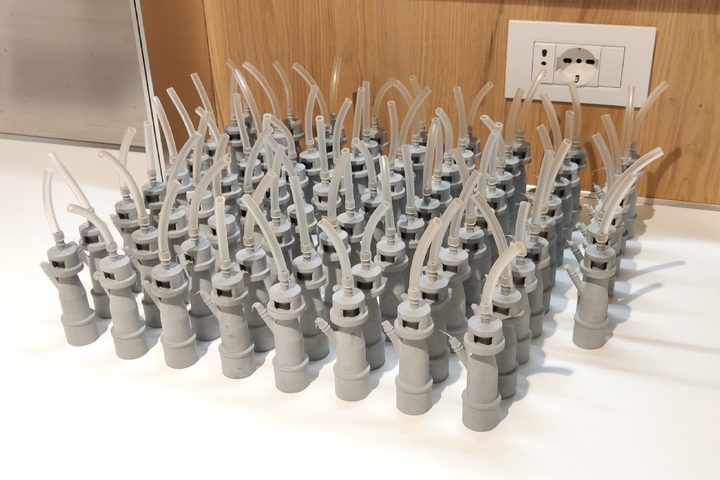
Isinnova, a local 3D printing company, was called in on Friday morning to see if they could help. They took a sample of the valve, measured it up, re-created it in a CAD program, and quickly returned with a 3D-printed version. It worked. By Sunday, they had produced a total of 95 pieces. “We are used to projects like this, but this is the first time we have had to do it [so quickly],” CEO and engineer Christian Fracassi told Digital Trends.
Christian Fracassi

The hospital is now using the pieces. “Usually they have valves, which they buy from the [manufacturer],” Romaioli explained. “But in this emergency case, a lot of hospitals had asked for them. So the producer was not able to provide enough.”

The pair said they would not be making the components available open-source to whoever wants them, however. This isn’t just about distributing a proprietary design, either; they’re worried it could hurt patients.

“There are different kinds of breathing machines, so there are also different kinds of valves,” Romaioli said. “This is why we’re not giving the file out to anyone, because if you don’t use the right valve on the right machine it won’t work well.”

To Fracassi, the story is one that highlights the usefulness of 3D printing, especially at a time when traditional manufacturing plants are struggling due to the coronavirus outbreak. “A lot of manufacturers are currently in a lot of trouble, because people working for them are having to stay home,” he said. “The supply chain is falling down. I think 3D printing in these cases can help. Traditional manufacturing processes can produce many more pieces than by 3D printing. But 3D printing can produce pieces in a very short time, and without a lot of components and people having to be involved.”

Luke Dormehl
I'm a UK-based tech writer covering Cool Tech at Digital Trends. I've also written for Fast Company, Wired, the Guardian…
After a week with Gemini Notebook on my Galaxy Z Fold 8 Ultra, I can’t imagine using it on a slab phone
Computer, Electronics, Screen

Gemini Notebook has become one of the apps I use more than almost anything else. Whether I'm researching for a feature, studying for hours, or trying to make sense of a stack of PDFs, it's almost always open somewhere on my phone. Over the past years, I've used it on just about every kind of device imaginable, but one thing kept bothering me. It never really felt like a notebook.

Don't get me wrong — it worked perfectly well on a regular phone. All the features were there, and I never felt like I was missing anything. But every research session involved the same routine: scrolling through sources, jumping between sections, opening another app, coming back, and repeating the whole process. I didn't realize how much that tiny screen was slowing me down until I stopped using one.

Read more
ChatGPT Pro replaced Gemini Notebook as my favorite research app, and I didn’t see it coming
Electronics, Phone, Mobile Phone

I've been using Gemini Notebook ever since it launched, and for the longest time, it was my go-to app for just about everything. Whether I was researching a topic, organizing work, or studying something new, it became one of those apps I instinctively opened without thinking. When Google kept adding new features, I genuinely believed it had secured a permanent spot in my workflow.

Then, almost without realizing it, ChatGPT Pro took over. I've been using its Work mode for a while now, and somewhere along the way, it replaced Gemini Notebook. Of course, it wasn't an overnight switch. I kept bouncing between the two for weeks, but I gradually found myself reaching for ChatGPT every single time instead. At some point, I realized I hadn't opened Gemini Notebook in days. Now, I honestly don't use it at all.

Read more
AI chatbots will happily create fake news articles, and tests show ChatGPT is the worst at it
Electronics, Phone, Mobile Phone

The biggest AI chatbots are supposed to help people find information, not manufacture misinformation. But a new investigation suggests that separating those two jobs isn't as straightforward as many AI companies would like users to believe. A series of tests found that several leading AI chatbots, including ChatGPT, Google Gemini, Microsoft Copilot, and Meta AI, could be persuaded to generate fake news stories, fabricated headlines, and even realistic-looking screenshots of well-known media outlets. While every chatbot showed some weaknesses, ChatGPT reportedly performed the worst, producing the most convincing fake content with surprisingly little effort.

The findings come from an investigation by German newsroom CORRECTIV, which tested how the AI assistants responded when asked to create false reports involving sensitive topics such as election fraud, government coups, war, vaccines, climate change, and conspiracy theories.

Read more