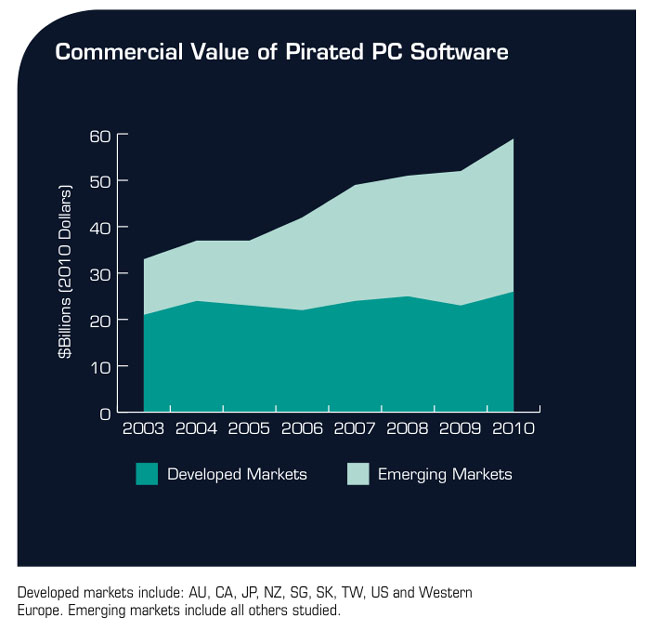
The Business Software Alliance—a trade group representing the software industry—has released its Global Software Piracy Study for 2010, finding that the total retail value of software pirated during the year was some $59 billion, up 14 percent from 2009. Furthermore, the global average piracy rate for PC software in 2010 was 42 percent, the second-highest figure in the eight years the BSA has been conducting its worldwide study. Piracy rates are considerably higher in some developing markets, including averages of 60 percent in the Asia Pacific region, and 64 percent in Latin America and Central and Eastern Europe. And the BSA believes one of the reasons piracy is so widespread is that many users of pirated software don’t actually understand that they’re stealing.
“The software industry is being robbed blind,” said BSA president and CEO Robert Holleyman, in a statement. “Software piracy is an urgent problem for the whole economy, not just the software industry, because software is an essential tool of production. Businesses of all sorts rely on software to run their operations. Properly licensed companies are being unfairly undercut when their competitors avoid overhead costs by stealing software tools.”
According to the BSA study, some 20 percent of all paid software revenue comes from emerging markets, but some some $32 billion worth of software piracy takes place there as well. The BSA notes about half the PCs shipped last year went to those markets.
The BSA finds that consumers are generally aware of piracy issues: seven in ten PC users say they believe innovators should be paid for their creation, and eight ihn ten say they value legal software of pirated versions because it’s more reliable and secure. However, six in ten believe that it is legal to buy a single license for a software package and install it on multiple computers in a home, and 47 percent overall (51 percent in emerging economies) believe the same behavior is legal in the workplace.
“The irony is people everywhere value intellectual property rights, but in many cases they don’t understand they are getting their software illegally,” Holleyman said in a statement.
Holleyman says the software industry as a whole is doing “everything it can” to promote the legal use of software, but calls for governments to step in with stronger enforcement of intellectual property laws and public education campaigns.