Windows 8 is a major release of Microsoft’s signature operating system. It not only represents Microsoft’s best chance of being seen as a market leader again, it will likely be the product that either assures or damns Steve Ballmer as CEO. I doubt even he could survive its failure. It is being underfunded (as has been consistent with products under his leadership), but given the team leading the effort, it probably won’t be incomplete.
In many ways, Windows 8 will define what Microsoft is, and whether it will remain relevant to those of us who don’t work in technology. Next week at Microsoft’s annual Build conference, we will get the first real impression whether Microsoft is going to be able to push back on what is increasingly becoming a post-Microsoft world. The question that will start to be answered is whether the company, from top to bottom, will step up or step out.
 Underfunding

At the core of Microsoft’s problem is Steve Ballmer, who has focused excessively on cost containment during his term as CEO. Of course, you could also argue he didn’t focus on it enough, because Mark Hurd pushed on costs even harder at HP, and financial analysts rewarded him for it until the board fired him for a variety of reasons. Not the least of which was that he crippled HP by massively overcutting costs.
This is a common problem when the visionary founder leaves a company. Founders will generally focus on the future vision for their firms, and if they make mistakes, may overfund a critical project because failure isn’t an option; they are deeply invested in the vision that created the company. It is not unusual for founders to take massive and seemingly unreasonable risks, to see a dream through.
But the people who follow a founder, and I think of both Steve Ballmer and Apple’s Tim Cook here, typically aren’t as invested in a vision that isn’t their own. They focus more on tactical financial measurements, so they aren’t criticized for not meeting their financial obligations. Typically it is because these new CEOs have been held tightly to metrics for much of their careers, and don’t understand that as CEOs, success is actually measured by how well the company stock does, not just how well they meet internal metrics. This seems to frustrate many of them when they get the job; it is as if the rule book they so painstaking learned isn’t relevant. And, in reality, there is no other job in a firm even remotely similar to that of a CEO.
I think this underfunding problem is so common and important that when I wrote “The 15 Secret Rules that Govern the Success or Failure of Tech Companies” I hit it twice in rule 2 and rule 14. A budget should be set based on what it will cost to be successful, not based on what you want to spend. What Microsoft appears to have budgeted is a fraction of what it typically would cost to change the growing perception that Windows and PCs are obsolete in a global market.
Product
While Microsoft would like us to measure Windows 8 on its merits alone, Apple has conditioned the market to look at the entire package. This package includes hardware, and that means the showcase hardware will need to compare favorably to the iPad. The market is also conditioned to think of the iPad as a derivative of the iPhone, not of the PC, and Microsoft is on a different path. The path Microsoft is on actually better anticipates where the tablet is going better than Apple’s does. The iPad is optimized as a consumption device, while the next generations of tablets will move them into the creation space, making them increasingly difficult to separate from PCs.
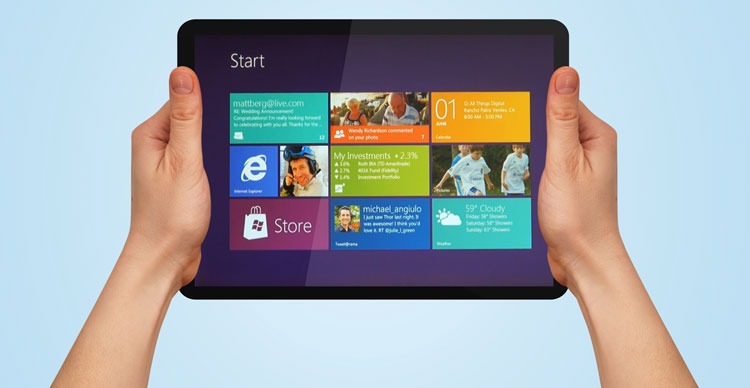
Microsoft is working to get there first, but if it can’t shift iPad-centric perceptions, it will likely be pounded more for the differences than praised for the advantages. This means designer will likely have to, at the very least, address weight, battery life, an app store, services, and the lack of a Genius Bar to assure a win.
It might actually be easier to position this as a next-generation tablet, because both Apple and Microsoft are working with the same core technology, suggesting that tradeoffs can’t be avoided.
iPad trends
I’m working with a number of large-scale enterprise vendors who don’t, themselves, have tablets or PCs. Folks like IBM and BMC are reporting a massive influx of iPads into their accounts, and both are working to put product interfaces onto iPads as a result. The iPad is becoming the replacement for the terminal in what is increasingly looking like a terminal (cloud-centric) world.
OnLive, the hosted gaming service, is working to make the iPad a better client, and there is even an initiative to put a full hosted Windows desktop on it. Taken collectively, this all seems similar to the push IBM gave Microsoft in the early days of DOS, and Apple is vastly more capable and powerful than Microsoft was back then.
In short, the iPad is trending to be the next PC-like device, and this is the first time since Windows came to market that Microsoft has not been the lead for the next desktop. This represents a risk that goes well beyond Microsoft’s CEO if it can’t be effectively countered.
Windows 8 will save or damn Microsoft
Microsoft has a number of keystone products. These are products that assure entire classes of other dependent offerings. Of their keystone products, Windows is the most important. From Windows, Microsoft’s tools, applications, even the company’s relevance springs. If Microsoft loses this fight, it’s done. It could continue on for years, but it likely will always be overshadowed by its former greatness and companies like Apple and Google.
It will be a crime if Microsoft fails due to underfunding or poor execution. We’ll know next week whether Microsoft, from top to bottom, will step up or step out.
Guest contributor Rob Enderle is the founder and principal analyst for the Enderle Group, and one of the most frequently quoted tech pundits in the world. Opinion pieces denote the opinions of the author, and do not necessarily represent the views of Digital Trends.