Despite the fact that I can run console-quality games on my Steam Deck, that’s not usually what I actually want play on the device. Instead, I’m always looking for smaller games that are better suited to the console’s portable nature — ones that won’t drain my battery in under two hours. I dug into Brotato earlier this summer and have been slowly making my way through Dave the Diver, but my latest handheld obsession is even smaller: a quirky indie puzzle game called Let’s! Revolution!
A debut game from animation studio Buck, Let’s! Revolution! is a clever little genre mash-up that I’m already losing hours to. It takes the basic rules of Minesweeper and combines them with a fantasy roguelite where the goal is to slay enemies and hunt down a dastardly king across a handful of tile-based maps. It’s a simple premise, but one that’s perfect for anyone looking for a great on-the-go experience delivered in bite-sized morsels.
Fighting tiles
Let’s! Revolution! unfolds in a standard roguelite fashion, with players working through a run while grabbing handy upgrades that’ll make them more powerful. Other than those staples, the gameplay is unlike anything I’ve seen in the genre before. It’s perhaps best described as a tactical puzzler where players need to use logic to navigate a board safely, predicting every danger before it happens.
To complete a “run,” players choose a character class and make their way through a series of 10 boards that increase in size and complexity each time. All tiles start face own, except for the first one players stand on at the start of a level. As players move from tile to tile to reveal them, they’ll see a number in the corner. That indicates how many road tiles are connected to that space (just like Minesweeper), and those are the only tiles that enemies can appear on. The optimal way to clear a level is to never bump into an enemy by accident, instead landing preemptive strikes on them before they’re revealed.
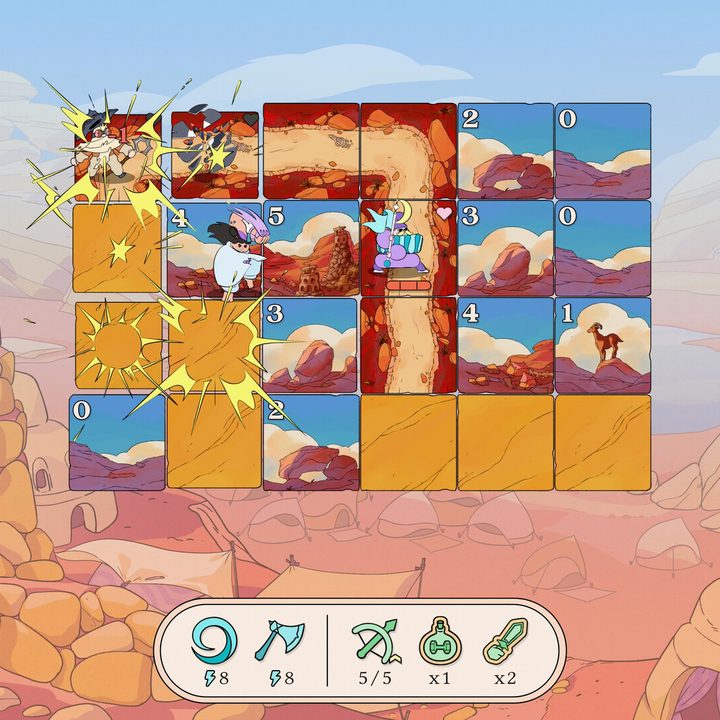
That loop builds on what makes Minesweeper so satisfying by implementing some clever combat hooks. I bought in on that right away when playing a round with my first character class, the Trooper. His primary hook is that he can execute a roundhouse kick that hits every tile surrounding the one he’s standing on. If I find myself on a tile that is connected to five roads, I know the odds are good that I’ll likely hit an enemy or two if I’m positioned right. Other weapons require different, but equally clever planning. When I buy a spear from a shop, I gain the ability to jab forward a few spaces, letting me anticipate how far forward that road might extend. Landing a hit thanks to my spatial reasoning is even more satisfying than diffusing a bomb.
There’s an extra layer of resource management on top of that, bringing in some more strategic considerations. Attacks and special moves cost energy, which the Trooper replenishes by flipping tiles. My roundhouse kick, for instance, costs a big chunk of energy, making it a risky attack. If I whiff, I’ll need to hunt for safe tiles to rebuild my energy before continuing to clear the board. Adding even more heat to the fire, all enemies attack on a timer once they’re revealed. If I accidentally flip one early but don’t have enough energy stored to attack, I’ll need to move carefully to restore my power and get back in time to attack before I take damage. Every single move or action matters, turning each board into its own combat puzzle.
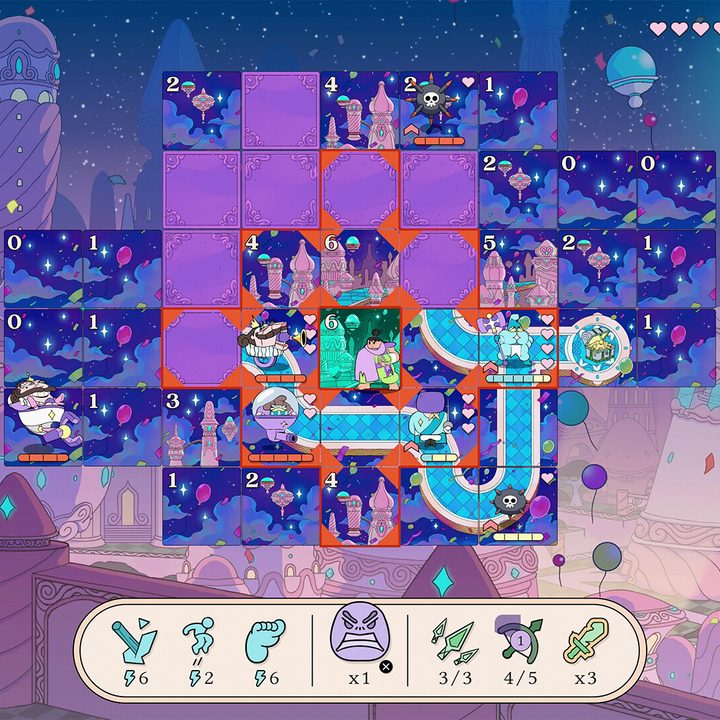
Here’s the twist, though: Everything I’ve just described is only one character class’ strategy. Each one completely changes the rules of play, making it feel like an entirely different game.
The Shadow class, for instance, is all about revealing as few tiles as possible. To win those runs, I’ll need to backstab unrevealed spaces and hide in smoke to flip the spaces around me back over. Then there’s the Oracle, whose skills are entirely built around deducing how many enemies are in a column and avoiding combat entirely, getting bonuses for flipping all non-road tiles on the board. On top of that, they can only regain energy by casting a spell that reveals a hidden enemy on the map. With five extra classes to unlock (and several new game+ challenges for each class), there’s a lot to work toward in a package that’s much larger than it initially seems.
I’m already hooked on those ideas, instantly making Let’s! Revolution! one of my new go-to Steam Deck titles. Its quick runs are perfect for those 10-minute stretches between work meetings or quick commutes. I won’t stop until I’ve snuffed out the king with each character class, like I’m planting red flags on every mine until my kingdom is safe from tyranny.
Let’s! Revolution! launches on July 19 for PC.