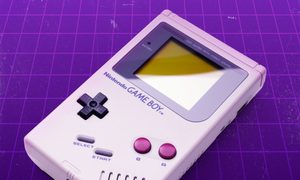
It took me visiting a Taito Station arcade in Japan to truly understand what makes arcades special.
I’ve always been infatuated with arcade-inspired games. I enjoy revisiting those classics and love learning about their history and importance to the game industry. By the time I was old enough to feel all that, though, arcades had died out in North America. I’m most familiar with arcades as part of larger establishments like Dave & Buster’s or bowling alleys rather than standalone entities. While I frequented Galloping Ghost Arcade when I lived in Chicago, that arcade put all of its games into free play and was more focused on preservation. That changed during my visit to Japan.
Last month, I was in Osaka to play the first five hours of Monster Hunter Wilds and tour Capcom’s headquarters. While I was busy with work for a lot of the trip, I knew I had to visit a Japanese arcade and did so before heading out for my flight back to the United States. I’m grateful that I took the time to do this because playing arcade games in their true, natural context gave me a deeper appreciation for their tactility and design philosophies than I ever have had before.
Prize games
The arcade I visited in Japan was Taito Station Osaka-nipponbashi. While Taito is an arcade brand that feels dead in the United States nowadays, several arcades bearing the Space Invaders creator’s name can be found around Japan. Like many buildings in Osaka, this Taito Game Station built into a space with more verticality than width. It squeezed right between two other storefronts but still stood out thanks to the arcade’s massive logo (which stuck out even behind some electrical wires) and many claw machines on the first floor.
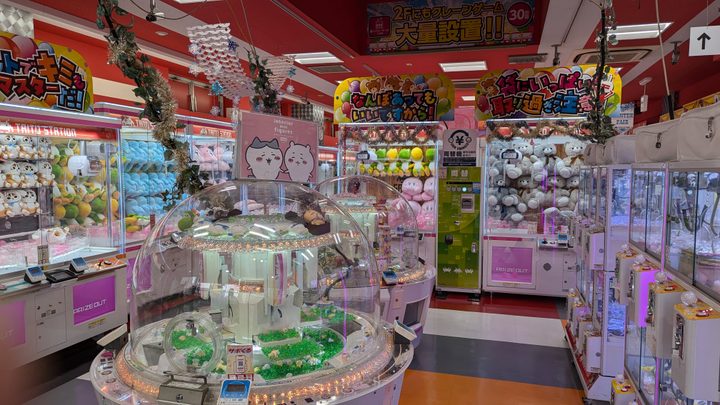
I strolled into this Game Station and exchanged some of my yen for coins I could put in any machine I wanted to play (typically costing between 100 and 300 yen). Like Mario trying to save Pauline from Donkey Kong’s clutches, I ascended up this building to get the complete Japanese video game arcade experience. The first floor and much of the second floor comprised “prize games,” known colloquially in America as claw machines.
I typically don’t spend much time on claw machines when I see them out and about, but these actually had some plushies I wanted. They held stuffed versions of popular Nintendo characters like Kirby and Yoshi, and there was even a smaller one themed around Suika Game.
Unfortunately, the claw gaming gods were not on my side and dropped the plushies I was trying to get every time, even when I thought I had a good grasp on them. It was time to move on and start playing some video games, although I’d go on to find that they felt just as intentionally designed to be experienced in an arcade setting as these prize games.
Taiko no Tatsujin
The middle floors of this arcade had more modern titles, but I was more drawn to the games with a tactile element. The standout to me on these floors was Taiko no Tatsujin. This is a rhythm game from Bandai Namco, and while I’ve enjoyed some free demos of its console games, the full appeal of Taiko no Tatsujin never felt very clear to me. That changed when I physically picked up drumsticks and beat a giant drum.
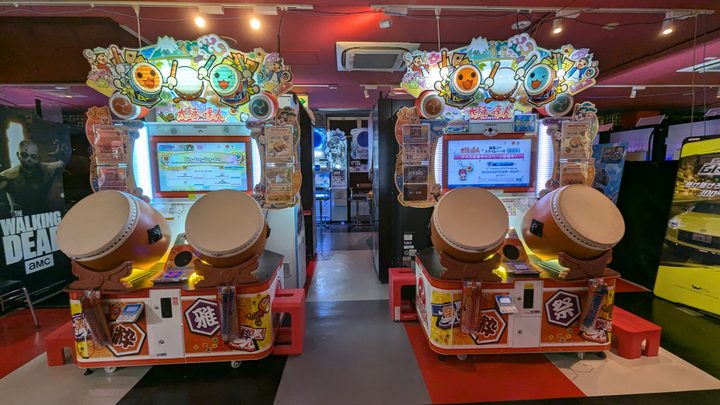
Even in a foreign arcade in a foreign country, there was a universal sensibility to hitting this drum to a rhythm. I quickly found myself in a flow state I rarely get into when playing rhythm games on consoles. While I prefer to play on consoles, controller designs and schemes have become fairly standardized. Playing Taiko no Tatsujin the way it was initially conceived to be experienced made me appreciate how, beyond light guns or steering wheels, arcades allow game developers to be more innovative and rethink how we interact with video games.
Nowadays, it’s unwieldy for a developer to release a video game with a proprietary controller for home consoles. The Guitar Hero craze dying out and the short lifespan of the toys-to-life fad proves this. There’s a lesson to be learned from games like Taiko no Tatsujin: Game developers should think about the “how” of the gaming experience just as much as the “what.” Retro arcade games had to constantly find ways to do this, whether that be just through graphical innovations like we saw in Atari’s Star Wars or the version of the first Street Fighter where players had to actually punch part of the cabinet to attack. Games like Taiko no Tatsujin keep that spirit alive.
Retro arcade games
Retro arcade games were my Pauline of this Taito Station. Reaching the top floor, I instantly spotted the decades-old arcade games that thrived during these establishments’ heyday. The first game I decided to play was Marvel vs. Capcom 2: New Age of Heroes. While I didn’t have anyone to play against, I felt more engrossed in playing a fighting game than I have in quite a while once I understood that it was my money on the line in these fights.
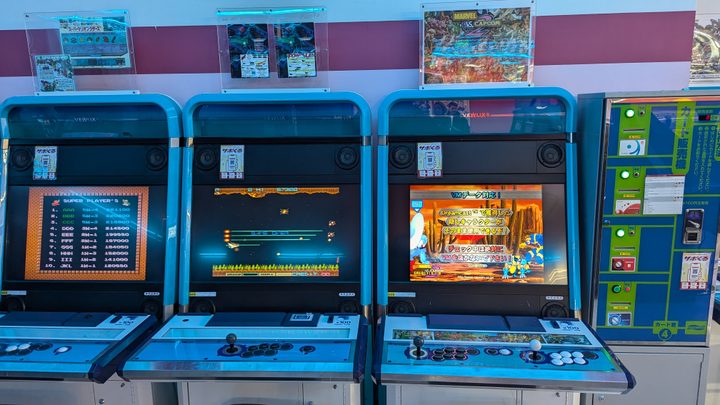
My team of Omega Red, Ruby Heart, and Sun Son got me through one victory, but I unfortunately fell to my next opponent. While Marvel vs. Capcom Fighting Collection is still the optimal way for most people to experience this game nowadays, playing Marvel vs. Capcom 2 in this way gave me a better understanding of the stakes that playing fighting games in an arcade came with.
A few cabinets down, another game piqued my interest: VS. Super Mario Bros. This is an arcade take on the Nintendo classic. The scoring system in Super Mario Bros. games never meant much to me, but seeing how it was utilized here to turn this single-player platformer into a communal arcade experience allowed me to view this classic from a new angle. Knowing that my score would be listed on a leaderboard along with others encouraged me to play better and is making me heavily consider picking up the Arcade Archives version of this game on Nintendo Switch.
I felt similar as I played more arcade games on this top floor, like Space Invaders, Donkey Kong, and Galaga. While I’ve played all of these through various collections throughout the years, this is the first time I played any of them in a proper arcade setting. Others had paid money to play these games before me, and I’m sure many others have already paid to do so after.
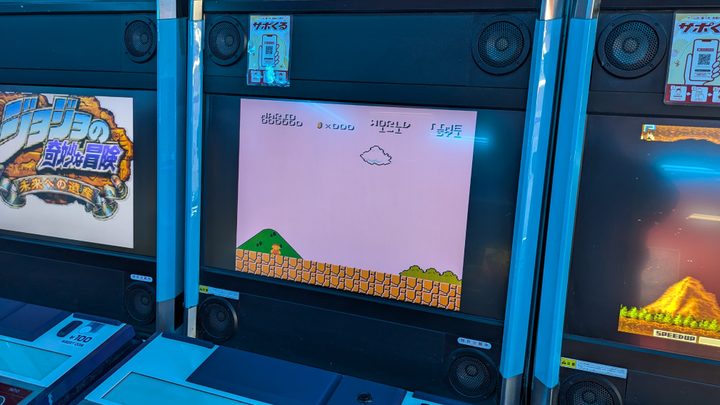
Unfortunately, this kind of gaming experience is so hard to properly find nowadays in the United States. Looking over and seeing DualShock 4 controllers hooked up to a Street Fighter 6 cabinet indicates that player preferences are shifting away from quirky, arcade-specific setups. I don’t know when I’ll be back in Japan again, so I savored the experience as I slowly walked down to the first floor, reflecting on what I played and looking at everything else I didn’t even have the time to try.
By seeing a Japanese Taito Station arcade in its full glory, I could fully understand why arcades were so beloved: They were social spaces that provided a variety of innovative gameplay experiences that felt specially tailored to that particular, noisy setting. Game developers shouldn’t forget that arcade magic.