1. Home
  2. Space
  3. Computing
  4. News

Amazon’s Kuiper satellite launch called off 30 minutes before liftoff

Add as a preferred source on Google
ULA's Atlas V rocket on the launchpad at Cape Canaveral in Florida.
ULA

Amazon is keen to get its second batch of internet satellites into orbit, but it won’t be happening just yet.

The launch of 27 Project Kuiper satellites was set to take place early Monday afternoon ET at Cape Canaveral in Florida, but just 30 minutes from liftoff, rocket operator United Launch Alliance (ULA) said it was standing down for the day “due to an engineering observation of an elevated purge temperature within the booster engine” on its Atlas V vehicle. In simple terms, this means part of the booster became too hot and needs to be investigated.

Recommended Videos

ULA said it will release a new launch date just as soon as one is decided.

The rocket had been due to launch last Friday, but poor weather conditions prompted mission planners to shift the date to Monday.

Similar to SpaceX’s established Starlink service, Amazon’s Project Kuiper aims to provide fast, affordable broadband internet to customers globally. It’s particularly keen to serve locations where fiber, cable, or cellular infrastructure is unavailable or unreliable, such as rural and mountainous areas, while the service could also play an important role in disaster zones — something that Starlink has done a number of times in recent years to support emergency and relief efforts.

The company plans to deploy a constellation of 3,236 satellites in low Earth orbit, which will be completed by 2029 at the latest. Before then, Amazon is aiming to launch a high-speed broadband service by the end of this year with around 1,000 satellites, though building the constellation over time will improve network performance and reliability for what the company expects to be a growing customer base. 

To deploy its internet satellites, Amazon has secured more than 90 rocket launches with a slew of spaceflight firms that include not only ULA but also ArianeGroup, Blue Origin, and even SpaceX, spending more than $10 billion in launch contracts.

Customers signing up to the Project Kuiper service will be able to choose from three types of user terminals: a compact 7-inch square model for portability (up to 100 Mbps), a standard 11-inch model for households (up to 400 Mbps), and a larger model for enterprises (up to 1 Gbps).

Amazon expects to sell its standard customer terminal for around $400 per unit, which would make it about $50 more expensive than Starlink’s terminal for residential customers.

Interested in watching the launch? Digital Trends has everything you need to know.

Trevor Mogg
Contributing Editor
Not so many moons ago, Trevor moved from one tea-loving island nation that drives on the left (Britain) to another (Japan)…
Space is becoming Bezos and Musk’s next data center site, and we have every reason to worry
The AI boom is coming for the night sky
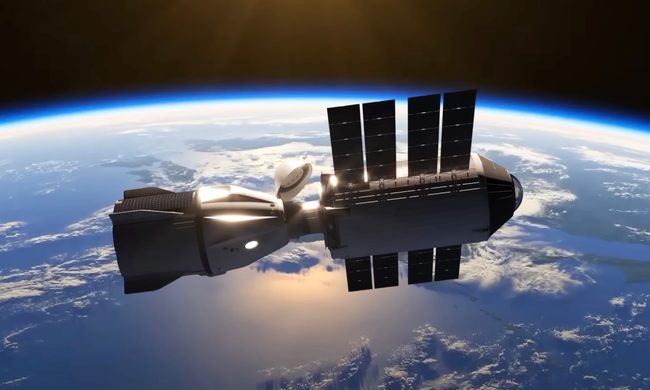
How Vast's space station will look in orbit.

AI data centers already consume vast amounts of electricity and water on Earth, so Silicon Valley has begun looking somewhere considerably more spacious... literally.

Elon Musk's SpaceX and Jeff Bezos' Blue Origin, along with several other companies, have proposed enormous constellations of satellites designed to operate as orbital data centers. However, environmental groups and former space officials are now warning that putting them into orbit at the proposed scale could have severe consequences for Earth's atmosphere and the night sky.

Read more
The first possible exomoon is here, and it makes our Moon look hilariously tiny
Scientists may have found the first exomoon, except this one is the size of Jupiter
This artist’s concept depicts a potential volcanic moon between the exoplanet WASP-49 b, left, and its parent star. New evidence indicating that a massive sodium cloud observed near WASP-49 b is produced by neither the planet nor the star has prompted researchers to ask if its origin could be an exomoon.

We have already discovered more than 6,000 planets outside of our immediate neighborhood. Yet, finding a moon orbiting one of those distant worlds has proved considerably harder. Astronomers may finally have something close to the real deal, but this particular object stretches the word “moon” almost beyond recognition.

Using the European Southern Observatory’s Very Large Telescope in Chile, researchers detected strong evidence for a moon-like object in the CD-35 2722 system. Further observations are still necessary to confirm the discovery, but it could become the first confidently detected natural satellite outside our solar system. There is still one tiny complication though. This moon is apparently massive.

Read more
China’s answer to SpaceX’s reusable rockets literally catches boosters in a net
SpaceX catches boosters on legs. China just used a net.
Ammunition, Missile, Weapon

SpaceX's playbook for recovering a rocket booster generally involves legs, a precisely controlled vertical landing, and either a concrete pad or a drone ship. 

China just managed to pull off something similar, but in a slightly different way, and on July 10, it tested the method as well.

Read more