
Runner rejoice! Scientists have created a temporary tattoo that can act as a battery and is charged by your sweat. It may sound gross, but this could be the solution to all our wearable charging woes.
Researchers at UC San Diego may not have intended to create a small biobattery, but that’s what they ended up with after experiments on a better way to read lactate levels took a different direction. Initially, the researchers wanted to find a way to measure lactate, the acid that builds up in your muscles when you exercise.
Related: Organic power: Nokia charges Lumia 930 with 800 potatoes and apples
When you exert yourself during tough exercise, your body is forced to create more energy once you run out of it. That energy creation process is called glycolysis, but it has a byproduct called lactate, which isn’t so great for your muscles. Scientists can measure lactate to analyze the progress of a workout. Before the experiment started, lactate levels could only be measured by blood tests, according to Phys.org.
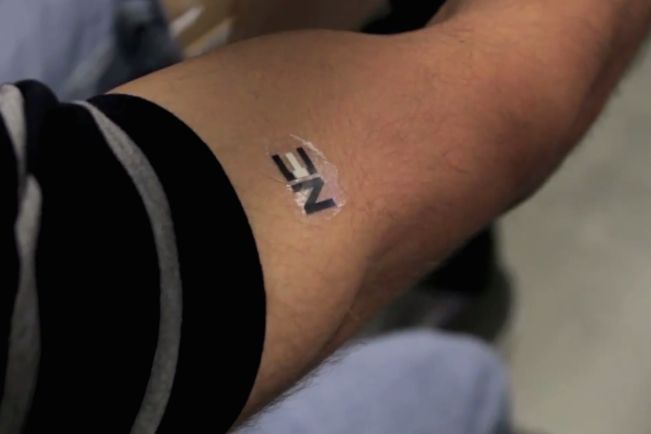
The researchers decided that since lactate can be measured in a person’s sweat, too, they would make a film to place on the users’ skin to measure the amounts of acid produced by various levels of exercise. They embedded a lactate sensor patch into a temporary tattoo, so that they could keep tabs on the acid without having to prick athletes with a needle.
Then, the scientists realized that during the process of measuring lactate, they had to remove electrons and doing so effectively made half of a battery cell. Once they realized that they were on to something great, the researchers added a cathode to complete the battery. After all, the anode already had the necessary enzyme to remove the electrons from lactate that can then be sent to the cathode, which contains a molecule that takes the electrons.
Related: Body heat harvesters, flexible screens, and more wearable tech revolutions
In a YouTube video explaining the process, UC nanoengineering professor Dr. Joseph Wang says, “We came up with this idea of harvesting energy from the body in a non-invasive manner.” The resulting prototype is what Wang calls”the first example of a biofuel cell that harvests energy from body fluid.”
Not only does the temporary tattoo offer battery power, it also tracks lactate levels, so users can tell how hard they’ve exercised. Currently, the researchers can’t get the tattoos to generate that much power, but they say they are working on increasing the amount, so as to power mobile devices and wearables in the future. Although it’s clearly just a prototype at this stage, the UC San Diego researchers appear to have stumbled across something with great potential.


