  1. Home
  2. Cars
  3. News

Tesla just found a way to make the Model S P100D even more ludicrous

Add as a preferred source on Google

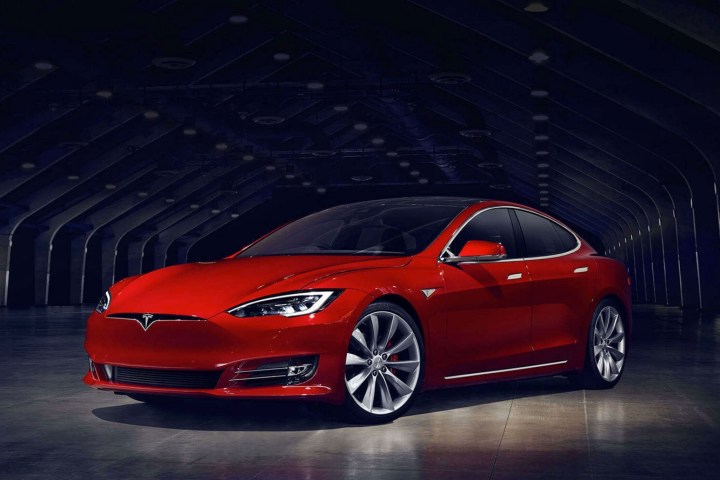
Tesla doesn’t have a lot to prove in terms of performance. The Model S P100D currently hits 60 mph from a stop in 2.5 seconds, a neck-snapping figure that makes it one of the quickest cars on the planet. That is more than fast enough, but company executives believe there is always room for improvement.

Tesla co-founder and CEO Elon Musk revealed on his Twitter account that starting in December, the Model S P100D will be capable of performing the benchmark zero-to-60 sprint in 2.4 seconds. The 0.1-second difference is hardly noticeable in real-world driving, but it cements the car’s spot as an electric family supercar capable of keeping up with a Bugatti Chiron in a race from a dead stop to highway speeds. The sedan’s quarter-mile time will also improve by a tenth of a second.

Recommended Videos

P100D owners will receive the extra power as part of an over-the-air software update that Tesla is finalizing. The car’s hardware will not change, meaning the sedan will continue to use a 100-kWh battery pack and dual motor all-wheel drive. Tesla has not revealed what effect — if any — the extra power will have on the 315-mile driving range.

Model X P100D owners will benefit from the same upgrade, though the crossover is a little slower than its sedan counterpart because it is heavier. Once the update has been installed, the X will be capable of accelerating from zero to 60 mph in 2.8 seconds. To put that figure into perspective, a Porsche 911 Turbo performs the same sprint in 2.9 seconds when it is equipped with the optional Sport Chrono package.

Musk has not revealed what else will be included in the over-the-air software update. It will be released nationwide in December, so we will not have to wait long to find out what other surprises the company has in store.

Ronan Glon
Ronan Glon is an American automotive and tech journalist based in southern France. As a long-time contributor to Digital…
A new AI model wants self-driving cars to think before they swerve
Forget guessing games, this self-driving AI actually shows its work.
Self driving car

Self-driving cars have gotten pretty good at driving. The harder problem is teaching them to drive safely in situations nobody planned for. We have heard horror stories of self-driving cars, behaving erratically in emergency situations, often times delaying first responders from reaching the scene.

A team at Seoul National University, led by professor Jun Won Choi from the Department of Electrical and Computer Engineering, thinks they have cracked part of that puzzle with a new AI model called SafeDrive. The research was recently selected as a highlight paper at CVPR 2026, a distinction that goes only to roughly 3% of all submissions.

Read more
Your next car’s software update could become its biggest security risk
Your next car could receive updates like your smartphone. That's also becoming a cybersecurity nightmare.
OTA technology allows manufacturers to remotely deliver software updates.

Modern cars are no longer machines that stay the same after they leave the showroom. Increasingly, they're becoming software-defined vehicles that receive new features, bug fixes, and security patches wirelessly, much like smartphones. But while over-the-air (OTA) updates have made vehicle maintenance easier and cheaper, cybersecurity experts are warning that the same technology could also become one of the automotive industry's biggest security challenges.

Researchers and policymakers are now calling for stronger oversight as connected vehicles become increasingly dependent on remote software updates. Their concern isn't just about hackers stealing personal data. It's about someone potentially interfering with the operation of a moving vehicle.

Read more
This sleek Chinese EV pairs supercar styling with three AI brains
The Xpeng L03 is an AI supercomputer disguised as a stylish family SUV
Xpeng L03

Xpeng’s latest electric vehicle carries enough processing power to make the term "smart car" actually sound more realistic than it actually is. The new Xpeng L03 debuted simultaneously in Europe and China on July 16, with the company presenting it across 65 markets. Available as a fully electric vehicle and an L03 Power X range-extender, the coupe-SUV is Xpeng’s most internationally focused model so far. Market-specific prices and sales dates remain unannounced.

Three AI chips and Google Maps built right in

Read more