1. Home
  2. Cars
  3. News

Tesla surprises both the fans and the haters by posting a profit in Q3

Add as a preferred source on Google

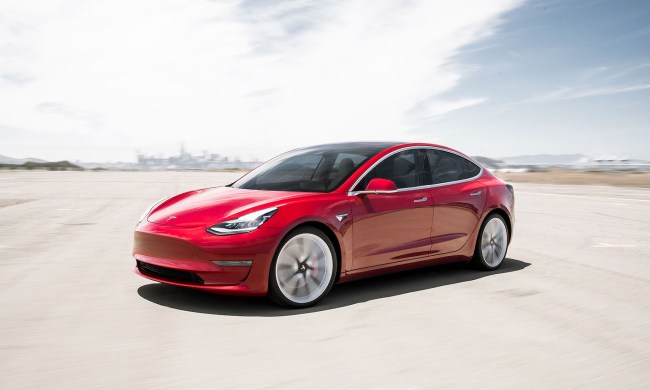
In the first half of 2019, Tesla lost 1.1 billion dollars — but in the third quarter of this year the company turned its fortunes around by posting a $143 million dollar profit. This was a surprise to even bullish backers of the EV company, and could mark the beginning of profitability for the firm. The news was relayed today when CEO Elon Musk held a Q3 earnings call with investors and customers.

During the call, Musk restated his pledge to sell more than 360,000 vehicles in 2019. That would require sales of 105,000 vehicles during the last three months of this year. Last month, Tesla reported that in Q3 it delivered 95,200 vehicles. This was a record for the company, and came in above Wall Street expectations. An increase of 10,000 or so vehicles seems like a small number, but still represents a significant increase for a company that put itself in “production hell” getting to those record numbers in the first place.

Recommended Videos

Today’s earnings and profit surprise marks two positive announcements in a row for the company, and investors are reacting by increasing the stock price by 18% to $299.41 in after-hours trading. Also buoying traders’ good feelings are the upcoming Model Y, the Tesla Truck, and the just-approved Chinese factory. This last bit of news will save Tesla a fortune in shipping costs and allow the company to quickly react to China’s fluctuating EV market.

In previous quarters, record deliveries of the Model 3 have led to lower profits because Tesla makes a smaller margin on its more affordable model. The Model S has always been the money-maker for Tesla, and its sales have not climbed anything like those of the Model 3. Today’s earning’s report hopefully shows that Elon and his managers have found a way to carve more profit out of the Model 3, or at least ironed out inefficiencies in production and delivery.

Adam Kaslikowski
Former Digital Trends Contributor
I don't have oil in my veins, but I do have it all over my carpets and clothes. Over my 10-year journalistic career, my…
Your next car’s software update could become its biggest security risk
Your next car could receive updates like your smartphone. That's also becoming a cybersecurity nightmare.
OTA technology allows manufacturers to remotely deliver software updates.

Modern cars are no longer machines that stay the same after they leave the showroom. Increasingly, they're becoming software-defined vehicles that receive new features, bug fixes, and security patches wirelessly, much like smartphones. But while over-the-air (OTA) updates have made vehicle maintenance easier and cheaper, cybersecurity experts are warning that the same technology could also become one of the automotive industry's biggest security challenges.

Researchers and policymakers are now calling for stronger oversight as connected vehicles become increasingly dependent on remote software updates. Their concern isn't just about hackers stealing personal data. It's about someone potentially interfering with the operation of a moving vehicle.

Read more
This sleek Chinese EV pairs supercar styling with three AI brains
The Xpeng L03 is an AI supercomputer disguised as a stylish family SUV
Xpeng L03

Xpeng’s latest electric vehicle carries enough processing power to make the term "smart car" actually sound more realistic than it actually is. The new Xpeng L03 debuted simultaneously in Europe and China on July 16, with the company presenting it across 65 markets. Available as a fully electric vehicle and an L03 Power X range-extender, the coupe-SUV is Xpeng’s most internationally focused model so far. Market-specific prices and sales dates remain unannounced.

Three AI chips and Google Maps built right in

Read more
A new sodium battery posts wild four-minute charging numbers, but don’t expect it in an EV yet
The breakthrough could improve fast charging and battery life, but the study hasn’t demonstrated those results in a production-sized pack
EV Charger

A new sodium-metal battery has posted a charging number that makes today’s EVs look painfully slow. In laboratory testing, the cell operated at a 15C rate, equivalent to completing a charge or discharge in roughly four minutes.

That doesn’t mean researchers plugged in an electric car and watched it fill up before the driver finished buying coffee. The result came from a small experimental cell using a new quasi-solid electrolyte, while the larger pouch-cell prototype delivered far less dramatic performance.

Read more