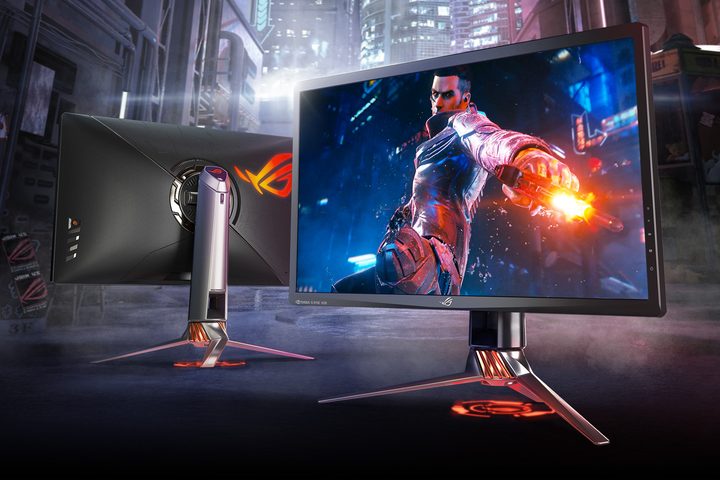
The Asus Republic of Gamers-branded Swift PG27UQ desktop display for gamers will finally ship in late June. But hold on to your seat for the price — it’s $2,000. For that amount, you can buy a decent gaming desktop or laptop, or even a large, curved 4K HDR TV for your entire family can enjoy.
Key specs
- Screen size: 27 inches
- Panel type: IPS
- Resolution: 3,840 x 2,160
- Typical brightness: 300 nits
- Max brightness: 1,000 nits
- Typical contrast ratio: 1,000:1
- HDR contrast ratio: 20,000:1
- Response time: 4ms
- Display colors: 1.07 billion
- Max refresh rate: 144Hz
The ROG Swift PG27UQ is based on Nvidia’s G-Sync HDR reference design originally introduced in January 2017 to launch in products toward the end of the year. That never happened, given both Asus and Acer delayed their products. But Nvidia said in March that it was confident solutions would launch by the end of April.
Nvidia’s design focuses on increasing four key areas: brightness, contrast, color gamut, and refresh rate. In the case of the new ROG Swift panel, it has a typical brightness of 300 nits but a peak brightness of 1,000 nits, qualifying it as a certified DisplayHDR 1000 product. It also has an HDR contrast ratio of 20,000:1 and a typical contrast ratio of 1,000:1, support for 1.07 billion colors, and a maximum refresh rate of 144Hz at a 3,840 x 2,160 resolution.
The display relies on an in-plane switching quantum-dot panel, meaning you get rich colors and wide viewing angles. The quantum dot aspect means the panel relies on nano-sized crystals that absorb and emit specific shades of color, depending on the size of their core. Ultimately, quantum dots provide “precise” colors whereas a color generated by a single pixel in a typical LCD panel will bleed into the color of a neighboring pixel.
“With local dimming, its LED backlight is dynamically controlled across 384 zones, providing very high contrast for richer, more natural-looking dark scenes,” the company says. “It can selectively turn LEDs on and off to create a wide range of dynamic luminance.”
The new display includes a built-in ROG Light Signal in its stand to display the logo on a wall or backdrop. There is also a Light Signature projection kit to create and customize light effects to beam on your desktop surface, such as an illuminated custom logo. The panel supports the Aura Sync platform so you can synchronize the illuminated logo with the colors and effects assigned to your other supported devices.
On the connectivity front, the new G-Sync HDR display includes one HDMI 2.0 port, a headphone jack, two USB-A ports, and one USB-B port that connects to your PC. It also provides a five-way OSD Navigation joystick to manage the settings and a built-in ambient light sensor that adjusts the brightness levels of the display based on your current lighting conditions.
If you think the ROG Swift PG27UQ is crazy expensive, it’s no different than the other monitor in the G-Sync HDR duo: The $2,000 Acer Predator X27. It’s out of stock on Newegg and won’t return until the beginning of June.