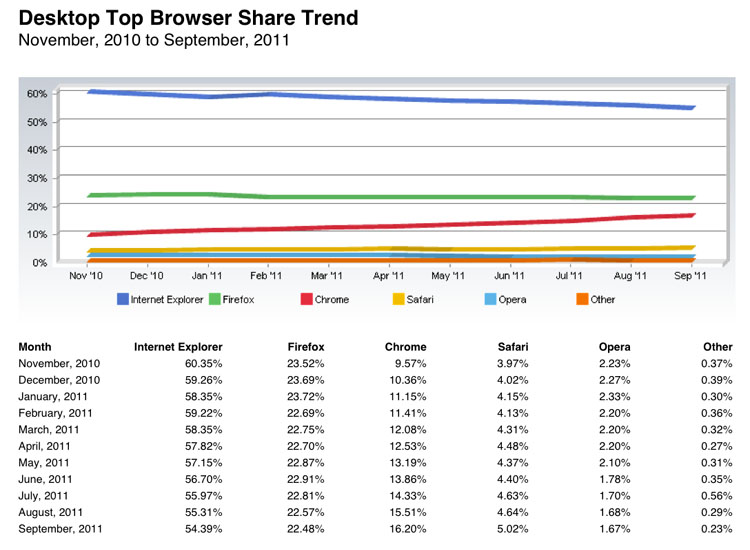
Microsoft has been pushing hard to encourage customers to adopt Internet Explorer 9 as their primary browser (or, at the very least, leave IE6 behind), but the effort seems to be meeting with a solid skepticism: Microsoft is seeing the global desktop browser share for Internet Explorer drop steadily, while Safari and (particularly) Chrome are seeing steady progress. According to Net Applications, Internet Explorer’s share of the browser market dropped almost a full percentage point in September to a new all-time low of 54.4 percent of the world market. And most of that loss went to Google Chrome, which picked up seven tenths of a percentage point to reach a new high of 16.2 percent.
If trends continue, Google Chrome could break the 20 percent barrier in early 2012. However, in an ironic move, Microsoft’s own Security Essentials product mistakenly identified Google Chrome as malware. Microsoft has apologized for the error, and says it impacted about 3,000 people.
Apple’s Safari Web browser also posted a four-tenths of a percentage point gain for the month, bringing its overall share of the browser market to just over five percent, the browser’s largest jump in recent memory. Firefox, however, continues to see its share of the browser market erode ever-so-slowly: Firefox lost almost one tenth of one percent from August to September, and now accounts for 22.48 percent of the browser market.
Within the universe of Internet Explorer, however, Microsoft does seem to be having some luck pushing users towards IE9. The number of users running IE9 increased from 7.91 percent in August to 8.72 percent in September, with IE8 and even IE6 seeing declines: IE8 usership dropped from 30.07 percent of the market to 29.91 percent, while IE6 dropped from 9.73 percent to 8.6 percent.
Microsoft also noted that if IE6 users in China were omitted from the figures, IE6’s worldwide usership drops to just 3.5 percent.
In China, nearly 29 percent of all Internet users are running Internet Explorer 6—in the U.S., the figure is about 1.4 percent. Microsoft maintains an Internet Explorer 6 Countdown site outlining progress towards putting IE6 in the refuse bin of software history: Norway, Finland, Denmark, Sweden, and now Poland are the only countries under 1 percent.