Computer maker Lenovo has unveiled a bevy of new systems for CES this year, including its new Y470 and Y570 notebooks that the company claims are the world’s fastest-booting Windows 7 PCs, going from power-on to the Windows desktop in under ten seconds thanks to Lenovo’s Enhanced Experience 2.0 for Windows—and SSD drives. The new systems also feature Intel’s second-generation Core processors (going all the way up to Core i7s) for powerful computing and entertainment options.
“We’re very excited about our latest lineup of IdeaPad laptops—they are the industry’s newest benchmark for consumer PC design,” said Lenovo VP for business operations Dion Weisler, in a statement. “We’ve enriched our portfolio with wow features such as sub-10 second boot times and sleek new industrial designs that deliver higher performance and a more compelling experience for consumers.”

The new Lenovo notebooks feature slim designs with brushed metal covers and raised textures to lend a modern look: under the hood, the Y570 and Y470 machines feature Nvidia GT 550M discrete graphics with 1 GB of dedicated video memory and Nvidia 3DVision support, but can switch over to power-conserving integrated graphics for ordinary computing tasks. The systems also feature Lenovo’s OneKey Theater II, which converts over to optimum AV settings with one touch. The systems will be available with either conventional hard drives or solid-state drives, but it’s going to be a while before customers can set hands on them: they should be available in May with prices starting at $899.99.
Lenovo is also rolling out a variety of new notebook models in its S-, V-, G- Z- and B-series. The B-series are aimed at being affordable home and small business systems that will sport up to second-generation Intel Core i5 processors; they should go on sale in April at prices starting at $499.99. Lenovo is also adding three models to its 21-mm thick V-series for home and office with Lenovo’s OneKey Rescue System for quick backup and recovery, along with optional fingerprint readers and a USB port locker to prevent unauthorized access to USB ports. Expect the V-series in April for prices starting at $599.99. The S-series are designed to be ultraportable, with 10.1-inch and 11.6-inch displays, chiclet keyboards, optional integrated 3G connectivity, and a selection of colorful case designs: they should land as early as March with prices starting at $329.99. The Z-series notebooks will feature eye-catching high-end exterior design powered by second-generation Core i7 processors, 13.3 to 15.6-inch screen sizes, optional Blu-ray drives, and premium sound, while the value oriented G-series will run from 14- to 17-inch screen sizes. Lenovo hasn’t revealed pricing or availability for the Z- and G-series; however, several models across Lenovo’s new notebook lines feature the company’s Enhanced Experience 2.0 for Windows 7 for fast boot times, quick shutdown, and enhanced multimedia.
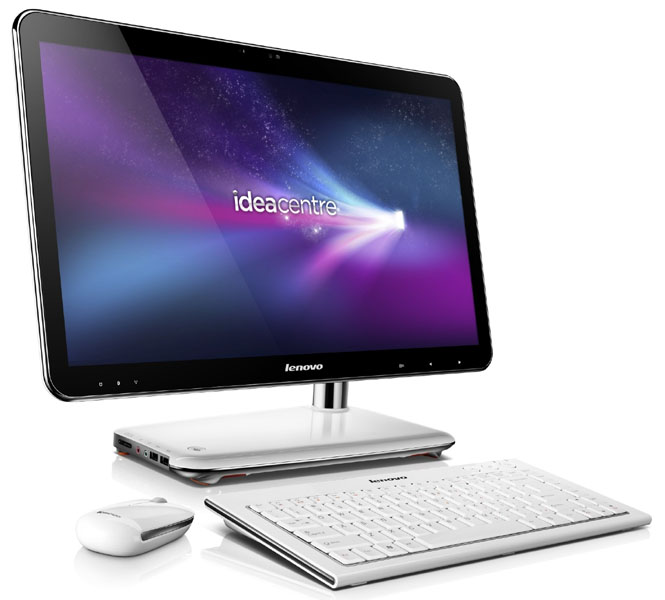
Lenovo isn’t just about notebooks: the company is also rolling out four new entries in its IdeaCentre line. The IdeaCentre B520 sports what Lenovo is calling the industry’s first “frameless” all-in-one design, along with a second-generation Intel Core i7 processor, a 23-inch capacitive touchscreen display with optional Nvidia 3D vision capability, and premium audio. The IdeaCentre A320 aims at home computing users with an 21.5-inch widescreen display, second-generation Core i5 processor, and features like HDMI input and a card reader for enjoying media from other devices. The IdeaCentre B320 will feature a multitouch HD display, a second-generation Core i5 processor, and “Hardware TV,” meaning that users won’t need to boot the computer to use the system as a television, and can switch between the two modes with a single button (or use both in a picture-in-picture configuration). However, both the B-series IdeaCentres won’t land until June (with suggested prices of $899 for the B520 and $699 for the B320), and Lenovo says the A320 will be priced at $699 but isn’t indicating when it will be available. The company will also be offering a $449 Lenovo C205 all-in-one as a low-cost, space-saving “info-tainment” PC for kitchens or other areas of the home: the C205 will be available with 720p HD capability (powered by AMD Radeon 6310 or up to AMD Radeon HD6000-series graphics) along with an AMD E-350 dual-core processor—but, again, no word on when consumers will be able to set hands on it.
Lenovo’s strategy with its notebook and desktop lines seems to remain focused on offering a broad selection of slightly-different models to meet the needs of different target markets—a plan made more complicated by Lenovo branching out from its traditional focus on business PCs to consumer-oriented systems. However, the broad range of options and configuration possibilities within product lines makes for confusing buying decisions. Although the dilemma is not unique to Lenovo, to succeed with any of these models Lenovo will have to rely on channel partners and marketing to clearly communicate to customers which options are right for them.