  1. Home
  2. Computing
  3. News

Digital Trends may earn a commission when you buy through links on our site. Why trust us?

Apple dips its toe into VR with the $30 View-Master headset

Add as a preferred source on Google

Holiday Gift Guide Banner
Image used with permission by copyright holder

This product was featured in our Holiday Gift Guide! Check it out to find gift inspiration for everyone in your life.

Recommended Videos

Last year, Mattel rebooted the classic View-Master toy as an affordable virtual reality headset, with support for Google Cardboard apps and compatibility with a wide range of different smartphones. Now, while Apple is allegedly hard at work on its own Virtual Reality ideas, the Cupertino company is selling the revamped View-Master headset on its website.

First spotted by Reddit user dbx001, the “View-Master Virtual Reality Starter Pack” is not only available to ship to your home address, but those interested can also pick it up at the store. When I personally tried to pick one up at a nearby Apple Store location, each store listed the item as “Available in about a week.” That means the View-Master may be making its way to Apple’s retail locations too, in addition to just the website.

Within the past few weeks, Apple has certainly demonstrated its interest in VR, albeit secretly, by bringing together a “large team of experts” to contrive both virtual and augmented reality projects from the privacy of its own offices. In fact, during a recent earnings call, Apple CEO Time Cook expressed his thoughts on Virtual Reality, declaring the technology “cool” and that it has some “interesting applications.”

While it might take some time before we see an iVR (Apple VR?) headset in the flesh, in the meantime you can enjoy a retro throwback, emended for the future for only $30 from Apple’s website.

To be clear, though, Mattel and its View-Master share no partnership affiliation with Apple. The View-Master works with a variety of smartphones aside from the iPhone. This is just a way for the company to make a few bucks off someone else’s product in order to appear competent against the likes of Google’s Cardboard or Samsung’s Gear VR. Nonetheless, it’s probably working, because I’ll be ordering mine just as soon as I finish writing this sentence.

Gabe Carey
A freelancer for Digital Trends, Gabe Carey has been covering the intersection of video games and technology since he was 16…
The Mac Pro nearly received an M3 Extreme chip twice as powerful as M3 Ultra
High production costs likely killed Apple’s M3 Extreme plans
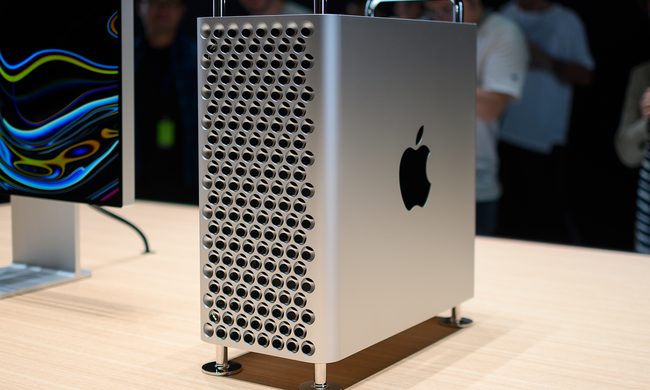
Apple's Mac Pro on a table at a press event.

Apple discontinued the Mac Pro earlier this year, ending a 20-year run for a computer that once represented the very best of the company’s desktop lineup. However, Apple reportedly had much bigger plans for the machine before ultimately replacing it with the Mac Studio.

According to Bloomberg’s Mark Gurman, Apple developed an M3 Extreme chip that could have offered twice as many CPU and GPU cores as the M3 Ultra. The processor was intended to sit above the Ultra tier and could have finally given the Mac Pro the performance advantage it badly needed. Apple eventually abandoned the chip due to concerns over production costs and limited demand for such an expensive machine.

Read more
Hidden prompts can secretly rewrite an AI’s memory, and researchers say that’s a serious problem
Researchers discover AI attack that rewrites an assistant's long-term memory
Chatbot on a smartphone.

Large language models are getting better at remembering us. Whether it's your preferred writing style, recurring tasks, shopping habits or project deadlines, AI assistants are increasingly storing long-term memories to make future conversations feel more personal and useful. But according to new research, that same feature could become one of AI's biggest security vulnerabilities.

Researchers from New Mexico State University have demonstrated a new attack called GhostWriter, capable of secretly planting false memories inside AI agents. Rather than stealing information outright, the attack manipulates what an AI remembers, potentially causing it to make dangerous decisions long after the original attack has taken place.

Read more
This experiment shows how easy it is to poison an open-weight AI model for under $100
This research raises new doubts about trusting open weight AI models.
Computer, Electronics, Laptop

Open-weight AI models have been having a moment lately. Just this month, Moonshot's massive Kimi K3 model landed close behind Claude Fable 5 and GPT 5.6 Sol in several benchmarks, all while remaining fully open-weight and downloadable by anyone.

However, Katie Paxton-Fear, a cybersecurity lecturer at Manchester Metropolitan University and staff security advocate at Semgrep, managed to poison an open-weight model and proved how easily that openness can be turned against you (via The Register).

Read more