It’s hard to think of anyone who would consider 2020 to have been a brilliant year. Things are a bit different in the robotosphere, however. In fact, the past 12 months have given us no shortage of examples of breakthrough robots.
Objectively selecting which robots have made the biggest impact in the past year is difficult (not least because many of them have been around a few years already, but gained additional momentum in 2020.) Nonetheless, we have come up with seven of the best new robot projects that Digital Trends covered in 2020.
Meet the robo-barber
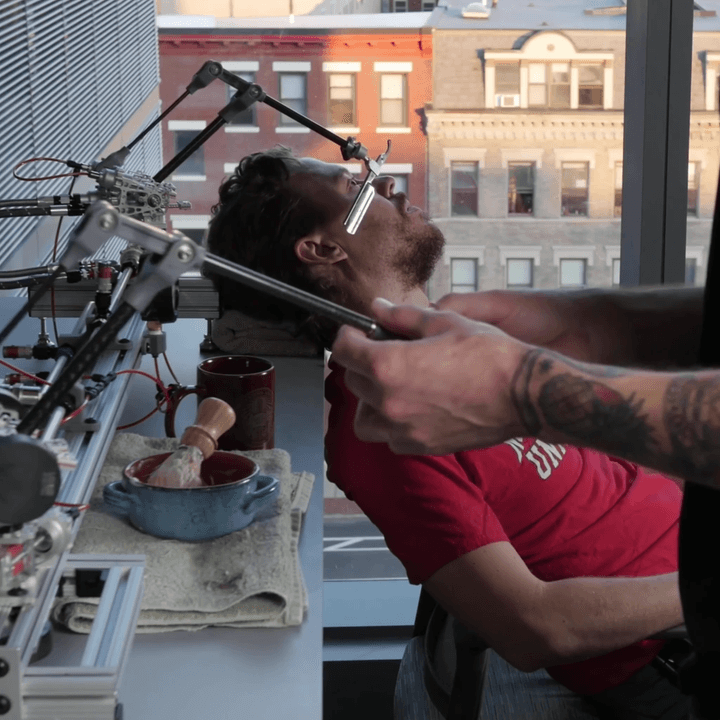
Most roboticists would tell you they have faith in their creations. But when push comes to shove (or blade comes to neck), it takes a certain kind of person to willingly receive a straight-razor shave from a robot. John Peter Whitney, assistant professor of mechanical and industrial engineering at Northeastern University College of Engineering, is just such a person — and, based on the evidence, he has every right to have that kind of superhuman faith.
“Straight-razor shaving is extreme in [its] demands,” Whitney told Digital Trends. “We require the ability to provide high stiffness in some directions and very low stiffness in other directions, and these directions are changing continuously as the position and orientation of the blade changes. In addition, we need the ability to have a fast ‘reflex’ to pull away if safety limits are violated. The only way to achieve this is to build a system in which every single joint is extremely light and extremely low friction.”
The TL;DR version? Whitney and Ph.D. student Evelyn Mendoza created a robot setup that allowed Whitney to be shaved by a robot that was remotely controlled by a barber. And amazingly, it didn’t end up looking like a scene from a Nightmare on Elm Street movie.
Robot tour guide
With museums and art galleries closed due to coronavirus this year, an enterprising gallery in the United Kingdom elected to continue letting visitors check out their exhibitions — by teaming with the Bristol Robotics Laboratory to offer real-time, Zoom-style guided tours with the aid of two-wheeled telepresence robots.
“Our initial idea was to help people who lived in places like care homes to have access to the gallery,” Will Barrett, communications and marketing manager at Hastings Contemporary, told Digital Trends. “When the pandemic first started to roll around, we thought it would be good to bring this forward and accelerate the use of it.”
Robot turbine inspectors
There’s a good chance you’ve never given too much thought about the best way to inspect and maintain wind turbines. The folks at BladeBUG have not only thought about it; they’ve built a freaking suction cup-equipped robot insect to help make it easier.
“This opens the door to autonomous inspection and repair of wind turbines, improving the efficiency of the blades and reducing risk for rope access technicians,” Chris Cieslak, founder and director of BladeBUG, told Digital Trends. “[Our robot] uses a patent-pending six-legged design with suction cup feet, which means each of the legs can move and bend independently. This is significant because it enables the robot to walk on the blade’s changing curved surface, as well as inside the blade, tower, or hub of the turbine.”
Disney’s freaky staring robot
The House of Mouse isn’t best known for scaring the bejesus out of people. So why exactly did it build a robot with glaring human-looking eyes staring out of a skeletal robot face complete with rows of gritted teeth in a lipless mouth? No, it’s not to haunt the dreams of anyone who wrote nasty things about the new Star Wars movies on the internet. Instead, it’s a piece of research that could one day result in more realistic animatronic robots for Disney theme parks.
“Eye gaze is a significant part of the interactions between people; quite a bit of information is conveyed through movements of the eyes,” Matthew Pan, a postdoctoral associate at Disney Research, told Digital Trends. “We wanted to try to emulate this communication on a robot by designing eye-gazing behaviors using principles of animation. We have layered these behaviors using a subsumption architecture proposed over 30 years ago by Rodney Brooks to create complexity and realism.”
Robot masseuse
After the year we’ve all had, who wouldn’t welcome a relaxing massage? And what with social distancing and all, we might just have to make do with the masseuse in question being a tad on the robotic side. Created by researchers from the U.K.’s University of Plymouth, this robot masseuse is built using the KUKA LBR iiwa robotic arm.
The arm can be taught a variety of motions, with joint torque sensors that let it detect contact and reduce the levels of force and speed instantly. Because no one wants a massaging robot that, like some kind of aromatherapy candle-smelling Terminator, won’t stop, ever, until you’re relaxed.
“If the force sensor of the robotic arm detects a force value we defined in advance, the entire system will stop working,” Chunxu Li, lecturer at Plymouth’s School of Engineering, Computing and Mathematics, told Digital Trends. “In addition, the stiffness value of each joint of the robotic arm can be set in the interactive interface to ensure the output of force.”
All hail the robo-omelet maker
Once you’re up from your robo-massage, wearing your monikered robe and a pair of comfy slippers, what could be better than chowing down on an omelet, made just the way you like it? (By a robot of course.) Created by researchers from the U.K.’s University of Cambridge, this omelet chef robot can do everything from cracking the eggs to shaking the salt and pepper containers to handling the frying pan to plating up a finished dish. This involves an assortment of challenges in robot manipulation, computer vision, sensing, and human-robot interaction.
“We did this project as [a] collaboration with kitchen appliance company Beko to [explore] the future of kitchens and the use of robots in this context,” Fumiya Iida, a researcher from Cambridge’s Department of Engineering, told Digital Trends. “There are many ways these technologies can be exploited for commercial products in the near future — from intelligent kitchen appliances [to] assistive technologies for elderly [people and those with disabilities.]”
Robot dolphin
Without diminishing the great conservation work many zoos do, keeping animals in captivity purely for the benefit of a viewing public seems, well, kind of wrong. What’s the answer? According to San Francisco-based engineering firm Edge Innovations, the answer is robot animals. With that in mind, Edge has developed an 8.5-foot long, 550-pound robot dolphin that can swim for up to 10 hours on a single charge, and looks and acts almost eerily like its real-world inspiration. It can operate in either autonomous “exhibition” mode or a “show” mode in which it’s controlled using a joystick.
“A woman in the audience ran out of the pavilion, through an emergency exit, setting off an alarm, and used her cell phone to call the Orlando [Florida] police and the Orlando SPCA, the Society for the Prevention of Cruelty to Animals,” Roger Holzberg, creative director at Edge Innovations, told Digital Trends, concerning an early robot dolphin test run. “[She told them] that Disney had put a real dolphin in the Living Seas Pavilion, that they had bolted a camera to its head, ran a wire to it, and put it in a costume — and that someone needed to come down there now and arrest people for cruelty to this animal.”
Believe it or not, things have gotten significantly more advanced on the robot front since then.