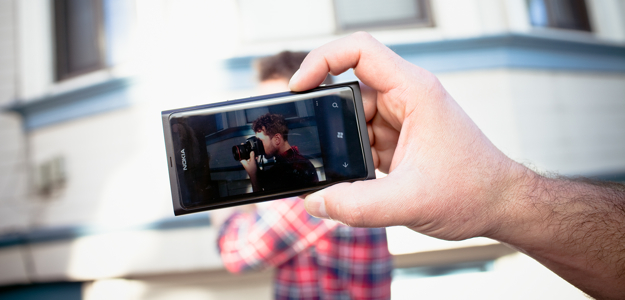
 You know that moment when someone famous walks down the street and there’s a sudden pandemonium? You want to snap a picture of said famous person, then all of a sudden some super tall guy gets in your way and just won’t budge. Not only is he blocking your view, now you can’t Instagram whatever it was you wanted to show off. In most circumstances, this would end with you looking over at the person perfectly placed to get the ideal shot with a mixture of dejection and jealousy. So what if you could just use their phone’s camera to get a shot for yourself?
A new system called CoSync aims to make that kind of inter-device sharing possible. Created by a team at the Massachusetts Institute of Technology led by Eyal Toledano, CoSync is a software that allows multiple mobile devices to link up via Bluetooth or Wifi, and offer users the ability to share features of each device from camera to microphone or similar inputs.
In a test carried out by Toledano using a prototype system, six different phones were linked and controlled by one “master” device. That master device sent a signal to all six phones, telling them use their camera flash on a specifically timed instance so that all angles were evenly lighted and the final picture avoided overexposure. The result was compared to pictures taken with a single device, and was judged to have outperformed each one in terms of lighting and final photograph. Such timed multiple flashes, Toledano explains, could also be used to avoid red-eye in photographs in future.
In a separate test, multiple phones placed around two people throwing a ball back and forth managed to capture a series of staggered images that, according to a report in New Scientist, allowed Toledano and his team to “recreate the ‘bullet time’ effect pioneered in the film The Matrix.”
The benefits of the CoSync technology are clear; they’ll allow for the quicker dissemination of information and experience, especially for smaller, more intimate events where only a few would have the chance to experience what was happening otherwise. The potential use of the technology as a security system or way to keep track of a fast-moving event is also there…
Still, as with most sharing innovations, there is a potential for abuse with CoSync. After all, this is essentially TeamViewer for mobile devices, albeit within certain parameters; Allowing remote access for laptops and desktop systems has opened virtual doors for hackers to hijack the computers in question. If you open your phone’s camera up to other people to use, would it really be that much of a surprise if they started taking pictures or recorded sound of things you would rather keep private?