 For almost as long as there has been an Internet, there have been jokes (and, to be fair, legitimate concerns) about the perils of diagnosing your health via the Web. Without the expert hand of a medical professional to guide you, you would find yourself at the mercy of too much information and likely to jump to wrong conclusions as a result (Let’s face it, that headache might be the first sign of a deadly brain tumor – we just don’t know). But what if there was a way for the Internet to dispense good advice that’s pertinent to the topic at hand? And, even more unexpectedly, what if that way was the result of crowdsourcing?
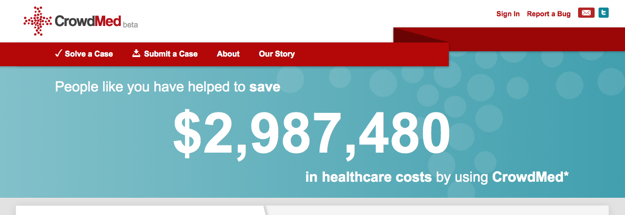
CrowdMed, a solution that launched April 16 at the TedMed conference in Washington, D.C., aims to fill that particular need. The service will offer potential diagnoses of diseases online by allowing members of the CrowdMed community – open to anyone, regardless of their background or medical training – to examine the details of a particular case, including symptoms and patient history before making a diagnosis.
That diagnosis is then weighed against the diagnoses of other members of the community, with the three most popular diagnoses eventually being passed to the patient as a guide to a final result. Patients are suggested to use the top three as a matter for discussion with their physician, presuming that the patient wouldn’t just use the top three in place of a visit to their physician. Still, that seems like an odd tactic; after all, if they were planning on going to the doctor in the first place, why ask the Internet for a guide to what could be wrong?
This idea of crowdsourcing medical information is a simple one that gains a new dimension with the addition of a points system that will reward those who make the correct diagnosis; such points will then act as a sign of credibility when future diagnoses are made by those users.
The idea definitely has legs; in 20 early test cases, the correct diagnosis was amongst the top three selections of around 700 participants. One of those test cases managed to correctly identify within a week a real life illness that “traditional” medical methods of trial and error had taken three years – and more than $100,000’s worth of insurance claims – to name. “To get an answer in just a week is exciting, astounding and incredibly frustrating,” said Sarah Sheridan, the patient in question. “I keep thinking, ‘Where were you three years ago?’ It really would have changed the course of my life.” Let’s hope this is way better than WebMD forums and Yahoo! Answers.
Editors' Recommendations
- Mysterious drone tells New Yorkers to socially distance during pandemic
- Wild new ‘Trojan horse’ nanoparticle clears your arteries by gobbling up plaque
- Sphero’s new mini robot kits hone your STEM and soccer skills
- Your smartphone could be the key to predicting natural disasters