1. Home
  2. Emerging Tech
  3. News

Digital Trends may earn a commission when you buy through links on our site. Why trust us?

Playing ‘Pokémon Go’ with a drone is the most 2016 thing ever

Add as a preferred source on Google

We defy anyone to come up with a tech concept that is more quintessentially 2016 than DroneMonSpy. A bit like the first time you heard about selfie sticks, DroneMonSpy is so perfectly pitched to today’s obsessions gone slightly mad that it could almost be an episode of Charlie Brooker’s Black Mirror.

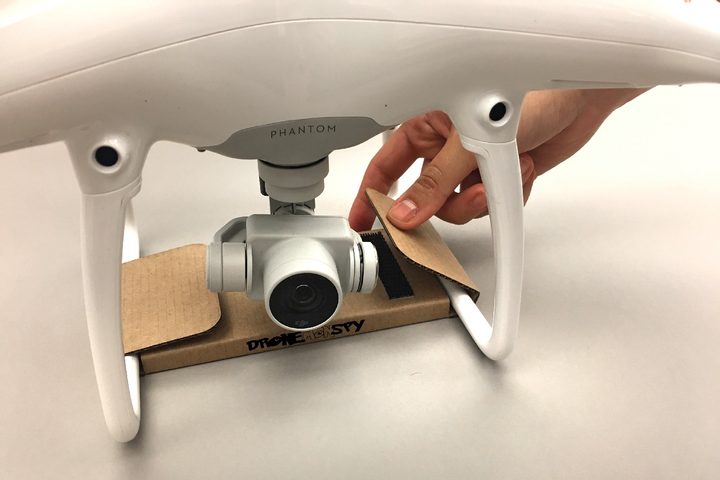
The elevator pitch is basically this: If you love everything about Pokémon Go except for that whole pesky exercise thing, DroneMonSpy is a universal adapter that lets you attach your smartphone to a DJI Phantom drone, and then fly it around searching for Pikachu and his chums. Right now it’s available for pre-order through creator company Atellani’s website, priced just $9.99.
003
Image used with permission by copyright holder

“DroneMonSpy quickly attaches to the landing gear of your DJI drone using lightweight cardboard and industrial-strength Velcro,” Agnese Accordino, strategic designer at Atellani, told Digital Trends. “By using DroneMonSpy to safely attach your phone to a drone you can quickly and effortlessly find Pokémon and hatch eggs by simply flying around your drone.”

Recommended Videos

Accordino said that the concept arose when people working for Atellani noticed Reddit users posting about simple ways to strap their phones to drones using tape or other insecure methods. “The crude manner in which phones were being attached meant that they were susceptible to causing damage to both devices,” she continued.

The fact that DroneMonSpy is made of cardboard, with two foldable openings to hold your smartphone, means that it isn’t the most rugged of constructions — although it’s certainly more secure and easy-to-mount than alternative options. To get it up and running, you launch Pokémon Go on your phone, pair it with a screen sharing tool like TeamViewer, and then attach it to your DJI Phantom by way of DroneMonSpy.

Easy, right? With that taken care of, you’re then free to focus 100 percent of your attention on wild Pokémon and the tiny matter of catching ’em all …


Luke Dormehl
I'm a UK-based tech writer covering Cool Tech at Digital Trends. I've also written for Fast Company, Wired, the Guardian…
Anker just exposed a big problem with portable power stations
Appliance, Device, Electrical Device

When you're shopping for a portable power station, there's one number that's almost impossible to ignore: battery capacity. A 2 kWh battery should give you roughly 2 kWh of usable power, right? Unfortunately, things aren't quite that simple. Anker SOLIX has published new efficiency data for its S Series portable power stations, and it's putting the spotlight on something that doesn't get nearly as much attention as capacity: how much of the energy stored inside the battery actually makes it to your devices.

According to Anker, portable power stations are commonly advertised with efficiency figures measured under relatively heavy loads, where they can reach roughly 89% to 92% efficiency. But that's not necessarily how most people use one during an outage. Think about what you'd actually plug in. A Wi-Fi router might sip power continuously, a refrigerator switches its compressor on and off throughout the day, and a CPAP machine could run overnight. Together, those devices may draw just a fraction of what a large power station is capable of supplying. And that's where efficiency can start slipping.

Read more
OpenAI’s first gadget sounds like a tiny expressive AI companion
The device will have a doughnut-shaped body, built-in cameras, and moving parts
OpenAI press image

For months, reports have suggested that OpenAI’s first hardware product would be a screen-free smart speaker designed to act more like an AI companion. We already knew it could understand its surroundings, be carried around the home, and proactively help users. A new Bloomberg report now gives us a clearer picture of what the device may actually look like.

As per the report, OpenAI’s first gadget will be shaped like a doughnut and measure about the same size as a hockey puck. You will be able to carry it between rooms or leave it nearby on whatever surface is convenient. The device is expected to be on the expensive side, as the company has pondered pricing it around $300 to $400. A release is currently planned for 2027.

Read more
Google Antigravity just built an AI translator that works without the internet
Electrical Device, Switch, Robot

Google has shown off a new AI project that could make language barriers a little less intimidating, and it doesn't need an internet connection to do it. The company has introduced the Gemma Translator, a compact prototype built in collaboration with Antigravity. Unlike most AI translation tools that rely on cloud processing, this device runs entirely offline using Gemma 4 E2B, Google's lightweight open model. Everything happens locally on the device, making it both portable and independent of an internet connection. The prototype is powered by a Raspberry Pi 5 and includes a microphone and speaker inside a custom 3D-printed enclosure, creating a self-contained translator you can carry almost anywhere.

AI translation, without the cloud

Read more