  1. Home
  2. Emerging Tech
  3. News

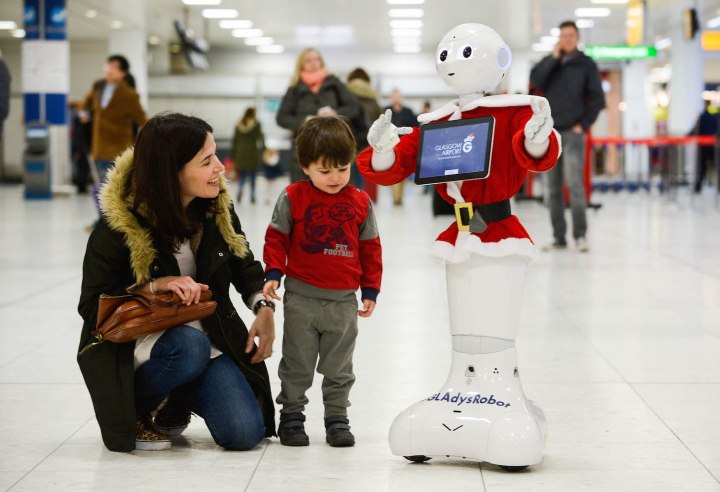
An android is entertaining passengers at a Scottish airport

Add as a preferred source on Google

Geneva airport has Leo. Amsterdam has Spencer. And now Glasgow has Gladys.

We’re talking robot assistants, in Glasgow’s case an all-singing, all-dancing android that in reality is Pepper in a Christmas suit.

Recommended Videos

Gladys, who’s believed to be the first robot used by a U.K. airport, rolled into the departure lounge for the first time this week to entertain travelers as they wait for their flights.

In the run up to Christmas Day, the “humanoid robot airport ambassador” will sing and dance to various festive songs, among them Santa Claus is Coming to Town and everybody’s favorite, Rudolph the Red-Nosed Reindeer.

She’ll also keep younger passengers entertained by regaling them with a number of seasonal tales such as ‘Twas the Night Before Christmas and Santa’s Workshop.

Passenger response to Gladys will be monitored by the airport’s operator to help it explore how interaction with customers can be further improved through the use of digital technology. As long as no one does anything like this to Gladys, the airports android project should be a success.

The airport is clearly keen to make the most of modern tech to help keep passengers and visitors informed and entertained. In 2015 it launched Holly the Hologram at different locations throughout the facility, with the virtual assistant continuing to offer a range of advice to travelers.

“We’re always looking for new and innovative ways in which we can further enhance customer experience at Glasgow and believe the introduction of Gladys to be a first for a U.K. airport,” Glasgow airport’s Mark Johnston said.

In recent years, an increasing number of airports have been exploring how robots can work for them. Besides Gladys and the other two mentioned at the top of the article, we’ve also borne witness to this rather crude effort at Indianapolis airport, as well as this more advanced android introduced at Tokyo’s Haneda airport in September.

Trevor Mogg
Contributing Editor
Not so many moons ago, Trevor moved from one tea-loving island nation that drives on the left (Britain) to another (Japan)…
Anker just exposed a big problem with portable power stations
Appliance, Device, Electrical Device

When you're shopping for a portable power station, there's one number that's almost impossible to ignore: battery capacity. A 2 kWh battery should give you roughly 2 kWh of usable power, right? Unfortunately, things aren't quite that simple. Anker SOLIX has published new efficiency data for its S Series portable power stations, and it's putting the spotlight on something that doesn't get nearly as much attention as capacity: how much of the energy stored inside the battery actually makes it to your devices.

According to Anker, portable power stations are commonly advertised with efficiency figures measured under relatively heavy loads, where they can reach roughly 89% to 92% efficiency. But that's not necessarily how most people use one during an outage. Think about what you'd actually plug in. A Wi-Fi router might sip power continuously, a refrigerator switches its compressor on and off throughout the day, and a CPAP machine could run overnight. Together, those devices may draw just a fraction of what a large power station is capable of supplying. And that's where efficiency can start slipping.

Read more
OpenAI’s first gadget sounds like a tiny expressive AI companion
The device will have a doughnut-shaped body, built-in cameras, and moving parts
OpenAI press image

For months, reports have suggested that OpenAI’s first hardware product would be a screen-free smart speaker designed to act more like an AI companion. We already knew it could understand its surroundings, be carried around the home, and proactively help users. A new Bloomberg report now gives us a clearer picture of what the device may actually look like.

As per the report, OpenAI’s first gadget will be shaped like a doughnut and measure about the same size as a hockey puck. You will be able to carry it between rooms or leave it nearby on whatever surface is convenient. The device is expected to be on the expensive side, as the company has pondered pricing it around $300 to $400. A release is currently planned for 2027.

Read more
Google Antigravity just built an AI translator that works without the internet
Electrical Device, Switch, Robot

Google has shown off a new AI project that could make language barriers a little less intimidating, and it doesn't need an internet connection to do it. The company has introduced the Gemma Translator, a compact prototype built in collaboration with Antigravity. Unlike most AI translation tools that rely on cloud processing, this device runs entirely offline using Gemma 4 E2B, Google's lightweight open model. Everything happens locally on the device, making it both portable and independent of an internet connection. The prototype is powered by a Raspberry Pi 5 and includes a microphone and speaker inside a custom 3D-printed enclosure, creating a self-contained translator you can carry almost anywhere.

AI translation, without the cloud

Read more