1. Home
  2. Space
  3. Emerging Tech
  4. News

Meet the new rocket from Jeff Bezos' Blue Origin — the enormous New Glenn

Add as a preferred source on Google

The space race is on, and it’s taking place in the private sector. Forget the United States and Russia — it’s really Jeff Bezos and Elon Musk who are competing for dominance off the planet. And now, Bezos has made the latest move, introducing the New Glenn, the future rocket of Blue Origin.

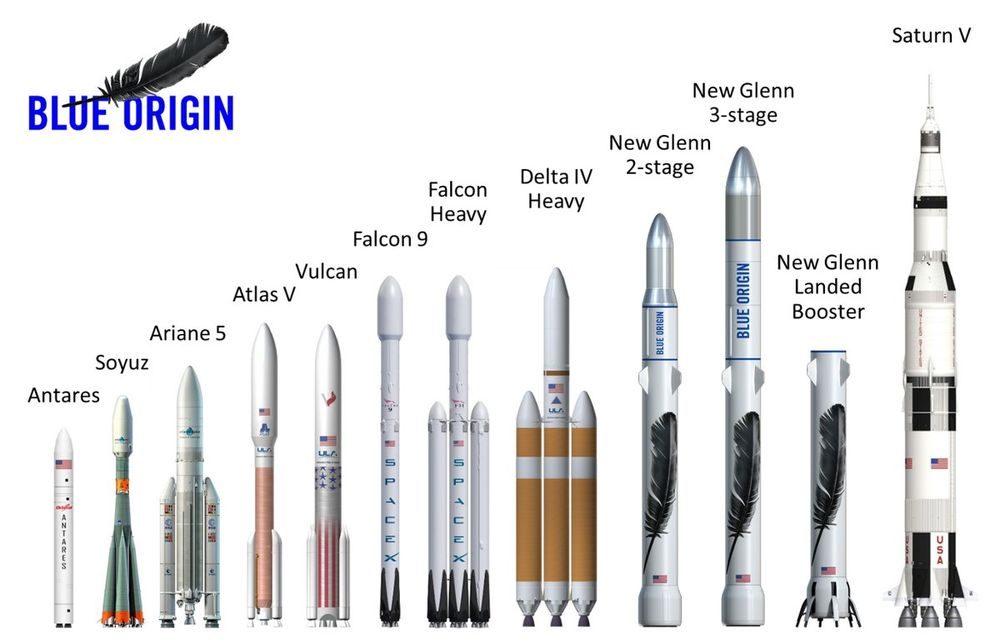
Boasting the capacity to send both payloads and people into the beyond (that is to say, outer space), the New Glenn takes its name from famed astronaut John Glenn, the first American to orbit Earth. And as per newly unveiled images of the New Glenn, this space ship is going to be nothing shy of a monster.
new-glenn-blue-origin
Image used with permission by copyright holder

Appearing to be the biggest rocket since the Saturn V, which NASA used several decades ago in the late 1960s and early 1970s, the New Glenn will reportedly measure 23 feet in diameter and range between 270 and 313 feet high. The discrepancy is dependent upon whether the rocket has one or two upper stages atop it — should there be only one, the New Glenn would be capable only of reaching lower Earth orbit. With both upper stages, however, people and satellites can go considerably further.

Recommended Videos

It’s quite the statement for Blue Origin, which was the first private company to send a rocket into space and successfully recover it on Earth in a vertical landing (though technically, it didn’t go that far into space — just 100 kilometers above Earth’s surface). Since then, however, most space headlines have involved SpaceX and Elon Musk’s impressive achievements beyond our planet. But the latest rocket from Bezos is looking to shake things up.

The New Glenn will far surpass its predecessor’s achievements, though it still doesn’t necessarily have the thrust to go as far as, say, SpaceX’s Falcon Heavy. Whereas Blue Origin’s new rocket will have about 3.85 million pounds of thrust, the impending Falcon Heavy (though smaller than the New Glenn) will boast around 5 million pounds of thrust.

“Our vision is millions of people living and working in space, and New Glenn is a very important step. It won’t be the last of course,” Bezos wrote in an email announcing the rocket. “Up next on our drawing board: New Armstrong. But that’s a story for the future.”

Lulu Chang
Fascinated by the effects of technology on human interaction, Lulu believes that if her parents can use your new app…
Space is becoming Bezos and Musk’s next data center site, and we have every reason to worry
The AI boom is coming for the night sky
How Vast's space station will look in orbit.

AI data centers already consume vast amounts of electricity and water on Earth, so Silicon Valley has begun looking somewhere considerably more spacious... literally.

Elon Musk's SpaceX and Jeff Bezos' Blue Origin, along with several other companies, have proposed enormous constellations of satellites designed to operate as orbital data centers. However, environmental groups and former space officials are now warning that putting them into orbit at the proposed scale could have severe consequences for Earth's atmosphere and the night sky.

Read more
The first possible exomoon is here, and it makes our Moon look hilariously tiny
Scientists may have found the first exomoon, except this one is the size of Jupiter
This artist’s concept depicts a potential volcanic moon between the exoplanet WASP-49 b, left, and its parent star. New evidence indicating that a massive sodium cloud observed near WASP-49 b is produced by neither the planet nor the star has prompted researchers to ask if its origin could be an exomoon.

We have already discovered more than 6,000 planets outside of our immediate neighborhood. Yet, finding a moon orbiting one of those distant worlds has proved considerably harder. Astronomers may finally have something close to the real deal, but this particular object stretches the word “moon” almost beyond recognition.

Using the European Southern Observatory’s Very Large Telescope in Chile, researchers detected strong evidence for a moon-like object in the CD-35 2722 system. Further observations are still necessary to confirm the discovery, but it could become the first confidently detected natural satellite outside our solar system. There is still one tiny complication though. This moon is apparently massive.

Read more
China’s answer to SpaceX’s reusable rockets literally catches boosters in a net
SpaceX catches boosters on legs. China just used a net.
Ammunition, Missile, Weapon

SpaceX's playbook for recovering a rocket booster generally involves legs, a precisely controlled vertical landing, and either a concrete pad or a drone ship. 

China just managed to pull off something similar, but in a slightly different way, and on July 10, it tested the method as well.

Read more