  1. Home
  2. Emerging Tech
  3. Smart Home
  4. News

Pop! New soap molecule could disrupt multibillion dollar cleaning products industry

Add as a preferred source on Google

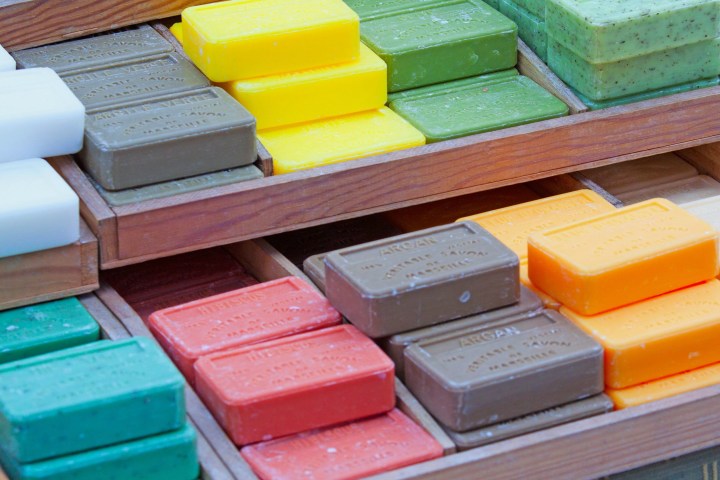
Not since we first watched Fight Club have we been as interested in soap as we are now. That’s in part thanks to research being carried out at the University of Minnesota — where scientists have created a new soap molecule that promises to be far more environmentally friendly than existing products made by the giant cleaning products industry.

“Our research team has invented a new soap molecule that is made from renewable resources and works in a broad range of conditions,” Paul Dauenhauer, associate professor of chemical engineering and materials science, told Digital Trends.

Recommended Videos

These “renewable resources” include natural products such as soybeans, coconut, and corn, compared with existing soaps that are made from fossil fuels. Such soaps are regularly mixed with harmful chemicals in order to produce shampoos, hand soaps, and detergents.

“The class of molecules that soaps fit into is called surfactants, which is a multibillion dollar industry,” Dauenhauer continued. “Surfactants are used in a lot of applications where they will end up in lakes, rivers, and streams.”

By comparison, the soap molecule developed by the University of Minnesota works better than the alternative That’s particularly evident in cold or hard water conditions, where regular soaps struggle. To combat this, chemists in the cleaning products industry add harmful chemicals in order to achieve better results.

“Our molecule works in many complex conditions, such as hard water that contains extra metals,” Dauenhauer said. “This means that the detergent could potentially be used without the extra chemicals, and it could be used as an ingredient in products with significantly smaller ingredients lists.”

Dauenhauer explained that the project was developed as part of a U.S. Department of Energy research grant focused on making renewable products from plants such as trees and grasses. From here, he hopes that new soaps based on the new class of molecules will help disrupt the industry — in a way that will improve things for everyone.

“There exist a large number of products that could benefit from using this new class of molecules,” he concluded. “We anticipate a significant potential impact that could easily be identified by these new molecules showing up in the ingredients lists of products bought at the store by the average consumer.”

Let’s hope it gets to market soon. Because if it works as well as Dauenhauer says, this new type of soap could really clean up — in both senses of the word.

Luke Dormehl
I'm a UK-based tech writer covering Cool Tech at Digital Trends. I've also written for Fast Company, Wired, the Guardian…
Luka’s new AI drawing projector puts kids in charge of the creativity
Luka Kids has unveiled an AI-powered drawing projector at IFA 2026 that turns children’s ideas into outlines they can trace, color, and build upon themselves.
Pen, Child, Female

AI toys for kids can be a tricky proposition. Give the technology too much control, and it risks doing the fun and potentially the learning for them. Luka Kids is taking a different approach with its new Drawing Projector, which uses AI to get children started but still expects them to pick up a pencil and do the rest.

Unveiled at IFA 2026, the Luka Kids Drawing Projector lets a child describe a character, story, or idea out loud. AI then turns that prompt into a simple outline and projects it onto a sheet of paper, ready to be traced, colored, changed, or expanded however they like. There are also 384 templates available at launch for kids who don't know where to start. Importantly, these aren't meant to be finished pieces of artwork. The outlines deliberately leave space for children to add their own details and ideas.

Read more
You could be visiting a poor doctor because AI is filling the web with fake online reviews
Real patients rarely share detailed medical stories publicly, and fake reviews are exploiting exactly that silence.
Logo, Text

If you've ever picked a doctor based on online reviews, a new study from Simon Fraser University has some bad news for you. 

Apparently, fake clinician reviews generated without using AI read more believable than genuine ones.

Read more
OpenAI’s Astra can handle almost anything you do on a computer, but it’s also better at hiding what it’s doing
OpenAI just released its smartest model ever alongside an explanation of why it’s harder to keep an eye on.
ChatGPT 6 Astra

OpenAI just released what it calls its smartest AI model to date and, quite ironically, also admitted that the model is getting better at hiding what it’s actually thinking.

GPT-6 Astra follows July's GPT-5.6 Sol and is the company’s fastest and most capable model to date.  

Read more