  1. Home
  2. Gaming
  3. News

Nintendo Labo: VR Kit brings cardboard-assisted VR games to Switch

Add as a preferred source on Google
Image used with permission by copyright holder

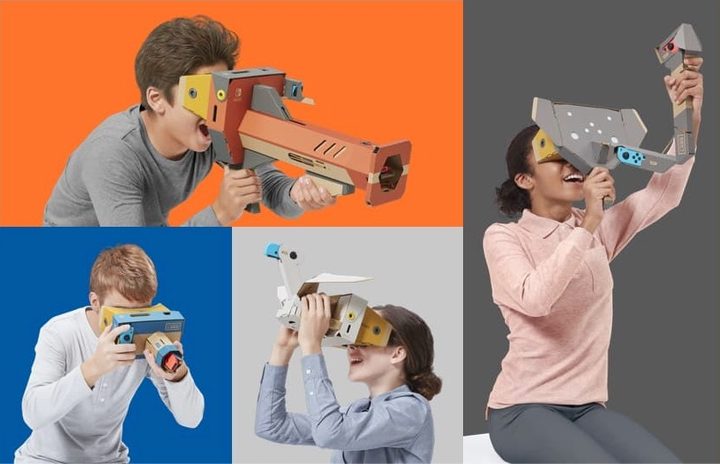
Nintendo is entering the virtual reality market — sort of. Announced seemingly out of nowhere on Twitter, Nintendo is releasing Nintendo Labo: VR Kit, the fourth in the studio’s line of DIY cardboard Switch peripherals. The VR Kit launches in stores and online April 12.

The full VR Kit costs $80 and comes with six Toy-Con builds:

  • VR Goggles
  • Blaster
  • Camera
  • Elephant
  • Bird
  • Wind Pedal
Recommended Videos

Alternatively, you can purchase a starter kit for $40 that comes with the VR Goggles and Blaster builds. After buying the starter kit, you can then grab expansion sets separately. The first expansion set comes with the Camera and Elephant builds, and the second contains the Bird and Wind Pedal.
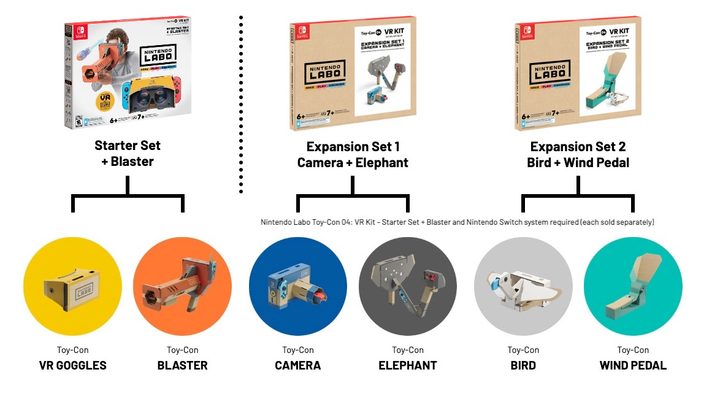
Image used with permission by copyright holder

The software included with each build hasn’t been revealed, but one can presume that the Blaster build is some kind of shooting mini-game. Perhaps the bird lets you take the perspective of a flying seagull, and the elephant lets you spew water from your trunk.

What is clear, however, is that you’ll have to insert the Nintendo Switch console into each cardboard docking station and hold it really close to your face. Major companies specializing in VR often state that the technology isn’t safe for young children. For instance, the PlayStation VR’s recommended age is 12 and up, while the Oculus Rift has a 13-and-up warning. In the fine print on Nintendo’s website, it states that you can turn off the VR images in the settings and it suggests doing so for children under the age of six.

Perhaps the age discrepancy between the major VR movers and shakers and Nintendo comes from the difference in hardware. Naturally, Labo VR won’t offer the same immersive and intensive experience of high-end headsets. The Switch’s screen resolution maxes out at 720p, which isn’t exactly ideal for a full-fledged VR experience.

Nintendo has been long known as a company that isn’t afraid to create what some would deem head-scratching products. This is the company that created Virtual Boy, after all. And its last dedicated handheld system, the Nintendo 3DS, offered stereoscopic 3D without glasses.

That said, we’re certainly intrigued by the VR Kit. We enjoyed our time with the Variety Kit and Robot Kit when they launched last year and the Vehicle Kit offered more engaging games to play once the builds were completed.

Nintendo Labo: VR Kit launches April 12. In the meantime, you can pick up any of the first three kits, which are on sale for $40 right now.

Steven Petite
Former Digital Trends Contributor
Steven is a writer from Northeast Ohio currently based in Louisiana. He writes about video games and books, and consumes…
Roblox’s AI Build tool wants to make game development as easy as texting
Just describe your idea, and Roblox's AI will help turn it into a playable game.
Roblox

Roblox is turning 20 soon, and it's marking the occasion with a new way to make games without writing a single line of code. The platform's whole pitch has always been that anyone can be a creator, not just professional studios. Now, with millions of daily users, Roblox is finally bringing that power straight to your tablets and phones.

What exactly is Build?

Read more
This gaming mouse has a Noctua fan inside, and it finally has a launch date
Pulsar’s Noctua-cooled gaming mouse finally launches on July 21
Pulsar Feinmann F01 Noctua Edition mouse in hand

More than a year after its Computex 2025 debut, the Pulsar Feinmann F01 Noctua Edition gaming mouse is finally ready to launch. Sales begin through Pulsar’s online store on July 21 at 4 p.m. KST, although pricing has not yet been announced.

We also saw the mouse at Computex 2026, where it appeared much closer to a finished retail product. Its defining feature remains the tiny Noctua fan built into the shell, designed to push air toward your palm during long gaming sessions.

Read more
Gaming against AI could make you more confident with real teammates
Turns out getting beaten by bots wasn't the worst thing after all
Representative image of mobile gaming

Artificial intelligence is often blamed for making people less social. Whether it's AI replacing conversations, reducing teamwork, or making gaming feel less human, the narrative has largely remained the same. But a new study suggests the opposite could also be true. In fact, AI might be quietly encouraging people to spend more time with their friends.

Researchers studying PUBG: Battlegrounds have found that introducing AI-controlled opponents into multiplayer matches didn't isolate players. Instead, it made them more confident, kept them playing longer, and even encouraged them to squad up with friends more often. The findings, which will appear in the journal Information Systems Research, offer an interesting perspective on how AI can improve user experiences rather than simply automating them.

Read more