You’ve been searching for months and have finally decided which 4K TV you’ll be buying for the living room. Rest assured — the hardest part (picking a TV) is over, but there’s still work to do. With a new TV comes picture settings to tweak, additional accessories to buy, and in the case of 4K displays, specific content to purchase, download, and watch. For all your new-TV needs, we’ve put together this how-to guide for getting the absolute most out of your big-screen investment.
Further reading:
TV location

The first thing to ask yourself is: Where is your TV going to go? If you’re wall mounting your TV, a cable and power management kit is a great way to make that install look clean. It helps you route your cables and power from near the floor, up through the wall to where your TV is mounted.
Some entertainment spaces will have natural constraints based on their size, but you should take time to think about the distance from your TV. Distance correlates to the size of your TV and is especially important for 4K TVs, as you want to be close enough to appreciate all those extra pixels but not too close to miss the action or get eyestrain. There are different schools of thought on this, but if your TV is around 50 inches (this is where 4K really starts to shine), then you should be between 6 and 10 feet away. By the time you get up to 65 inches, you should be between 8 and 13 feet away … and so on. If you are upgrading from an HDTV in the same spot, you may want to arrange your space so you’re sitting a bit closer now.
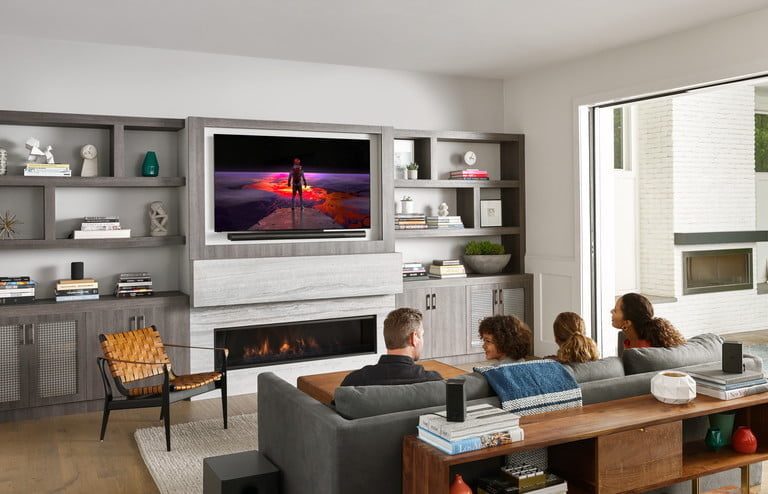
It’s also important to think about height. You generally want your TV level with your eyes. This is one reason we don’t recommend putting a TV above a fireplace — it’s often too high for easy viewing and can cause neck strain, among other problems. Sit at different parts of the room to see where a good eye-level position is. If people in your home often watch TV standing up or sitting on bar stools, etc., then a higher placement is a good idea.
TV protection and safety

If you are setting your TV on a stand, we recommend securing it so it doesn’t tip over by accident. Whether it is a stray pillow hitting the TV or, worse, an earthquake, having a security strap is good protection against unknowns.
Finally, if you don’t already have one, we recommend a surge protector or power strip to plug all your expensive electronics into. These not only let you plug everything into one place but will also protect your gear from electrical spikes and surges.
If you’ve got the cash to spend, certain surge protectors will even monitor the voltage feeding in and out of your home theater system. If the protector detects an unhealthy amount of juice coming in, it’ll automatically power down your tech to avoid your tech meeting an early grave. Brands like Panamax may run a bit more than you’d expect from a surge protector, but with additional features like noise filtration and powered USB ports for charging phones and tablets, there are plenty of benefits to be had.
TV connections

Next question: What are you hooking up to your new TV? Do you already have a cable box, antenna, gaming console, Blu-ray or UltraHD Blu-ray player? What about a streaming box or stick? You’ll want to gather up all the sources you plan on connecting to the TV and see what types of cables they require. This way you only have to make one trip to the store for supplies.
Always use HDMI cables whenever possible. They provide the highest-quality picture and sound. For 4K Ultra HD sources like an Ultra HD Blu-ray player or a 4K streaming set-top box, make sure you have HDMI cables rated to handle 4K bandwidth. The latest version of HDMI is 2.1 (with 2.2 on the way), so if you have a new TV, you’ll want HDMI 2.1 cables. Technically, 4K support started with HDMI 1.3, but it’s best to have the latest resolution and image support possible if you’re buying new cables. Keep in mind that HDMI cables don’t have their specific standard printed on the cable itself — although it should always be on the packaging when you buy.
Thin HDMI cables are much easier to route to components, and they minimize clutter, so it might be worth getting new HDMI cables just to save space. Do not spend too much on HDMI cables, though! A 6-foot HDMI cable should go for $8 to $12 — anything more is overpriced and won’t provide any performance benefit. Older components like a Nintendo Wii will use analog RCA cables, so keep that in mind when you’re figuring out which cables you will need.
4K TVs and sound

If you want big sound to go with the big picture of your new 4K TV, it’s certainly worth considering adding something like a soundbar, soundbase, or even a home theater speaker system. If you want to go next-level, you can even check out some of the latest wireless speaker tech to reduce cable clutter. No matter what you choose, it will upgrade the sound of your TV. Movies will be more fun to watch, and the dialogue will be much clearer and easier to hear. Remember, when connecting any speakers, use HDMI cables if the speaker system is compatible. If not, an optical cable will still deliver quality sound.
Do keep in mind that if you’re planning on a Dolby Atmos speaker setup or something similar, you’ll need to be using HDMI connections. An optical cable can pass certain 5.1 surround codecs but will not support Atmos and other advanced codecs. HDMI can also support ARC and eARC, which are connections that allow you to easily route audio and video through a compatible speaker, saving on cable management while still supporting Atmos, HDR, and other important standards. Ports will be clearly labeled if they support ARC/eARC technology.
Picture settings

Finally, once your TV is hooked up and powered on, it’s time to check the settings. There are many guides — including our own — available to help you achieve the best picture quality, but these essential changes will help you enjoy your TV right away.
First, go into the part of the TV’s menu that lets you choose the picture mode. For the most accurate picture select the Movie or Cinema preset. Some TVs have separate options for bright and dark rooms. Adjusting the backlight and brightness settings will also make the picture brighter. The Vivid and Sports modes are usually very bright, but the colors aren’t very accurate and the intense picture can wear on you over time. If you want the right balance between vividness and accuracy, the standard-setting is the way to go.
Another key setting to adjust is motion smoothing (also called image enhancement and other terms) — we recommend you turn this off. If you don’t, you’ll see image processing that makes the shows and movies you watch look like a soap opera. This is the number one complaint new TV buyers have and it is an easy fix.
Before you start setting up your TV, remember to plan ahead. Making a list and gathering everything together will streamline your installation process once you have started. Having a friend around is always a great idea too, especially for unboxing and placing or wall mounting the TV.
In the accompanying video, the Samsung Q9F, the BDI OLA stand, the DatacomTV cable organizer kit, the TV anti-tip strap, the RCA antenna, and the AmazonBasics HDMI cable were featured.