1. Home
  2. Space
  3. News

How to watch the two upcoming spacewalks from the International Space Station

Add as a preferred source on Google
NASA Live: Official Stream of NASA TV

Two of the astronauts on board the International Space Station (ISS) will soon be performing a pair of exciting spacewalks, one to install new equipment and another to perform upgrades to the outer part of the station. The first spacewalk will be this week, on Wednesday, January 27, and the second will be next week, on Monday, February 1.

Recommended Videos

NASA will be livestreaming both full spacewalks and we’ve got all the details on how you can watch both events live.

What to expect from the spacewalks
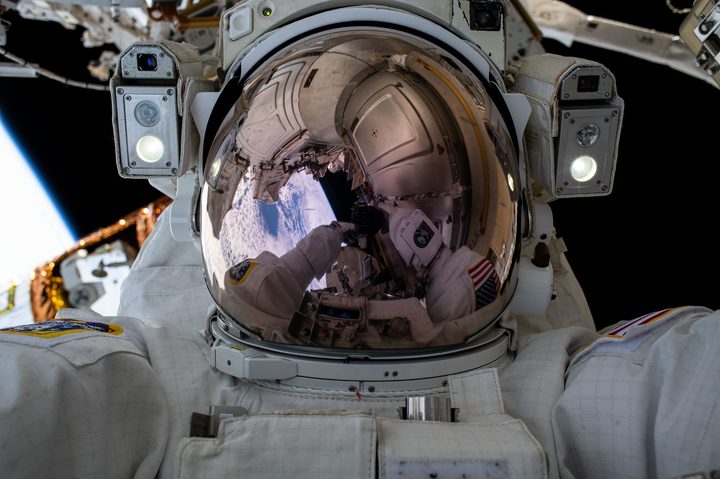
NASA astronaut and Expedition 63 Commander Chris Cassidy took this epic "space-selfie" during a spacewalk this at the International Space Station on July 21, 2020.
NASA astronaut and Expedition 63 Commander Chris Cassidy took this epic “space-selfie” during a spacewalk at the International Space Station on July 21, 2020. NASA

The two spacewalks will be conducted by NASA Flight Engineers Michael Hopkins and Victor Glover, both of whom arrived at the ISS on the SpaceX Crew Dragon on its first operations mission in November of last year.

The first spacewalk will complete work on the cabling and rigging for the European Space Agency’s Bartolomeo platform, which is attached to the station’s Columbus module. Bartolomeo will host scientific and commercial projects, including a device for measuring plasma in the space environment. Preparations for its arrival began with modifications to the outside of the space station last year.

The second spacewalk will include the installation of an adapter plate for lithium-ion batteries, part of an upgrade of the station’s power systems that have been running since 2017.

To see more details about what the crew will be doing, you can check out the preview animations provided by NASA showing the plans for the spacewalks.

How to watch the spacewalks

Both of the spacewalks will be livestreamed on NASA TV. The streams will show preparations for the spacewalks, then the full duration of each walk, which will be around six-and-a-half hours. NASA commentators will explain the steps the astronauts are taking and the processes they are following.

The livestreams will begin at 5:30 a.m. ET on the day of each spacewalk, Wednesday, January 27, and Monday, February 1. The spacewalks themselves will each begin around 7 a.m. ET and are expected to run until around 1:30 p.m. ET on both days.

To watch the livestreams, you can either head to NASA’s website or use the video player embedded at the top of this page.


Georgina Torbet
Georgina has been the space writer at Digital Trends space writer for six years, covering human space exploration, planetary…
Elon Musk’ Starlink could soon offer mobile services as a US carrier
Showcase of T-Mobile Starlink service on an iPhone.

Elon Musk’s Starlink has already changed how millions of people access the internet, especially in places where traditional broadband struggles to reach. Now, the satellite internet service could be preparing for an even bigger leap — becoming your mobile carrier.

According to a Financial Times report, SpaceX has told investors it’s considering launching a retail Starlink mobile service in the US. Instead of simply partnering with wireless carriers, the company could begin selling mobile plans directly to consumers, putting it in direct competition with Verizon, AT&T, and T-Mobile.

Read more
Lightsails have hit another speed bump on the road to interstellar travel
The coolest interstellar travel idea may get betrayed by the light pushing it
LightSail in Earth orbit

Laser-powered lightsails are one of the coolest answers to spaceflight. It might not be as sci-fi-sounding as a warp drive, but now, its practicality has also come under question. Using lightsails, a spacecraft could unfurl an ultra-thin reflective sail and let a powerful laser push it toward another star, without relying on fuel.

The tech was simple and elegant--except it's also more complicated than it sounds. A new preprint from researchers Chao Shen and Jiaze Li of the Harbin Institute of Technology suggests that relativistic lightsails may run into a hidden propulsion problem once they start moving extremely fast.

Read more
The galaxy has an exoplanet size mystery, and NASA’s EVE mission wants to solve it
This planet-hunting mission wants to catch baby worlds before they grow up
Artist’s Illustration of Exoplanets Orbiting Barnard’s Star

Mankind venturing into space ended up creating more questions than it answered, and one of the dilemmas is related to the planet sizes. Astronomers have found plenty of rocky super-Earths and plenty of puffier sub-Neptunes, but far fewer planets with a radius of about 1.8 times Earth’s.

That gap is known as the radius valley, and a proposed mission called the Early eVolution Explorer, or EVE, wants to figure out why it exists. NASA has a simple plan: look at planets while they are still young. The mission concept, detailed in a new arXiv preprint and covered by Phys.org, would focus on newly formed star clusters to see what small planets look like before billions of years of evolution.

Read more