1. Home
  2. Space
  3. News

Celebrate Mars Reconnaissance Orbiter’s 15th birthday with these views of planet

Add as a preferred source on Google

NASA’s Mars Reconnaissance Orbiter (MRO) recently marked 15 years since its launch, and to celebrate NASA has shared some of the most beautiful images that the spacecraft has captured during its tenure.

Armed with three different cameras, the orbiting spacecraft has been invaluable for mapping out Mars’s surface, for seeing rock formations, and for learning about the planet’s atmosphere. It is even capable of looking beneath the surface using radar.

Recommended Videos

The three cameras are for different purposes. The Mars Color Imager (MARCI) is used to create a global map of the planet which helps to identify changes between the Martian seasons and changes over the years, observing phenomena like dust storms and measuring the carbon dioxide in the atmosphere. Images of the terrain are captured in black and white by the Context Camera (CTX). And finally, the most famous and beautiful images of the planet are captured by the High-Resolution Imaging Science Experiment (HiRISE), such as the three images below.
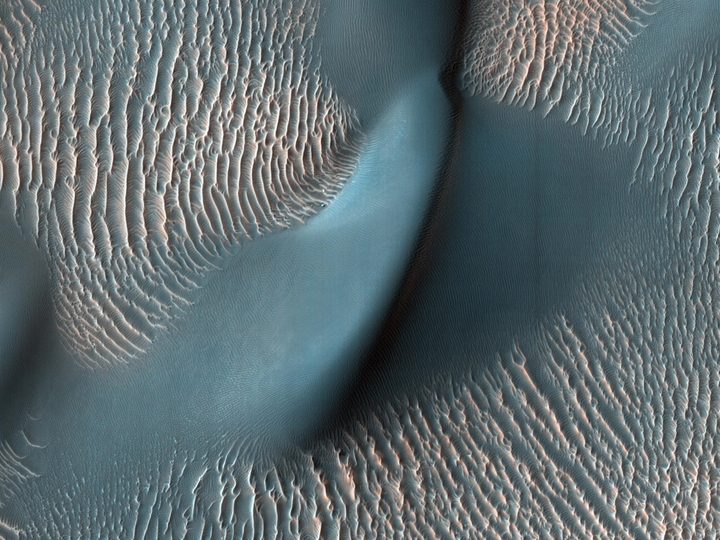
NASA's Mars Reconnaissance Orbiter captured these sand ripples and the large dune
The High Resolution Imaging Science Experiment (HiRISE) camera aboard NASA’s Mars Reconnaissance Orbiter captured these sand ripples and the large dune (at center) on Feb. 9, 2009. Color has been added to make textures easier to see. This area is in Proctor Crater at 47.8 degrees south latitude and 30.7 degrees east longitude. NASA/JPL-Caltech/University of Arizona

This image has been colorized to show off the ripples seen on the surface of Mars around a large sand dune, shown in the center of the image, which is located in the Proctor Crater. Taken in 2009, this image helped to show scientists that the Martian surface was not static but changed over time, demonstrating the way that winds on the planet move and reform surface features over the years.
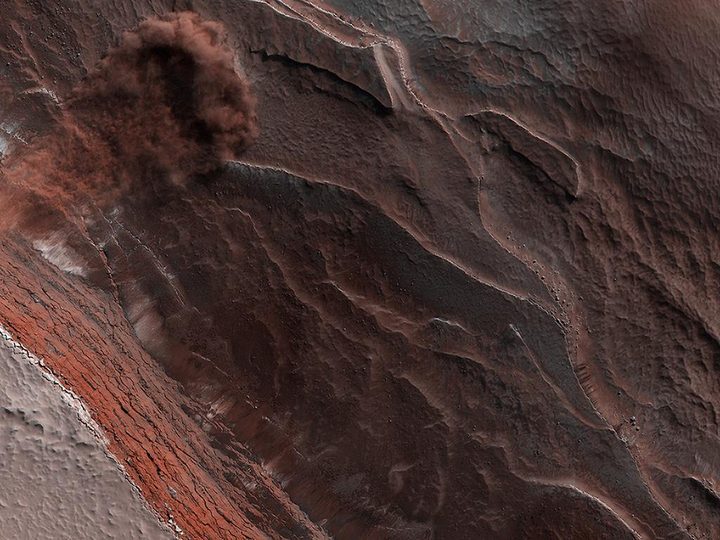
avalanche plunging down a 1,640-foot-tall (500-meter-tall) cliff on Mars
The High-Resolution Imaging Science Experiment (Hi-RISE) camera aboard NASA’s Mars Reconnaissance Orbiter captured this avalanche plunging down a 1,640-foot-tall (500-meter-tall) cliff on May 29, 2019. The image also reveals layers at Mars’ north pole during spring. As temperatures increase and vaporize ice, the destabilized ice blocks break loose and kick up dust. NASA/JPL-Caltech/University of Arizona

Another HiRISE image from 2019 captured an avalanche in action, caused when ice vaporized as spring brought higher temperatures. The disappearing ice affected the stability of these cliffs located near the north pole, reaching 1,640 feet tall, which began to crumble and so exposed layers of rock which had been gradually deposited over thousands of years.
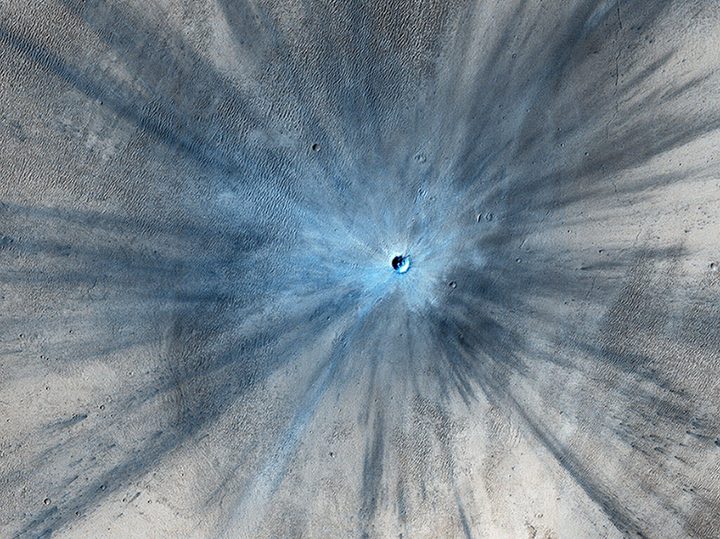
A dramatic, fresh impact crater
A dramatic, fresh impact crater dominates this image taken by the High Resolution Imaging Science Experiment (HiRISE) camera on NASA’s Mars Reconnaissance Orbiter on Nov. 19, 2013. Researchers used HiRISE to examine this site because the orbiter’s Context Camera had revealed a change in appearance here between observations in July 2010 and May 2012, bracketing the formation of the crater between those observations. NASA/JPL-Caltech/Univ. of Arizona

This striking image taken in November 2013 has also been colorized to show the dramatic impact crater created when a meteor smashed into the planet. The crater is 100 feet wide but the impact threw debris distances of up to 9.3 miles from the impact point.

Mars is particularly vulnerable to meteor impacts due to its thin atmosphere which provides little protection against incoming objects. Observations with the CTX indicated that this is a fresh impact crater, created between July 2010 and May 2012.

To see even more images the MRO has captured of Mars, you can head to NASA’s Jet Propulsion Laboratory website.

Georgina Torbet
Georgina has been the space writer at Digital Trends space writer for six years, covering human space exploration, planetary…
Getting to Mars may require a pit stop in orbit, and NASA just tested the nozzle to make that happen
A gas pump nozzle for spacecraft sounds simple. It is not, and that's what makes this test worth paying attention to.
Architecture, Building, Factory

Getting a spacecraft to Mars or beyond requires an enormous amount of fuel, most of which has to be hauled from Earth, adding to the overall cost and weight of the spacecraft. NASA has been working on a different approach, one that could be more efficient and effective.

It wants to refuel a spacecraft in orbit before heading out for the mission. What’s even more interesting is that the space agency just finished testing a component that could make that possible: a cryocoupler.

Read more
Elon Musk’ Starlink could soon offer mobile services as a US carrier
Showcase of T-Mobile Starlink service on an iPhone.

Elon Musk’s Starlink has already changed how millions of people access the internet, especially in places where traditional broadband struggles to reach. Now, the satellite internet service could be preparing for an even bigger leap — becoming your mobile carrier.

According to a Financial Times report, SpaceX has told investors it’s considering launching a retail Starlink mobile service in the US. Instead of simply partnering with wireless carriers, the company could begin selling mobile plans directly to consumers, putting it in direct competition with Verizon, AT&T, and T-Mobile.

Read more
Lightsails have hit another speed bump on the road to interstellar travel
The coolest interstellar travel idea may get betrayed by the light pushing it
LightSail in Earth orbit

Laser-powered lightsails are one of the coolest answers to spaceflight. It might not be as sci-fi-sounding as a warp drive, but now, its practicality has also come under question. Using lightsails, a spacecraft could unfurl an ultra-thin reflective sail and let a powerful laser push it toward another star, without relying on fuel.

The tech was simple and elegant--except it's also more complicated than it sounds. A new preprint from researchers Chao Shen and Jiaze Li of the Harbin Institute of Technology suggests that relativistic lightsails may run into a hidden propulsion problem once they start moving extremely fast.

Read more