1. Home
  2. Space
  3. News

NASA’s asteroid investigator Lucy tests out its four cameras

Add as a preferred source on Google

NASA’s Lucy mission launched last year on its trip to the Trojan asteroids, located in the orbit of Jupiter. Despite an issue with one of its solar arrays, the spacecraft has been traveling as hoped and is on its way to study the ancient asteroids with the aim to learn more about how the solar system formed. Now, NASA has shared some of the first images taken by Lucy’s instruments as part of their calibration process.

Lucy has a total of four cameras, including the two twin Terminal Tracking Cameras (T2CAM), which have a wide field of view and are used to lock onto asteroids and point the other instruments in the right direction as Lucy performs close flybys of them. The other cameras are the Multicolor Visible Imaging Camera (MVIC) which will take panorama-like images, and the Long-Range Reconnaissance Imager (L’LORRI) which will take high-resolution, up-close images of the asteroids. In addition to its cameras, Lucy also has a spectrometer and an instrument for mapping temperature.
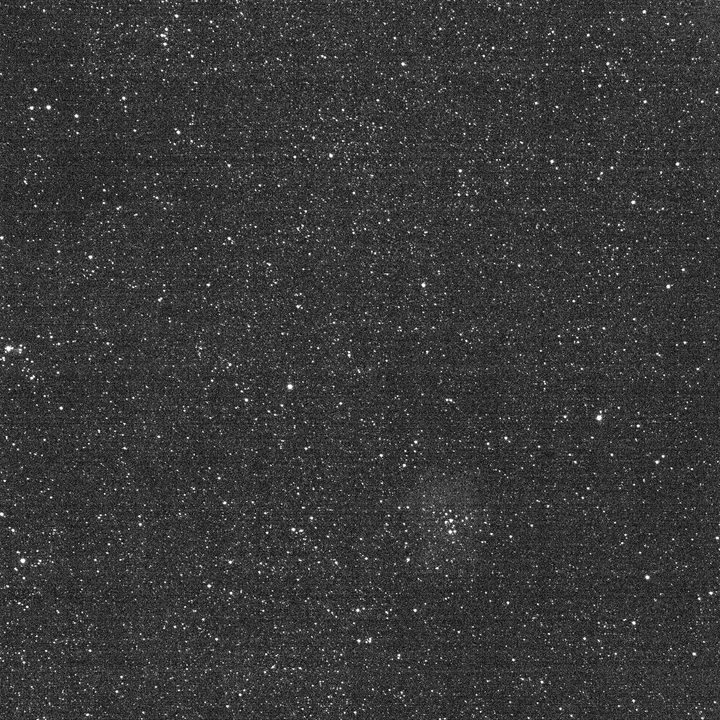
With an exposure time of 10 seconds, the Rosette Nebula is just visible in the lower right of center of the T2CAM frame.
With an exposure time of 10 seconds, the Rosette Nebula is just visible in the lower right of center of the T2CAM frame. NASA/Goddard/SwRI

These calibration images were taken in February this year, as part of a procedure that involved pointing the spacecraft instruments toward 11 different targets to check both that the spacecraft could point correctly and that the instruments were sufficiently sensitive and accurate. This was the second set of calibration images taken, after a preliminary but much less detailed set of images were taken soon after launch in November 2021.
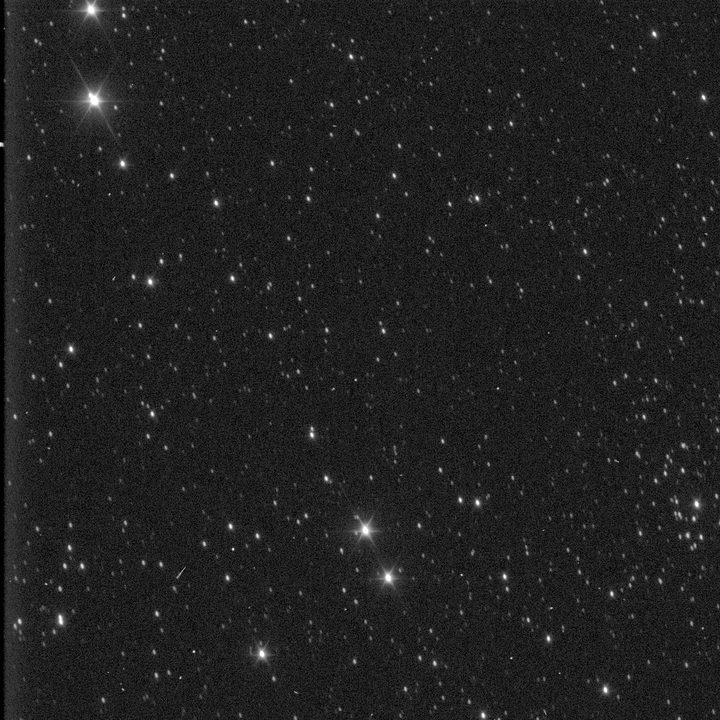
The faintest visible stars in this raw L’LORRI image are roughly 17th magnitude, 50,000 times fainter than the unaided human eye can see. Image brightness levels have been adjusted to enhance visibility of faint stars. The exposure time was 10 seconds. Keen observers will notice that the stars are slightly elongated in this relatively unprocessed image; the Lucy team has techniques to mitigate this effect, and the optical quality is sufficient for accomplishing the science goals of the mission.
The faintest visible stars in this raw L’LORRI image are roughly 17th magnitude, 50,000 times fainter than the unaided human eye can see. Image brightness levels have been adjusted to enhance visibility of faint stars. The exposure time was 10 seconds. Keen observers will notice that the stars are slightly elongated in this relatively unprocessed image; the Lucy team has techniques to mitigate this effect, and the optical quality is sufficient for accomplishing the science goals of the mission. NASA/Goddard/SwRI/Johns Hopkins APL

The images show that the instruments are working well and are ready for their encounter with the Trojan asteroids, where Lucy is set to arrive in 2027.

Recommended Videos

“We started working on the Lucy mission concept early in 2014, so this launch has been long in the making,” said Lucy’s principal investigator, Hal Levison of the Southwest Research Institute in the institute’s 2021 annual report. “It will still be several years before we get to the first Trojan asteroid, but these objects are worth the wait and all the effort because of their immense scientific value. They are like diamonds in the sky.”

Georgina Torbet
Georgina has been the space writer at Digital Trends space writer for six years, covering human space exploration, planetary…
Getting to Mars may require a pit stop in orbit, and NASA just tested the nozzle to make that happen
A gas pump nozzle for spacecraft sounds simple. It is not, and that's what makes this test worth paying attention to.
Architecture, Building, Factory

Getting a spacecraft to Mars or beyond requires an enormous amount of fuel, most of which has to be hauled from Earth, adding to the overall cost and weight of the spacecraft. NASA has been working on a different approach, one that could be more efficient and effective.

It wants to refuel a spacecraft in orbit before heading out for the mission. What’s even more interesting is that the space agency just finished testing a component that could make that possible: a cryocoupler.

Read more
Elon Musk’ Starlink could soon offer mobile services as a US carrier
Showcase of T-Mobile Starlink service on an iPhone.

Elon Musk’s Starlink has already changed how millions of people access the internet, especially in places where traditional broadband struggles to reach. Now, the satellite internet service could be preparing for an even bigger leap — becoming your mobile carrier.

According to a Financial Times report, SpaceX has told investors it’s considering launching a retail Starlink mobile service in the US. Instead of simply partnering with wireless carriers, the company could begin selling mobile plans directly to consumers, putting it in direct competition with Verizon, AT&T, and T-Mobile.

Read more
Lightsails have hit another speed bump on the road to interstellar travel
The coolest interstellar travel idea may get betrayed by the light pushing it
LightSail in Earth orbit

Laser-powered lightsails are one of the coolest answers to spaceflight. It might not be as sci-fi-sounding as a warp drive, but now, its practicality has also come under question. Using lightsails, a spacecraft could unfurl an ultra-thin reflective sail and let a powerful laser push it toward another star, without relying on fuel.

The tech was simple and elegant--except it's also more complicated than it sounds. A new preprint from researchers Chao Shen and Jiaze Li of the Harbin Institute of Technology suggests that relativistic lightsails may run into a hidden propulsion problem once they start moving extremely fast.

Read more