  1. Home
  2. Space
  3. News

Perseverance selfie shows it’s been a busy Mars rover of late

Add as a preferred source on Google

The Perseverance Mars rover snapped a selfie recently, showing its tracks wending through the Martian dust and up to a rock named Rochette. This is the area where the rover collected one of its recent Mars samples, drilling into the rock to collect a small amount in its sample tubes.

Eventually, the tubes will be collected by a future rover and brought back to Earth for study. In the image, you can see the two drill holes in the rock where the rover took the samples.
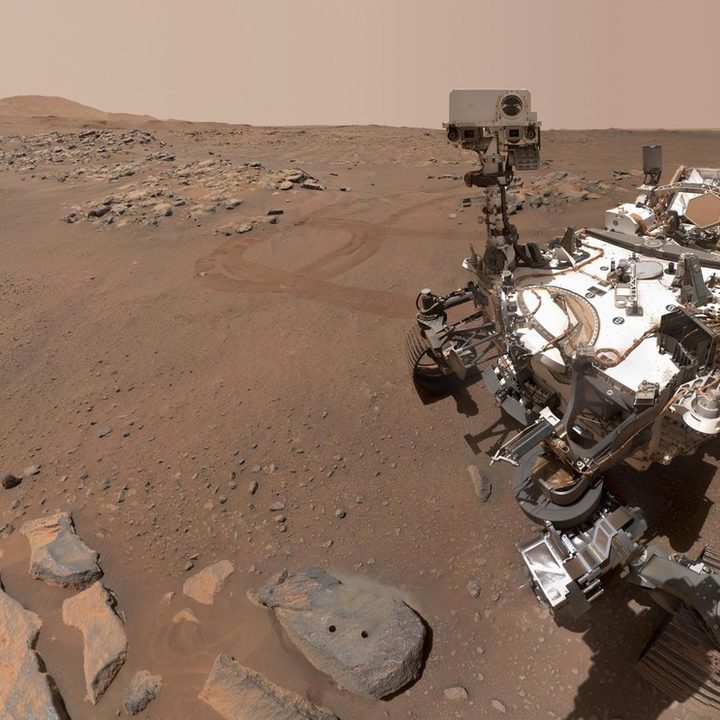
Using its WATSON camera, NASA’s Perseverance Mars rover took this selfie over a rock nicknamed “Rochette.”
Using its WATSON camera, NASA’s Perseverance Mars rover took this selfie over a rock nicknamed “Rochette,” on Sept.10, 2021, the 198th Martian day, or sol, of the mission. Two holes can be seen where the rover used its robotic arm to drill rock core samples. NASA/JPL-Caltech/MSSS

As well as taking charming selfies, the cameras on Perseverance are a vital part of its science mission. “The imaging cameras are a huge piece of everything,” said Vivian Sun, the co-lead for Perseverance’s first science campaign at NASA’s Jet Propulsion Laboratory. “We use a lot of them every single day for science. They’re absolutely mission-critical.”

Recommended Videos

The cameras include two navigation cameras and nine engineering cameras which help the rover find its way across the Martian landscape by enabling its autonomous driving. These cameras were also responsible for capturing the rover’s first panoramic view of the Martian surface. They give a quick, lower-resolution overview of what the rover is seeing, so more powerful cameras can be trained on targets of interest.

“The navigation camera data is really useful to have those images to do a targeted science follow-up with higher-resolution instruments such as SuperCam and Mastcam-Z,” Sun said.

SuperCam and Mastcam-Z are two of the rover’s instruments which include high-resolution cameras. Mastcam-Z’s cameras capture broad overviews, like panoramas or 3D images plus high-definition video. The SuperCam instrument is used to target specific sites which are further away by zooming in in great detail to study mineralogy.

And to zoom in for super close-up shots, there’s the WATSON (Wide Angle Topographic Sensor for Operations and eNgineering) camera on the end of the rover’s robotic arm which can image rocks in great detail.
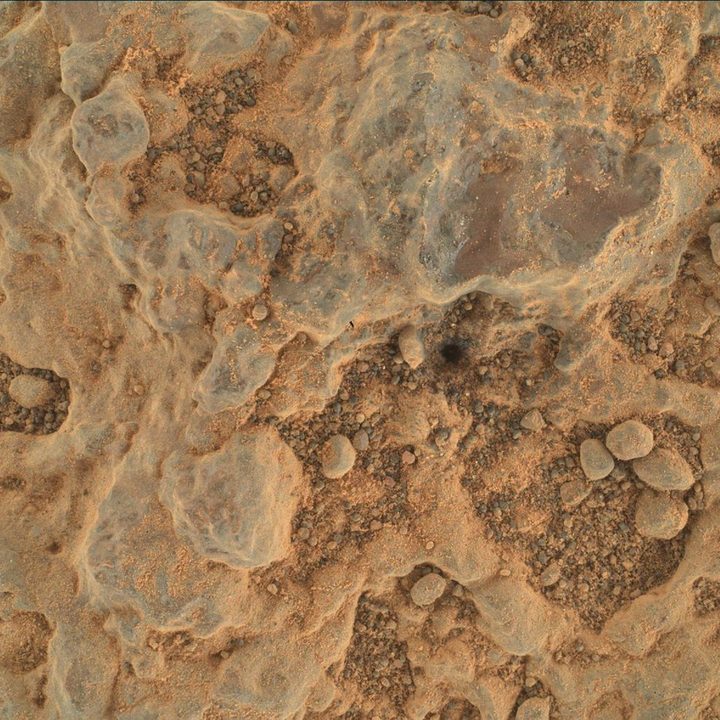
Perseverance took this close-up of a rock target nicknamed “Foux” using its WATSON camera on July 11, 2021, the 139th Martian day, r sol, of the mission. The area within the camera is roughly 1.4 by 1 inches (3.5 centimeters by 2.6 centimeters).
Perseverance took this close-up of a rock target nicknamed “Foux” using its WATSON camera. NASA/JPL-Caltech/MSSS

With these tools, researchers think they have the best chance yet of discovering evidence of ancient microbial life on the planet. “Once we get over closer to the delta, where there should be really good preservation potential for signs of life, we’ve got a really good chance of seeing something if it’s there,” said Luther Beegle, principle investigator for the rover’s SHERLOC instrument.

Georgina Torbet
Georgina has been the space writer at Digital Trends space writer for six years, covering human space exploration, planetary…
Scientists warn Elon Musk’s orbital data centers could blind Earth’s biggest telescopes
A new ESO study suggests millions of satellites could make parts of the night sky effectively unusable for astronomy.
One hour of satellites over the northern Atacama Desert in Chile (October 2025)

The race to blanket Earth with satellite internet has unlocked faster connectivity for millions. But according to the European Southern Observatory (ESO), it could also make one of humanity's oldest hobbies, and one of its most important sciences, a whole lot harder. The organization warns that the rapid growth of satellite mega-constellations could severely disrupt observations made by some of the world's most powerful telescopes.

Astronomers say the night sky is reaching its limit

Read more
Amazon’s Starlink rival just crossed a major milestone, but don’t expect perfect internet just yet
Amazon finally showed up to the space internet party
Amazon Leo satellite layout across all launch vehicles

Amazon has taken a significant step toward launching its long-awaited satellite internet service. Following its latest rocket launch, the company now has 396 Project Kuiper satellites in low-Earth orbit, enough to begin offering continuous service across select regions. The milestone keeps Amazon on track for its previously announced goal of launching commercial service by mid-2026.

https://twitter.com/Weber44Chris/status/2072575499461963938?ref_src=twsrc%5Etfw%7Ctwcamp%5Etweetembed%7Ctwterm%5E2072575499461963938%7Ctwgr%5Ed727a1b853cbf519585e7bf2655943afb2f91bb8%7Ctwcon%5Es1_&ref_url=https%3A%2F%2Fwww.theverge.com%2Fscience%2F960563%2Famazon-leo-service-tipping-point

Read more
Amazon’s Starlink rival is set to launch satellite internet later this year
After launching nearly 400 satellites, Amazon says its Leo broadband service will go live later this year.
Atlas V launches 29 Amazon Leo satellites from Cape Canaveral, Florida

Amazon's long-awaited answer to SpaceX's Starlink is finally nearing liftoff. According to an exclusive report from Reuters, the company plans to begin offering its Leo satellite internet service later this year, after its latest rocket launch pushed the constellation to 394 satellites in orbit.

The pieces are finally falling into place for Project Kuiper

Read more